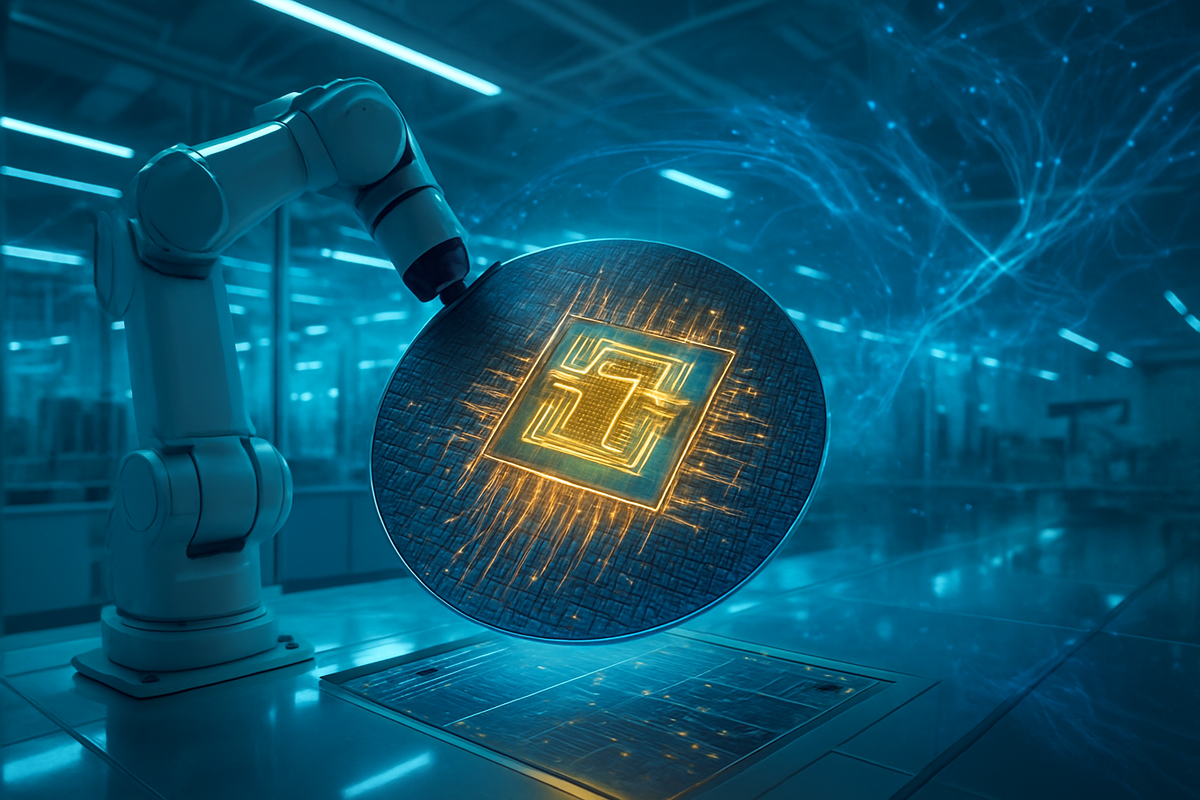
In a move that marks the beginning of the "Angstrom Era," Taiwan Semiconductor Manufacturing Company (NYSE: TSM) has officially entered mass production for its groundbreaking 2nm (N2) process technology. As of January 22, 2026, the company’s fabrication plants in Baoshan and Kaohsiung have reached high-volume manufacturing (HVM), signaling a seismic shift in the semiconductor landscape. This transition represents the first commercial implementation of Nanosheet Gate-All-Around (GAAFET) architecture for the world’s largest foundry, moving away from the FinFET design that has dominated the industry for over a decade.
The immediate implications are profound: the new N2 node offers a 15% performance boost at the same power level or a staggering 25–30% reduction in power consumption compared to the previous 3nm generation. For a global economy increasingly tethered to the power-hungry demands of generative AI and high-performance computing (HPC), TSMC's success in stabilizing 2nm yields is more than a technical milestone—it is a critical release valve for a supply chain that has been operating at its absolute limits.
The Transition to N2: A New Architecture for a New Age
The journey to this moment began years ago, but the final push through 2025 saw TSMC navigate the complex challenges of transitioning to GAAFET technology. Unlike the "fins" used in previous generations, nanosheet transistors wrap the gate entirely around the channel, significantly reducing current leakage and allowing for finer control over electrical characteristics. On January 20, 2026, TSMC internal reports confirmed that logic test chip yields have stabilized between 70% and 80%, a remarkably high figure for a brand-new architecture.
The rollout is centered in Taiwan, specifically at the Hsinchu (Baoshan) Fab 20 and the Kaohsiung Fab 22. Baoshan, designated as the "mother fab" for the 2nm node, is currently producing approximately 25,000 wafers per month. Meanwhile, Kaohsiung has accelerated its expansion, with equipment installation for Phase 3 moved forward to this quarter to meet unprecedented demand. By the end of 2026, TSMC expects its total 2nm capacity to reach 100,000 wafers per month, a rapid scale-up intended to satisfy the primary stakeholders: the titans of the AI and mobile industries.
Market reaction has been a mix of awe and financial pragmatism. While the technological leap is undisputed, the cost of innovation is rising; a single 2nm wafer is now estimated to cost roughly $30,000—a 50% premium over the 3nm node. Despite these "eye-watering" prices, the order books are already full, as major tech players realize that at the bleeding edge, performance is the only currency that matters.
Strategic Winners and the Cost of Falling Behind
The commencement of 2nm production has clearly demarcated the "Silicon Elite" from the rest of the market. Apple (NASDAQ: AAPL) remains TSMC’s most vital partner, having reportedly pre-booked over 50% of the initial 2nm capacity. These chips are earmarked for the upcoming A20 processors in the iPhone 18 series and the next generation of M-series Mac silicon. For Apple, 2nm is the key to maintaining its lead in on-device AI processing and battery efficiency, ensuring that its hardware remains the gold standard for consumer electronics.
However, the balance of power within TSMC’s client list is shifting. Nvidia (NASDAQ: NVDA) is now rivaling Apple for the title of TSMC’s largest customer by revenue. Driven by the "Rubin" and "Feynman" GPU architectures, Nvidia is utilizing 2nm and the upcoming A16 node to power the massive data centers required for agentic AI. Other winners include Broadcom (NASDAQ: AVGO), which is leveraging the new node to dominate AI networking, and hyperscalers like Microsoft (NASDAQ: MSFT) and Amazon (NASDAQ: AMZN), who are designing in-house silicon to optimize their cloud infrastructure.
On the other side of the ledger, the high barrier to entry is creating clear "losers." Samsung (KRX:005930) continues to struggle with yield rates for its 2nm SF2 process, reportedly languishing near 40%, which has led many of its traditional customers to seek capacity at TSMC or explore Intel (NASDAQ: INTC). Furthermore, smaller chip designers and mid-tier mobile manufacturers, such as those in the Chinese market, are being priced out. Many have opted to skip the 2nm generation entirely, remaining on more mature nodes like 3nm or 5nm to avoid the prohibitive R&D and wafer costs, potentially creating a significant performance gap in the mid-range market.
The Broader Significance: AI, Geopolitics, and the Angstrom Race
TSMC’s 2nm milestone fits into a broader industry trend where high-performance computing (HPC) has officially overtaken smartphones as the primary engine of semiconductor growth. We are no longer in a mobile-first world; we are in an AI-first world. The demand for 2nm is being driven by the need to pack more transistors into AI accelerators without causing them to melt under their own thermal loads. This has also placed a renewed focus on advanced packaging, such as CoWoS, which remains a critical bottleneck even as wafer production scales.
From a geopolitical perspective, the 2nm launch reinforces Taiwan’s "Silicon Shield." By keeping the most advanced production domestic, TSMC ensures its continued relevance to global security. While the US CHIPS Act has spurred the development of fabs in Arizona, these sites are currently focused on 4nm and 3nm production, with 2nm capabilities not expected stateside until late 2028. This leaves the global supply chain heavily dependent on the stability of the Taiwan Strait for at least the next several years.
Historically, this shift is comparable to the move from planar transistors to FinFET in the early 2010s. Just as that transition allowed for the smartphone revolution, the move to GAAFET and 2nm is expected to underpin the "Robotics and Physical AI" era. The only caveat is the widening "technology gap" between the West and China. With SMIC currently restricted from acquiring the EUV lithography tools necessary for 2nm, the divergence in computing power between the two regions is reaching a historical peak.
What Comes Next: The Roadmap to A16 and Beyond
The short-term focus for TSMC will be the stabilization of the Kaohsiung expansion and the rollout of the N2P node, which will introduce Backside Power Delivery (BSPD) in late 2026. This technical refinement, which moves power lines to the back of the wafer to free up space for data lines, is seen as the next major hurdle in the quest for energy efficiency. Intel is currently attempting to beat TSMC to this specific feature with its 18A node, creating a high-stakes race for the "performance king" title in the data center market.
In the long term, the industry is already looking toward the 1.4nm (A14) node. TSMC’s aggressive R&D schedule suggests that the foundations for 1.4nm are already being laid in its laboratories, with a target for mass production by 2028. The challenge moving forward will not just be physics, but economics. As design costs for a single 2nm chip approach $725 million, the industry may see a shift toward "chiplet" designs, where only the most critical components are made on 2nm, while secondary functions remain on cheaper, older nodes.
Investors should prepare for a period of high capital expenditure. TSMC has signaled a 2026 CapEx budget exceeding $52 billion to maintain its lead. While this puts pressure on short-term margins, the lack of viable alternatives for companies like Nvidia and Apple gives TSMC immense pricing power, a dynamic that is unlikely to change before the end of the decade.
A Comprehensive Wrap-Up: The Foundation of Future Tech
The commencement of 2nm mass production is a watershed moment for the financial and technological sectors. It confirms TSMC’s role as the indispensable architect of the modern world, successfully navigating the most difficult architectural shift in recent memory. For the market, this event validates the "AI Supercycle" and provides the hardware foundation necessary for the next generation of autonomous systems and large-scale language models.
Moving forward, the semiconductor market will be defined by capacity and yield. While Intel and Samsung are making valiant efforts to catch up, TSMC’s 70-80% yield at this early stage gives them a formidable lead. Investors should keep a close eye on Intel’s 18A performance in the coming months, as it represents the only credible challenge to TSMC’s near-monopoly on the bleeding edge.
The lasting impact of the 2nm era will be seen in the devices we use and the AI that powers them. As these chips begin to filter into the market throughout 2026, the performance gap between the leaders and the laggards of the tech world will only widen. In the high-stakes game of silicon, TSMC has once again proven that it holds the winning hand.
This content is intended for informational purposes only and is not financial advice.