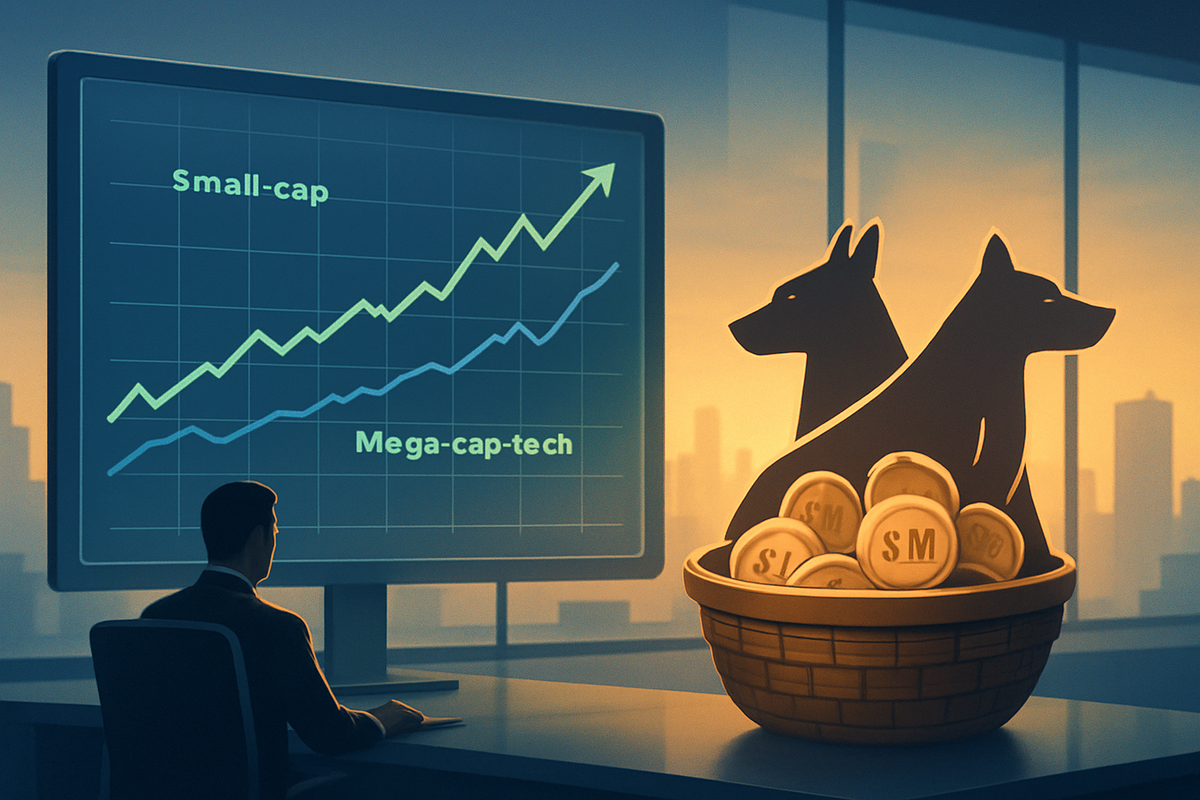
As the calendar turns to January 2, 2026, the investment landscape is undergoing a tectonic shift. After years of dominance by mega-cap technology giants, the "Great Rotation" has finally reached the small-cap sector. Investors, weary of the sky-high valuations in the S&P 500, are increasingly turning toward the S&P 600 Small-Cap index. Within this index, a strategy known as the "Dividogs"—a play on the classic "Dogs of the Dow" approach—is gaining massive traction. This strategy focuses on the highest-yielding, high-quality stocks in the small-cap universe, offering a rare combination of stability and income in an otherwise volatile market.
The immediate implication of this trend is a narrowing valuation gap between the large-cap and small-cap indices. While the S&P 500 enters 2026 trading at a forward price-to-earnings (P/E) ratio of approximately 22x, the S&P 600 remains a relative bargain at roughly 15x. This 30% discount, combined with a Federal Reserve that has successfully steered the economy toward a "Goldilocks" interest rate environment of 3.0% to 3.5%, has created a fertile ground for small-cap companies with robust balance sheets and sustainable dividends to outperform.
The 2025 Prelude: How Small-Caps Reclaimed the Spotlight
The journey to the 2026 "Dividogs" era began in late 2025. For much of that year, small-cap stocks were overlooked as artificial intelligence speculation continued to fuel large-cap growth. However, a pivot occurred in the fourth quarter of 2025 when inflation data consistently hit the Fed’s 2% target, prompting a series of rate cuts. This move was the catalyst small-caps needed, as these smaller entities often carry a higher proportion of floating-rate debt compared to their blue-chip counterparts. As borrowing costs stabilized, the "profits rebound" for the S&P 600 became a reality rather than a forecast.
Key players in this shift include institutional asset managers who began reallocating capital into value-oriented small-cap funds. By December 2025, the S&P 600 had staged a 12% rally in just eight weeks, its strongest year-end performance in over a decade. This momentum has carried into the first trading days of 2026, with the "Dividogs" strategy specifically targeting sectors like Energy, Financials, and Real Estate, which were left behind during the tech-heavy rally of the previous two years. Initial market reactions suggest that investors are no longer satisfied with growth at any price; they are now demanding tangible returns through dividends and share buybacks.
Winners and Losers: Identifying the 2026 Dividend Leaders
In this new regime, quality is the ultimate arbiter of success. Among the top "Dividogs" for 2026 is Nexstar Media Group (NASDAQ: NXST). With a dividend yield hovering around 4.0% and a 12-year growth streak, Nexstar is uniquely positioned to benefit from the 2026 U.S. midterm election cycle. Analysts expect a surge in political advertising revenue, potentially driving earnings growth by over 80% this year. Similarly, in the energy sector, SM Energy (NYSE: SM) stands out. Operating with a conservative payout ratio and a focus on deleveraging, SM Energy offers a yield of approximately 4.3%, supported by massive free cash flow from its Uinta Basin assets.
The financial sector is also producing winners, particularly small-cap banks that thrive in a 3.0% rate environment. Community Trust Bancorp (NASDAQ: CTBI) and Plumas Bancorp (NASDAQ: PLBC) are highlighted for their healthy net interest margins and low credit-loss provisions. These "Dividogs" offer yields exceeding 3.5%, providing a defensive cushion against market swings. Conversely, the "losers" in this environment are the "value traps"—companies with high yields but negative free cash flow or excessive variable-rate debt. Speculative small-cap biotech and debt-laden retailers are being shunned as investors prioritize "zombie-free" balance sheets.
A Broader Significance: The End of Mega-Cap Exceptionalism?
The rise of the S&P 600 Dividogs signifies more than just a seasonal rotation; it represents a fundamental change in market structure. For the better part of a decade, the "Dogs of the Dow" strategy—which focuses on the 10 highest-yielding stocks in the Dow Jones Industrial Average like Verizon Communications (NYSE: VZ) or Amgen (NASDAQ: AMGN)—was the go-to for income. However, the 2026 Dividogs strategy offers superior diversification by pulling the top yielders from every sector of the S&P 600, preventing the concentration risk inherent in the Dow.
This shift fits into a broader industry trend where the "AI capex story" is moving from the infrastructure phase (buying chips) to the execution phase (using AI to improve margins). Small-cap companies are often more nimble in implementing these efficiencies, which could lead to a sustained period of small-cap outperformance. Historically, such rotations occur every 7 to 10 years, and the current valuation extreme between the S&P 500 and S&P 600 mirrors the conditions seen just before the small-cap boom of the early 2000s.
The Road Ahead: Scenarios for 2026 and Beyond
Looking forward, the short-term outlook for the Dividogs is bolstered by a "Goldilocks" economic backdrop. If the Federal Reserve follows through with projected rate cuts in mid-2026, the cost of capital for small-caps will continue to fall, potentially sparking a wave of Mergers and Acquisitions (M&A). Larger companies, flush with cash, may look to acquire these high-quality "Dividogs" at current valuations, providing a secondary catalyst for price appreciation beyond the dividend yield.
However, challenges remain. The 2026 midterm elections could introduce policy uncertainty, particularly regarding trade and tariffs, which could disproportionately affect small-cap manufacturers. Investors must watch for companies that can maintain their dividend payouts even if global trade tensions flare up. A strategic pivot toward "onshoring" beneficiaries within the S&P 600 may be required if geopolitical volatility increases in the second half of the year.
Final Assessment: A New Era for Small-Cap Stability
As we move deeper into 2026, the "Dividogs" of the S&P 600 offer a compelling narrative for the prudent investor. The combination of historically low valuations, stabilizing interest rates, and high-quality dividend yields makes this a unique window of opportunity. The key takeaway is clear: the market is moving away from speculative growth and returning to its roots in valuation and cash flow.
Moving forward, the S&P 600 is no longer just a playground for risk-takers; it is becoming a sanctuary for income-seekers. Investors should closely monitor free cash flow yields and debt-to-equity ratios to separate the true "Dividogs" from the value traps. In a year likely to be defined by political noise and sector rotations, these small-cap yield kings provide the stability and income necessary to navigate the 2026 market with confidence.
This content is intended for informational purposes only and is not financial advice.