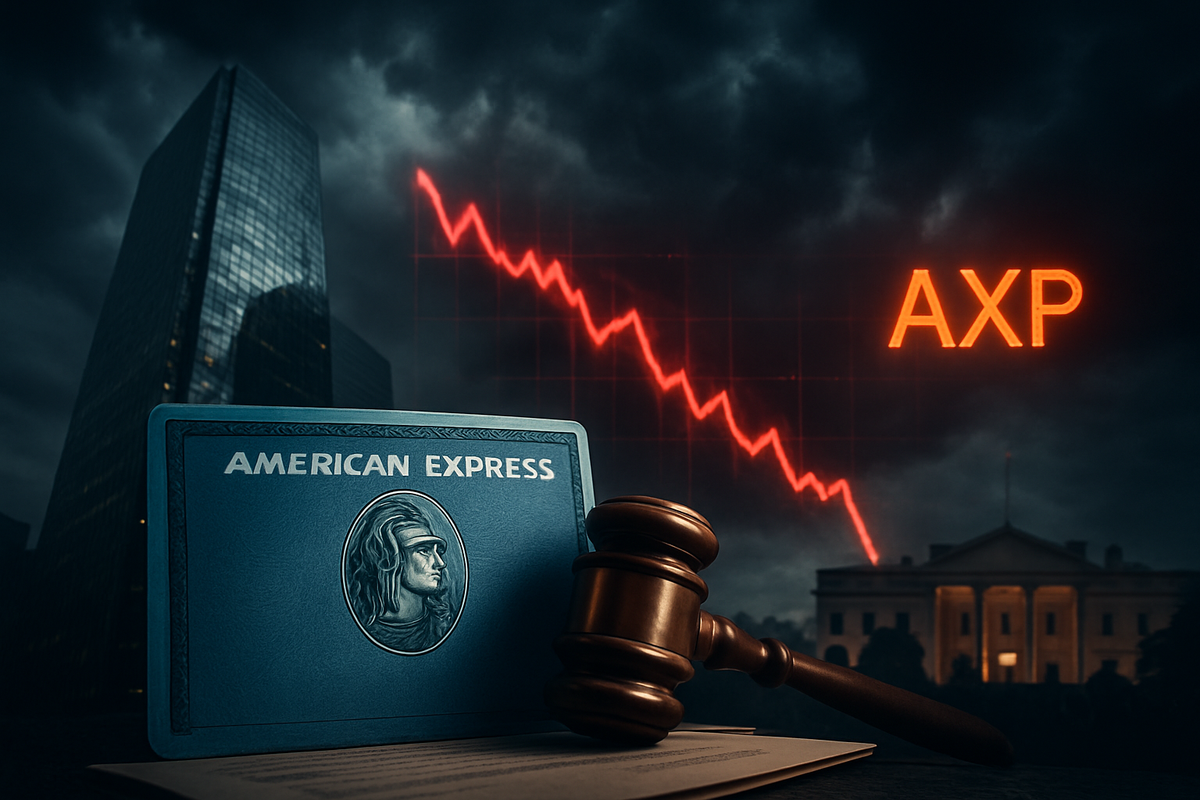
In a swift and sharp reaction to shifting political winds, shares of American Express (NYSE: AXP) plummeted more than 5% on January 12, 2026, as investors grappled with a dual-pronged regulatory threat from the highest levels of government. The selloff was ignited by President Trump’s weekend proposal to mandate a 10% ceiling on credit card interest rates—a move intended to provide "relief" to debt-burdened consumers—coupled with his unexpected endorsement of the Credit Card Competition Act (CCCA). The combined weight of these policy shifts has raised existential questions about the viability of the high-margin, rewards-heavy "premium" model that has fueled the growth of the financial giant.
The market reaction was immediate and visceral, reflecting fears that the regulatory environment is turning decisively hostile toward the traditional credit card business model. While the broader financial sector also faced headwinds, American Express bore the brunt of the volatility due to its premium valuation and its reliance on a high-fee ecosystem that many now believe is in the crosshairs of a populist economic agenda. For a company that has spent the last two years touting record-breaking revenue from younger, affluent demographics, the sudden pivot toward aggressive price controls and increased network competition represents a significant "black swan" event.
The 10% Ceiling and the Endorsement of CCCA
The catalyst for the week’s turmoil began late on Friday, January 9, 2026, when President Trump used a series of social media posts to lambast the credit card industry. "Americans are being ripped off by interest rates as high as 30%!" he declared, subsequently proposing a temporary, one-year cap on credit card interest rates at 10%, scheduled to take effect as early as late January 2026. This proposal was followed on January 13 by an official White House endorsement of the Credit Card Competition Act (CCCA), which was promptly reintroduced by Senators Roger Marshall (R-KS) and Dick Durbin (D-IL).
Historically, the CCCA aimed to break the "Visa-Mastercard duopoly" by requiring banks with over $100 billion in assets to offer at least two unaffiliated payment networks for transaction routing. American Express (NYSE: AXP) has traditionally enjoyed an exemption as a "three-party model" because it acts as both the network and the issuer. However, the 2026 iteration of the bill, now backed by a populist coalition in both parties, threatens to close these loopholes or create a "race to the bottom" in interchange fees that would force AXP to lower its merchant discount rates to remain competitive. The timeline has moved with startling speed, catching many institutional investors off-guard and leading to a cumulative weekly slide of nearly 7% for AXP.
Winners and Losers in the New Regulatory Landscape
The proposed regulations create a stark divide across the financial and retail sectors. The primary "losers" in this scenario are the major credit card issuers, particularly those with high concentrations of revolving debt. Synchrony Financial (NYSE: SYF) and Capital One (NYSE: COF) saw their shares drop 8.4% and 6.9%, respectively, as a 10% interest rate cap would effectively render many of their lending products unprofitable. American Express, while "spend-centric," is not immune; analysts estimate that a 10% cap could slash AXP's Net Interest Margin (NIM) from roughly 9.2% to a meager 5.7%, significantly impacting its bottom-line earnings.
Conversely, the potential "winners" are the nation’s retailers and merchants, represented by groups like the National Retail Federation. Lower interchange fees and increased routing competition could save merchants billions of dollars annually. However, this win for retailers comes at a cost to the consumer rewards ecosystem. Companies like Visa Inc. (NYSE: V) and Mastercard Inc. (NYSE: MA) are also facing downward pressure, as the CCCA specifically targets their dominance in transaction routing. If the bill passes in its current form, the revenue pool used to fund the lucrative cash-back and travel points programs that consumers have grown accustomed to could begin to evaporate.
Disruption of the Premium Business Model
The most profound impact of these regulations lies in the potential disruption of the "closed-loop" ecosystem that defines American Express. AXP relies on charging higher merchant fees—typically between 2.5% and 3.5%—than its competitors to fund its industry-leading rewards programs, such as Membership Rewards. If the CCCA successfully forces a reduction in "swipe fees" across the industry, AXP may be forced to either slash its rewards or further inflate its annual card fees. With the Platinum Card annual fee already standing at $895 in early 2026, there is growing concern that the company is reaching a "price ceiling" for its premium offerings.
Furthermore, the 10% interest rate cap would likely force AXP to drastically tighten its underwriting standards. To maintain profitability under a low-interest regime, the company would have to pivot away from younger "Millennial and Gen Z" cardholders—the very demographic that has driven its growth in recent years—who often carry balances as they build their careers. This shift could halt the momentum AXP has built in capturing the "next generation" of high-spenders, potentially reversing years of market-share gains. The precedent of the 2009 CARD Act offers a sobering comparison; that regulation led to a significant contraction in credit availability for subprime and near-prime borrowers, and a 10% cap could produce an even more drastic "credit crunch."
Navigating the Road Ahead: Scenarios for 2026
As the market looks toward the coming months, several scenarios are emerging. In the short term, American Express (NYSE: AXP) is expected to engage in intense lobbying efforts to preserve its "three-party model" exemption within the CCCA. If successful, AXP could emerge as a relative winner by remaining the only high-fee, high-reward network in a sea of low-cost competitors. However, if the 10% interest rate cap is enacted even temporarily, the company will likely be forced to engage in a massive strategic pivot, potentially involving the termination of less-profitable accounts and a total overhaul of its rewards structure to focus purely on transactional volume rather than interest income.
Long-term, the industry may see a surge in "alternative" credit products, such as "Buy Now, Pay Later" (BNPL) services, which might attempt to bypass interest rate caps through fee-based structures. For American Express, the challenge will be maintaining its brand cachet in an environment where the "perks" of membership—airport lounges, concierge services, and high-point earn rates—are under financial siege. Investors should brace for continued volatility as the legislative process unfolds in Washington, with particular attention paid to any language in the CCCA that specifically mentions "closed-loop" networks.
The Verdict for Investors
The events of mid-January 2026 mark a potential turning point for the credit card industry. The era of unchecked interest rates and high interchange fees is facing its most significant challenge in decades. For American Express (NYSE: AXP), the 5% slide is a warning shot, signaling that its premium valuation—which recently traded at a 30% premium to its historical average—is vulnerable to political and regulatory risk. The company's ability to navigate these populist economic policies will determine whether it can maintain its status as the "gold standard" of financial services or if it will be forced to become a leaner, less exclusive version of its former self.
Moving forward, investors should watch for two key signals: the specific wording of the CCCA as it moves through committee and the rhetoric from the Federal Reserve regarding the feasibility of an interest rate cap. While a 10% cap faces significant legal and constitutional hurdles, the mere proposal has already altered the risk profile of the sector. As the "spend-centric" leader, American Express is better positioned than its "lend-centric" peers to survive a low-interest environment, but the threat to its merchant fee revenue remains a critical vulnerability that could redefine the company's growth trajectory for the rest of the decade.
This content is intended for informational purposes only and is not financial advice.