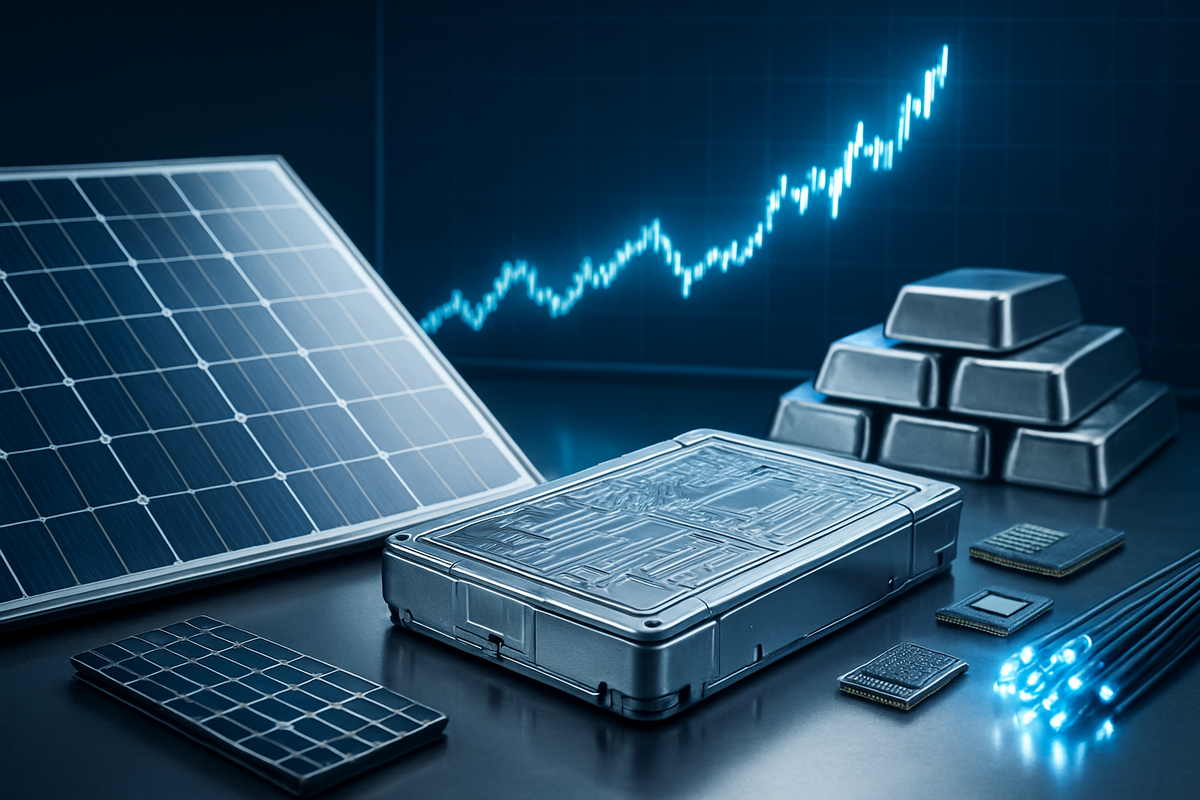
As the sun sets on 2025, the global financial markets are closing the books on a year defined not by the dominance of Big Tech or the stability of sovereign bonds, but by the meteoric rise of a humble metal: silver. In a historic performance that has stunned traditional analysts, silver has surged by a staggering 120% over the last twelve months, far outstripping the 64% gains seen in gold. This rally has fundamentally shifted the narrative around the white metal, moving it from its historical status as "gold’s neglected sibling" to a premier strategic asset essential for the modern economy.
The immediate implications of this surge are being felt across the globe, from the boardrooms of Mumbai to the manufacturing hubs of Shenzhen. With silver prices breaching the $70 per ounce mark this December, the global supply chain is grappling with a "perfect storm" of structural deficits and an insatiable appetite for the metal’s unique conductivity. This price action is no longer seen as a speculative bubble but as a structural re-rating of a metal that sits at the intersection of the energy transition and the artificial intelligence revolution.
The Path to $70: A Timeline of the Great Silver Breakout
The journey to silver’s current peak began in early 2024, but the momentum reached a fever pitch in mid-2025. After hovering near the $30 mark for several years, silver broke through the critical psychological barrier of $50 in October 2025, fueled by data confirming a fifth consecutive year of global supply deficits. By the time Vedanta Chairman Anil Agarwal publicly championed the metal’s dual-purpose role in late November, the market was already in a full-scale supply squeeze. Agarwal, whose company Vedanta Limited (NSE: VEDL) oversees Hindustan Zinc (NSE: HINDZINC), India’s largest silver producer, noted that silver has finally stepped out of gold's shadow, serving as both a reliable store of value and an irreplaceable industrial input.
Key players in this drama include the Silver Institute and major mining conglomerates that have struggled to keep pace with demand. The industry reaction has been one of cautious exhilaration; while miners are seeing record margins, industrial consumers are scrambling to secure long-term contracts. The timeline of 2025 was marked by a series of inventory drawdowns at major exchanges like the COMEX and the London Bullion Market Association (LBMA), which signaled to the market that the physical availability of silver was tightening to levels not seen in decades.
Mining Magnates and Manufacturing Margins: The Winners and Losers
The 120% rally has created a stark divide in the corporate landscape. On the winning side are the pure-play silver miners and streaming companies. First Majestic Silver (NYSE: AG) and Pan American Silver (NASDAQ: PAAS) have seen their stock prices triple as investors seek direct exposure to the rising spot price. Similarly, Coeur Mining (NYSE: CDE) has reported record-breaking quarterly earnings, driven by its recent facility expansions that came online just as prices surged. Wheaton Precious Metals (NYSE: WPM), a leading streaming company, has also benefited immensely, capturing the upside of the price rally without the direct inflationary pressures of mining operations.
Conversely, the industrial sector is feeling the heat. Solar manufacturers like JinkoSolar (NYSE: JKS) and Canadian Solar (NASDAQ: CSIQ) have seen their profit margins compressed as the cost of silver paste—a critical component in high-efficiency solar cells—doubles. Interestingly, First Solar (NASDAQ: FSLR) has emerged as a strategic winner in this environment; because its thin-film technology does not rely on silver, it has gained a significant cost advantage over its crystalline silicon competitors. In the automotive space, giants like Tesla (NASDAQ: TSLA) and BYD (OTC: BYDDF) are facing rising costs for the 25 to 50 grams of silver required in every electric vehicle, forcing a renewed focus on "thrifting," or reducing the amount of silver used in manufacturing.
Beyond the Bullion: The Wider Significance of the Silver Surge
The significance of silver’s 2025 performance extends far beyond the ticker tape. This rally is a direct reflection of the global shift toward high-efficiency technology. The solar industry’s transition to N-type technologies, such as TOPCon and Heterojunction (HJT) cells, has increased silver demand per cell by up to 70%. Simultaneously, the explosion of AI data centers has created a massive new market for silver in high-purity electrical connections and thermal management systems. Silver's unique physical properties—it is the most electrically and thermally conductive element—mean that for many of these applications, there is simply no substitute.
Historically, silver has been viewed as a high-beta play on gold, but 2025 has broken that correlation. The gold-silver ratio, which has historically averaged around 60:1, has compressed sharply toward 40:1 as silver’s industrial utility drives its valuation independently of monetary policy. This shift suggests that silver is being re-evaluated by the market as a "green metal," akin to copper or lithium, rather than just a precious metal. This has significant policy implications, as governments begin to view silver as a critical mineral essential for national energy security and technological sovereignty.
The Road Ahead: Scenarios for 2026 and Beyond
As we look toward 2026, the primary question for investors is whether this rally is sustainable. In the short term, the market remains in a state of extreme tension. If industrial demand continues at its current pace, some analysts suggest that a "triple-digit silver" scenario—prices exceeding $100 per ounce—is no longer a fringe theory but a distinct possibility. However, high prices will inevitably trigger strategic pivots. We expect to see intensified research into silver substitutes and more aggressive recycling programs aimed at recovering the metal from end-of-life electronics and solar panels.
The most likely scenario involves a period of price consolidation followed by a sustained high-price environment. Mining companies will likely use their record profits to fund exploration and brownfield expansions, but given that silver is often a byproduct of lead, zinc, and copper mining, increasing supply is not as simple as turning on a tap. This supply-side lag will likely keep the market in a deficit for the foreseeable future, providing a solid floor for prices even if the initial speculative fervor cools.
A New Era for the White Metal: Final Thoughts
The silver rally of 2025 has been a transformative event for the global markets. It has validated the vision of industry leaders like Anil Agarwal, who argued that silver’s dual role as a financial and industrial asset would eventually lead to a massive re-valuation. The key takeaway for the market is that the "silver story" is no longer just about inflation hedging or retail interest in coins and bars; it is about the fundamental plumbing of the 21st-century economy.
Moving forward, investors should keep a close eye on the pace of solar installations and the evolution of EV battery technologies. Any signs of successful "thrifting" could dampen demand, but for now, the momentum remains firmly on the side of the bulls. As 2025 comes to a close, silver has not only outperformed gold but has also established itself as a critical pillar of the global industrial complex, ensuring that its "extraordinary shine" will be a topic of market discussion for years to come.
This content is intended for informational purposes only and is not financial advice.