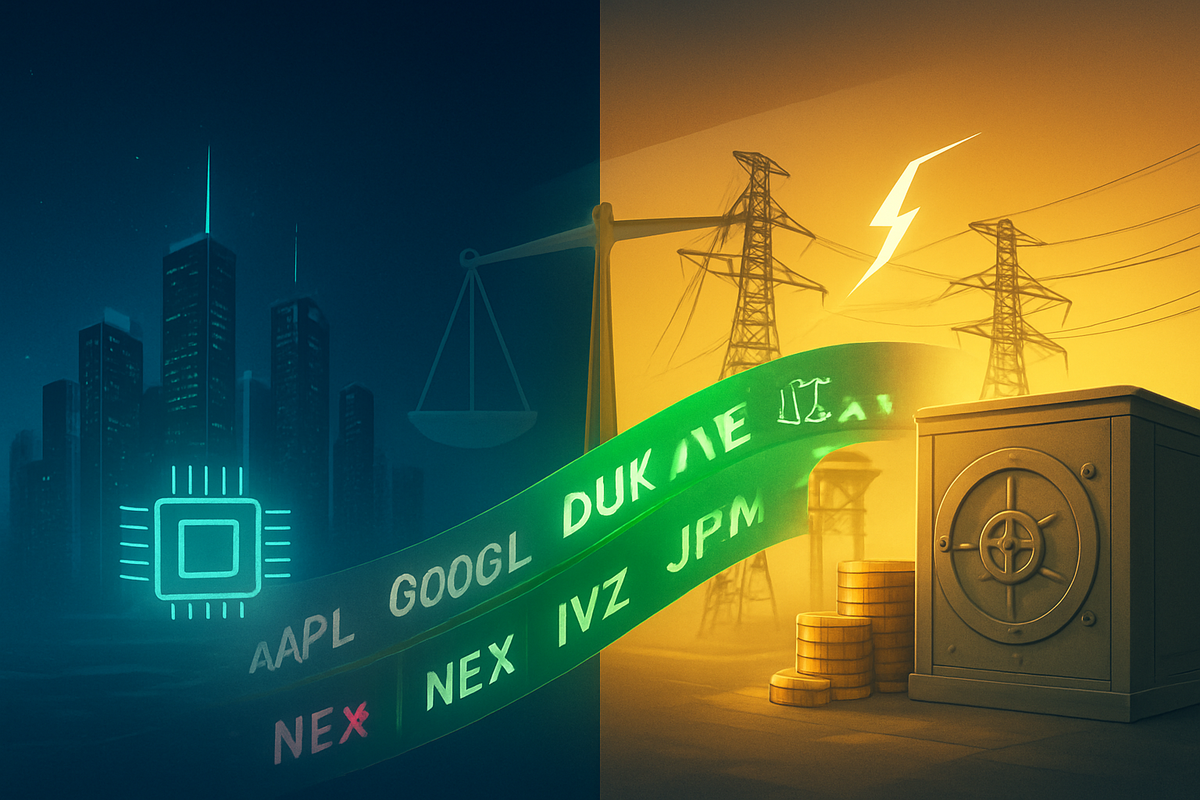
As the final trading days of 2025 approach, a tectonic shift is reshaping Wall Street. For years, the market’s momentum was dictated by a handful of silicon giants and the promise of an artificial intelligence revolution. However, as of December 22, 2025, the narrative has flipped. Investors are aggressively rotating out of high-growth technology stocks and into the once-stodgy defensive sectors, signaling a new era where tangible earnings and dividend yields are prized over speculative "moonshots."
This "Great Rotation" is being fueled by a combination of "AI fatigue" and a Federal Reserve that has finally begun to ease the monetary brakes. While the Nasdaq 100 (NASDAQ: QQQ) dominated the first half of the decade, it is now facing a significant "AI hangover," with capital flowing rapidly into the Utilities Select Sector SPDR Fund (NYSE: XLU) and Financials. This shift marks a transition from a market driven by future potential to one anchored in the realities of a "soft landing" economy.
The December Pivot: Rates, Returns, and Realities
The current market volatility reached a boiling point following the Federal Reserve’s policy meeting on December 10, 2025. Chairman Jerome Powell announced a 25-basis-point rate cut, bringing the federal funds rate to a range of 3.5%–3.75%. This was the third consecutive cut since September, providing a massive tailwind for interest-rate-sensitive sectors. While lower rates typically benefit tech, the market’s reaction has been counterintuitive. Instead of doubling down on growth, institutional desks are using the liquidity to de-risk, locking in multi-year profits from the semiconductor surge and moving into "bond proxies" like utilities.
The Nasdaq 100 has felt the brunt of this transition, sliding roughly 1.25% in the last week alone. This decline follows a period of "valuation fatigue" where even record-breaking earnings from AI leaders failed to move the needle. In contrast, the Utilities sector has become the unlikely darling of 2025, with the XLU surging nearly 16.5% year-to-date. The sector saw over $1 billion in fresh weekly inflows in mid-December, the highest level recorded since the early days of the post-pandemic recovery. Investors are no longer just looking for safety; they are chasing the "electrification of AI," realizing that the massive data centers built by tech giants require the very power grids managed by utility companies.
Winners and Losers: From Silicon to Substations
The primary casualty of this rotation has been the former "King of AI," Nvidia (NASDAQ: NVDA). After reaching a staggering $5 trillion market cap in October 2025, the stock has pulled back to the $4.2 trillion range as "bubble anxiety" takes hold. Similarly, Microsoft (NASDAQ: MSFT) has seen its valuation penalized by investors who are growing weary of the company’s massive capital expenditures. With an estimated $405 billion spent on AI infrastructure across the "Hyperscalers" this year, the lack of immediate, massive revenue offsets has led to a "show-me-the-money" ultimatum from shareholders. Apple (NASDAQ: AAPL), while viewed as a laggard for much of the year, has managed to remain somewhat stable by focusing on its "Apple Intelligence" consumer rollout, yet it too has failed to capture the explosive growth of years past.
On the winning side of the ledger, NextEra Energy (NYSE: NEE) has emerged as a standout performer, gaining nearly 16% this year. As the prime beneficiary of the rotation into clean energy infrastructure, NextEra is capitalizing on the insatiable power demand from AI data centers. Financial institutions are also seeing a resurgence; as the yield curve steepens and the economy avoids a recession, banks are reporting robust loan growth. Conversely, Consumer Staples have not shared in the defensive glory. Procter & Gamble (NYSE: PG) and its peers have traded flat to slightly down, as margin compression from sticky input costs and a shift toward budget-conscious consumer spending have dampened the appeal of the traditional "defensive" play.
The AI Hangover and the Search for Value
This shift is more than just a seasonal rebalancing; it represents a fundamental change in how the market values innovation. The "build-it-and-they-will-come" phase of AI investment, which defined 2023 and 2024, has officially ended. We are now in the execution phase, where the market is scrutinizing return on investment (ROI) with surgical precision. This mirrors the post-dot-com era, where the infrastructure providers (the "picks and shovels") eventually gave way to the companies that could actually generate cash flow from the new technology.
The broader industry trend is a move toward "diversification over speculation." The concentration risk that plagued the S&P 500 for the last three years—where five stocks accounted for the majority of gains—is finally dissolving. This broadening of the market is a healthy sign for long-term stability, even if it causes short-term pain for tech-heavy portfolios. Furthermore, the regulatory environment is beginning to catch up, with increased scrutiny on AI data privacy and antitrust concerns for the "Magnificent Seven," further incentivizing investors to look toward more regulated, predictable industries like utilities and financials.
The Road to 2026: What Lies Ahead
Looking toward the first quarter of 2026, the market is expected to remain in this transitional state. The Federal Reserve has signaled a cautious approach, with only one more 25-basis-point cut projected for the coming year. This "higher-for-longer-than-zero" environment favors companies with strong balance sheets and consistent dividend growth. Strategic pivots will be required for tech companies; expect a wave of "efficiency" initiatives and perhaps a slowdown in speculative capex as they attempt to appease a market that is suddenly very concerned with the bottom line.
A potential scenario for 2026 involves a "catch-up" trade for emerging markets and small-cap stocks, which have been largely ignored during the AI frenzy. If inflation continues its slow descent toward the 2% target without a spike in unemployment, the "soft landing" narrative will be fully realized, potentially sparking a renewed interest in value-oriented sectors that have been undervalued for nearly a decade. However, the risk of an "AI bubble" bursting remains a shadow over the market, and any significant miss in cloud revenue could trigger a more violent exit from growth stocks.
Closing Thoughts for the Year-End
The market of late 2025 is a far cry from the exuberant, tech-obsessed environment of 2023. The "Great Rotation" has proven that even the most powerful technological trends must eventually answer to the laws of valuation and interest rates. The pivot into Utilities and Financials suggests that investors are bracing for a more mature, stable economic cycle where "boring" is once again beautiful.
As we move into 2026, investors should keep a close eye on the "Capex-to-Revenue" ratios of the major tech firms and the continued performance of the power sector. The AI revolution isn't over, but its residency as the sole driver of market returns has ended. The watchword for the coming months is balance: a portfolio that ignores the stability of defensives in favor of pure growth may find itself on the wrong side of history in this newly diversified market landscape.
This content is intended for informational purposes only and is not financial advice