The U.S. surety bond market is a multi-billion dollar industry that most businesses interact with out of regulatory necessity rather than choice — yet understanding it can significantly reduce compliance costs, improve approval odds, and create competitive advantages in licensed industries.
This overview covers how the surety bond market is structured, key trends shaping the industry in 2026, and practical implications for businesses across the most bond-intensive sectors.
The Scale and Scope of the Surety Bond Market
The U.S. surety industry writes approximately $7-9 billion in premiums annually, covering millions of business and professional bonds across 50 states and thousands of regulatory jurisdictions. The industry is dominated by a handful of large insurers — Travelers, Liberty Mutual, Zurich, Tokio Marine — while a broader ecosystem of specialty sureties and bond agencies serves non-standard risk segments.
Bond Categories by Volume
Category
Share of Market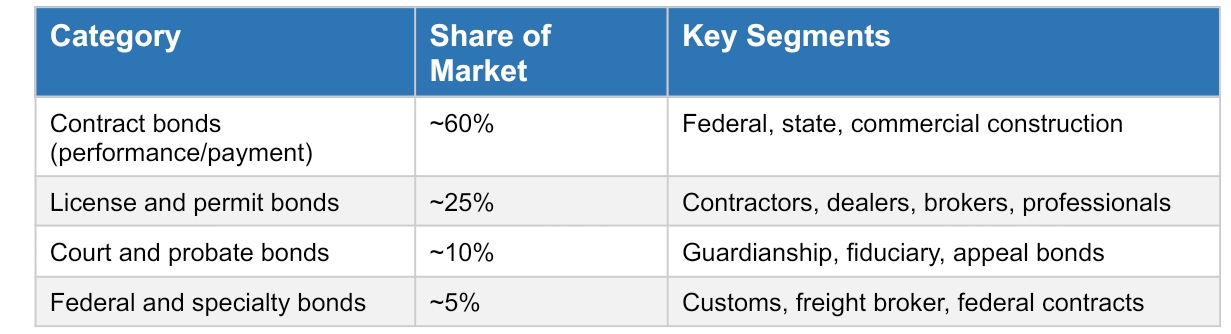
Ky Segments
Key Market Trends in 2026
1. Digital Transformation Accelerating
Online bond issuance, electronic filing with state agencies, and automated underwriting have compressed what was once a multi-day process into same-day transactions for standard bonds. Providers who have invested in digital infrastructure hold a significant competitive advantage in the growing online application segment.
2. Credit Risk Concentration in Non-Standard Segments
As standard credit applicants increasingly self-service through automated platforms, specialty providers are capturing a growing share of non-standard risk — contractors with bad credit, new businesses without track records, and industries with elevated claim frequencies. This segment requires human underwriting expertise that can't be fully automated.
3. Regulatory Expansion Creating New Bond Requirements
States continue to introduce new licensing requirements with bond mandates across emerging industries. Recent examples include New York's new model management company bond requirement (December 2025), expanding immigration consultant bond requirements, and evolving cryptocurrency business licensing bonds in multiple states.
4. Construction Market Bond Demand
The sustained infrastructure investment cycle — federal infrastructure spending, commercial real estate activity, and residential construction — is driving elevated demand for contractor license bonds, bid bonds, and performance/payment bonds. Competition for bonded contractors is intensifying, making proper bonding a market differentiator. Get a contractor bonds quote from BondsExpress.com.
5. Freight and Logistics Bond Growth
Growth in freight brokerage and third-party logistics has increased BMC-84 bond demand. The FMCSA's strict enforcement of continuous coverage requirements has also increased the business case for specialty providers who can issue and maintain bonds efficiently.
The Bond Agency Ecosystem
Most businesses obtain bonds through bond agencies — intermediaries who access surety markets on behalf of their clients — rather than directly from surety companies. The agency model provides several advantages:
- Access to multiple surety markets: Agencies can shop applications to many underwriters simultaneously
- Expertise in specific bond types: Specialty agencies develop deep knowledge in their focus areas
- Advocacy during claims: An agent familiar with the applicant can provide context that improves outcomes
- Regulatory updates: Good agents stay current on changing requirements across jurisdictions
BondsExpress is an example of a specialty bond agency with 60+ years of market history. Based in Syracuse, New York, they provide bonds across all 50 states with a particular focus on hard-to-place bonds that require specialty market access. More at
BondsExpress.com.
Implications for Businesses in Bond-Intensive Industries
Construction
Rising construction activity means stronger surety market competition for qualified contractors. Contractors with strong financials and clean bond histories are increasingly in demand, and some sureties are actively competing for quality accounts. Conversely, marginal contractors face tighter underwriting standards as loss experience from prior cycles works through the system.
Financial Services
Mortgage brokers, freight brokers, and auto dealers — all major bond consumers — continue to face regulatory scrutiny that reinforces bonding requirements. States that have loosened enforcement historically are increasingly implementing automated compliance checks that catch lapses quickly.
Emerging Industries
Cannabis businesses, cryptocurrency exchanges, and earned wage access providers are seeing bond requirements emerge as states develop regulatory frameworks. Early movers who establish surety relationships now will have advantages as these markets mature.
What Businesses Should Do Now
- Know your specific bond requirements — regulatory changes happen continuously
- Build a relationship with a specialty bond provider before you need complex assistance
- Manage your credit proactively — it's the primary lever on your bond costs
- Maintain continuous coverage — bond lapses create immediate license exposure
- Review your rates annually — the surety market changes and you may qualify for better pricing
For businesses seeking surety bonds and guidance on providers, USFinanceMarket.com provides a useful starting point: Where to Get a Surety Bond.
Find the right bond for your business.
BondsExpress has navigated the surety market for 60+ years. All bond types, all states, all credit profiles. Get your free quote today at BondsExpress.com.