Satellites have traditionally been among the world's most expensive assets. Building, launching, and operating a spacecraft often required investments measured in millions of dollars, limiting access to governments, military organizations, and large corporations.
China's commercial space industry is now attempting to change that equation.
Driven by automated manufacturing, expanding launch capacity, and large-scale satellite production, companies such as STARPATH GLOBAL are introducing shared-ownership models that can reduce the cost of satellite access to a fraction of traditional levels.
The trend has drawn comparisons to TEMU's impact on global retail: using China's manufacturing scale to make previously expensive products accessible to a much wider market.
China's Satellite Factories Are Scaling Up
For decades, satellites were essentially handcrafted products. Manufacturing cycles often lasted six months or longer, while each spacecraft was treated as a unique engineering project.
That model is rapidly changing in China.
Commercial satellite manufacturers are increasingly adopting automated production lines, digital engineering systems, and standardized satellite platforms. Industry reports indicate that some production facilities have achieved automation rates exceeding 70 percent, while intelligent manufacturing systems have reduced satellite production cycles from several months to as little as 20 days.
Mass production is becoming the new goal.
China Aerospace Science and Industry Corporation (CASIC) has established intelligent satellite assembly lines capable of producing more than 200 small satellites annually, demonstrating the industry's shift from bespoke manufacturing to industrial-scale production.
Companies such as MinoSpace have pioneered assembly-line production methods that break satellite manufacturing into standardized stages, allowing spacecraft to be produced in batches rather than as one-off projects.
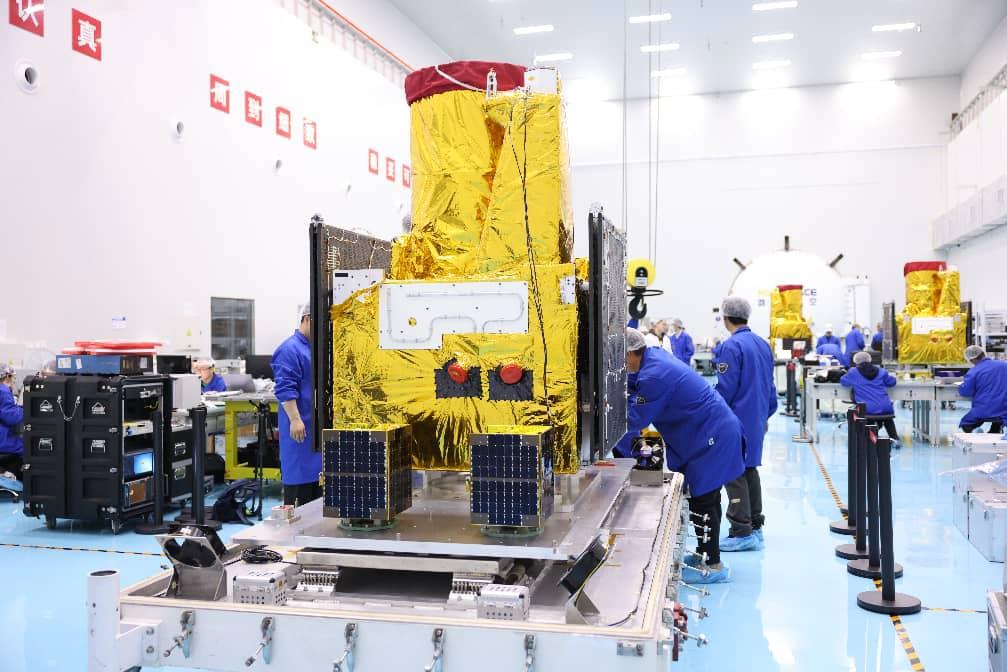
According to industry research released in April 2026, China now has 55 satellite manufacturing facilities with a combined designed production capacity of approximately 7,360 satellites per year. Of that total, 36 factories are already operational, representing roughly 4,050 satellites of annual production capacity, while additional facilities remain under construction or in planning stages. The figures highlight how rapidly China is building industrial-scale satellite production capabilities to support both commercial and national space programs.
The transformation mirrors what happened in industries such as consumer electronics, solar panels, and electric vehicles, where automation, supply-chain integration, and manufacturing scale dramatically reduced costs while increasing output.
Why Costs Are Falling So Quickly
The economics behind China's commercial space sector are increasingly resembling those of other advanced manufacturing industries.
Automation reduces labor requirements. Standardized satellite platforms reduce engineering costs. Large production volumes spread research and development expenses across hundreds of spacecraft instead of a single mission.
Industry experts increasingly point to three defining characteristics of the new generation of commercial satellites: low-cost manufacturing, rapid iteration, and batch production.
Rather than spending years developing a single spacecraft designed to operate unchanged for more than a decade, commercial operators are moving toward constellations of smaller satellites that can be upgraded, replaced, and expanded more frequently. The result is a manufacturing model that increasingly resembles the smartphone industry rather than traditional aerospace programs.
This approach enables faster technological upgrades while avoiding the lengthy development cycles historically associated with highly customized satellites.
According to STARPATH GLOBAL, these structural changes make it possible for customers to access satellite capabilities at approximately one-tenth of the cost traditionally associated with dedicated satellite ownership.
Instead of requiring a customer to purchase and operate an entire spacecraft, the company distributes ownership and operational costs across multiple participants, dramatically lowering the financial barrier to entry.

How Shared-Ownership Satellites Work
The concept behind STARPATH GLOBAL's model is straightforward: instead of one customer funding an entire satellite mission, multiple users share the same spacecraft and divide the associated costs.
Traditionally, satellite projects required customers to pay for manufacturing, launch services, insurance, mission operations, and ground infrastructure. Under a shared-ownership model, those expenses are distributed among multiple stakeholders.
The approach works because modern Earth-observation satellites collect far more data than any individual customer can consume.
For example, an Earth-observation satellite operating in a Sun-Synchronous Orbit (SSO) may capture imagery covering a ground swath ranging from tens to hundreds of kilometers wide during each pass, depending on its sensor design and imaging capabilities. Orbiting the Earth approximately every 90 to 100 minutes, the satellite can pass over multiple countries and regions as it collects data along its orbital path. The collected information can then be distributed to different customers according to their geographic needs.
A spacecraft collecting imagery over Southeast Asia in the morning may later pass over India, the Middle East, Europe, Africa, and South America. If the satellite were dedicated to a single customer, much of that imaging capacity would remain unused.
Shared ownership allows that capacity to be allocated across multiple customers, improving utilization while significantly lowering costs for each participant.
Rather than dedicating the spacecraft to a single user, shared ownership transforms unused orbital capacity into a multi-customer asset.
The model is similar to commercial aviation. Passengers do not purchase an entire aircraft to travel between cities; they purchase access to a small portion of its capacity. Shared satellite ownership applies the same principle to space infrastructure.
A New Phase for the Space Economy
China's commercial space industry is entering a new phase defined by automation, mass production, and lower costs.
What was once a sector characterized by scarcity is increasingly becoming an industry driven by scale.
Companies such as STARPATH GLOBAL are leveraging these changes to make satellite capabilities available to a broader range of customers through shared-ownership models that reduce costs and accelerate deployment.
For most of the Space Age, the challenge was how to build satellites. Today, China's commercial space industry is increasingly focused on a different question: how to make them affordable enough for everyone else.
That is why some industry observers describe the current transition as the "TEMU moment" of commercial space — a shift driven by mass production, lower costs, faster deployment, and broader access to space-based services.
Media Contact
Company Name: STARPATH GLOBAL
Contact Person: Jing Lv
Email: Send Email
City: Shanghai
Country: China
Website: https://starpath.global/