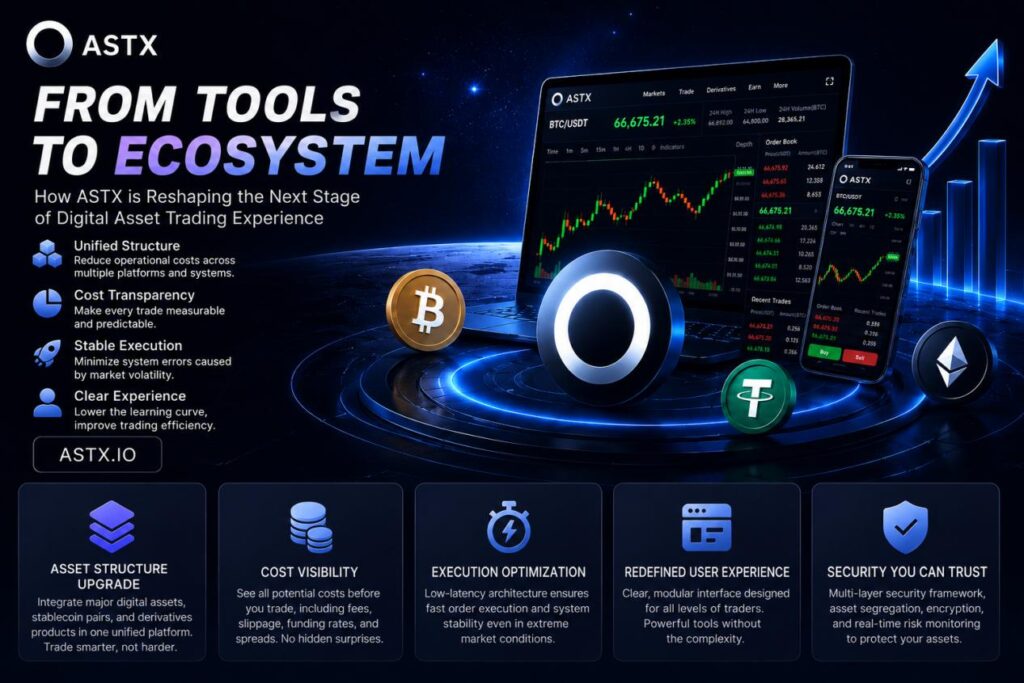
As digital assets continue to gain mainstream adoption, exchanges are evolving beyond simple venues for buying and selling. They are becoming comprehensive infrastructures that connect assets, information, and trading strategies.
A truly outstanding platform is not defined by the number of features it offers, but by its ability to make trading more transparent, efficient, and manageable.
Against this backdrop, ASTX has attracted growing attention from digital asset traders worldwide. The platform seeks to address a fundamental question: How can traders maintain structured decision-making in increasingly complex markets?
I. Upgrading Asset Architecture: Bringing Clarity Back to Choice
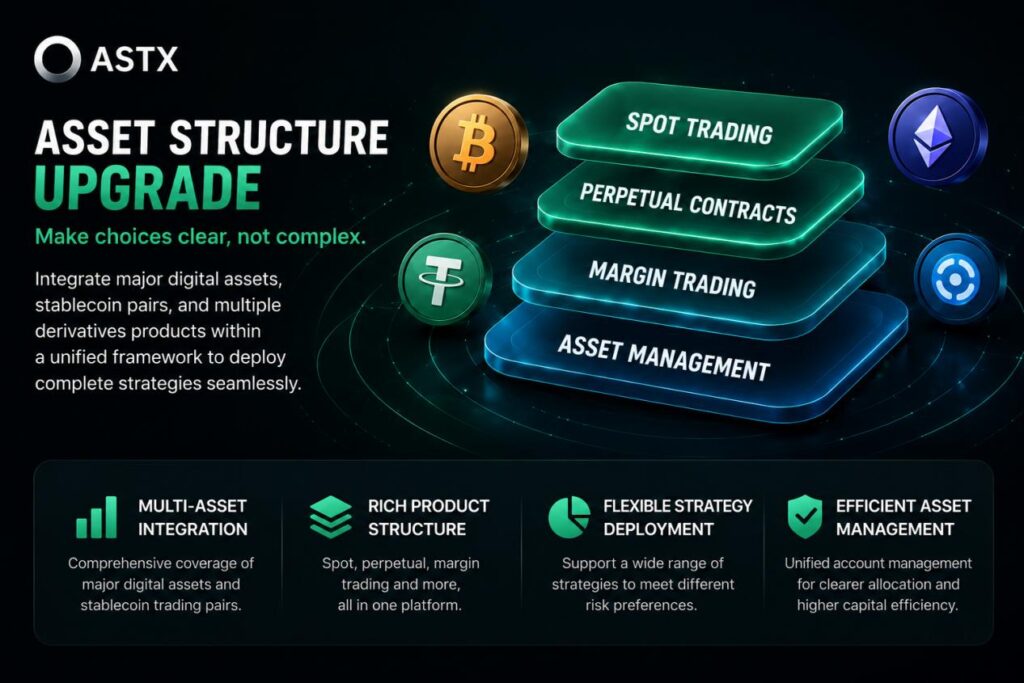
For most traders, the real challenge is not the lack of opportunities, but the fact that opportunities are often fragmented across different systems.
The separation between various on-chain assets, market cycles, and trading venues increases the complexity and cost of strategy execution.
ASTX approaches this challenge by reorganizing its asset ecosystem. Within a unified trading framework, the platform integrates major digital assets, stablecoin trading pairs, and multiple derivatives products, enabling users to implement complete trading strategies without frequently switching between platforms.
More importantly, this integration goes beyond simply listing products. Through a clearly structured interface, ASTX allows users with different risk preferences to quickly identify suitable trading pathways. Conservative allocations, trend-following strategies, and short-term trading opportunities each have distinct entry points, rather than being buried within a single information stream.
II. Cost Transparency: Trading Should Have No Hidden Variables
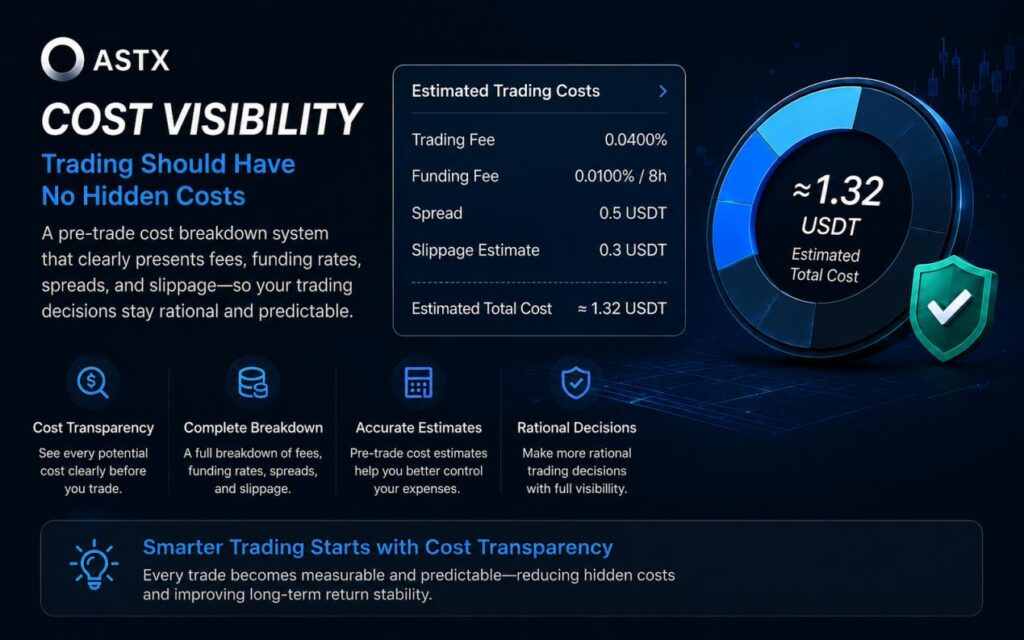
Many traders only realize during post-trade analysis that poor performance is often caused not by incorrect market views, but by opaque cost structures.
Slippage, trading fees, funding costs, and spread fluctuations can gradually erode returns if they are not presented clearly.
To address this issue, ASTX emphasizes a pre-trade cost visualization mechanism. Before an order is executed, users can view the potential fee structure associated with the trade and simulate how costs may vary under different market conditions.
The purpose of this design is not merely to reduce expenses, but to minimize uncertainty and allow trading decisions to be based on rational calculations rather than retrospective assumptions.
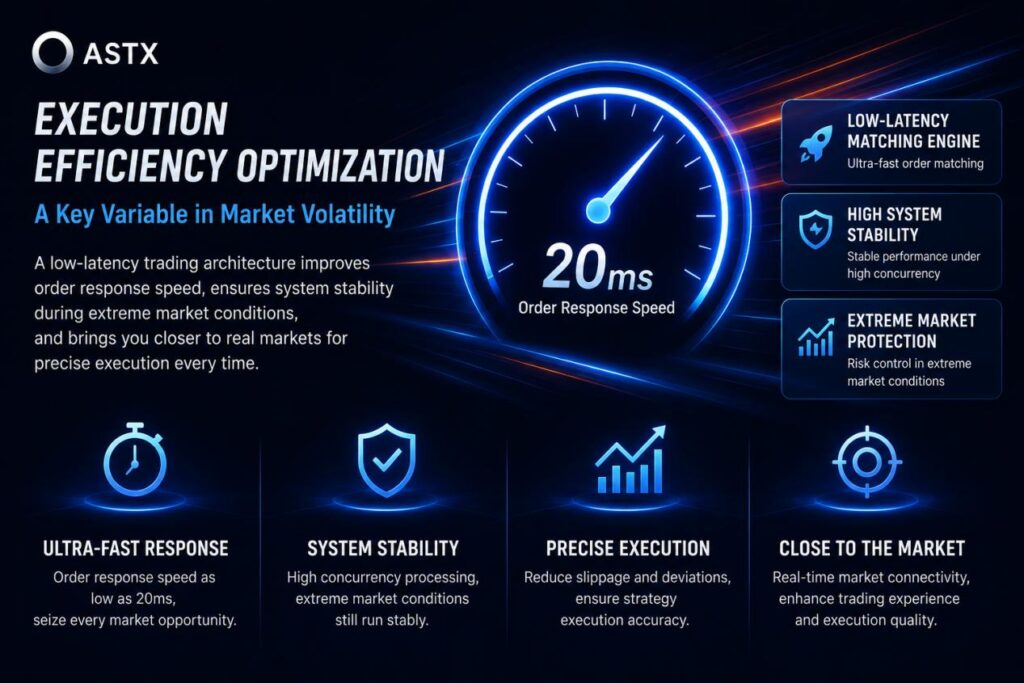
III. Optimizing Execution Efficiency: A Critical Factor in Volatile Markets
In digital asset markets, prices can change within seconds.
For high-frequency traders and short-term participants, execution latency alone can significantly affect outcomes.
ASTX has invested heavily in optimizing its matching engine and order execution system. Its low-latency trading architecture improves response times, enabling orders to enter the market more quickly and efficiently.
At the same time, the platform prioritizes stability during periods of extreme volatility, reducing the risk of interface lag or operational delays caused by sudden spikes in trading activity.
In other words, ASTX aims not merely to display market movements, but to provide an execution environment that closely reflects real market conditions.
IV. Redefining User Experience: Lowering Learning Costs Without Sacrificing Professionalism
Trading platforms often face a common dilemma: the more professional they become, the more complicated they are to use.
ASTX seeks to strike a balance between accessibility and functionality.
Its interface is designed around a clear workflow, organizing charting tools, order management, and asset information into distinct modules. This structure allows users with different levels of experience to locate essential functions quickly.
For beginners, navigation becomes more intuitive and straightforward. For experienced traders, advanced capabilities remain fully available, including multi-timeframe charting, technical indicators, and strategy execution tools.
Rather than simplifying the platform by removing features, ASTX focuses on reducing unnecessary cognitive burden.
V. Responsive Support Services: Confidence Beyond Trading
Market fluctuations are not the only factors that influence the trading experience. Equally important is whether users can receive timely assistance when problems arise.
ASTX has established a multi-timezone support framework covering account management, trading inquiries, and asset-related operations. Through online customer service and ticketing systems, users can obtain prompt assistance and minimize disruptions to their trading activities.
The goal of this support structure is not simply to provide answers, but to shorten the path to problem resolution.
In addition, ASTX offers educational resources and operational guides to help users gradually develop a deeper understanding of market dynamics and risk management principles.
VI. Security Architecture: The Foundation of Trading Trust
The core of any trading platform is not its interface or feature set, but the trust it can establish with users.
ASTX employs a multi-layered security framework that includes fund segregation, encrypted data transmission, multi-factor authentication, and real-time risk monitoring systems to mitigate potential risks at both the account and infrastructure levels.
At the same time, the platform emphasizes transparency in asset management, allowing users to gain a clearer understanding of fund movements rather than relying solely on balance displays.
Security is not a standalone feature—it is a continuous operational capability that underpins the entire trading ecosystem.
VII. Platform Value: Reducing Decision-Making Noise
Ultimately, the value of a trading platform lies not in offering more choices, but in helping traders focus on what truly matters.
ASTX’s design philosophy can be summarized in four key principles:
- Unified Structure — Reducing operational costs associated with using multiple platforms and systems.
- Transparent Costs — Making every trade measurable and predictable.
- Reliable Execution — Minimizing system-related deviations during periods of market volatility.
- Clear User Experience — Lowering cognitive load and improving decision-making efficiency.
Together, these principles serve a broader objective: enabling traders to devote their energy to strategy development and execution, rather than being distracted by tools and operational complexities.
Conclusion: A Platform Is Not the Answer, but an Amplifier
No platform can replace human judgment or eliminate market risk.
However, a thoughtfully designed trading system can amplify the impact of sound decisions while reducing unnecessary friction and execution losses.
ASTX does not claim to change the market itself. Instead, it aims to provide traders with a more stable execution environment and a clearer path toward informed decision-making.
Trading will always remain a personal endeavor, but the tools traders choose can determine whether their journey through the market is defined by disorder or by structure.
Official Website: ASTX.IO
Peter Chan