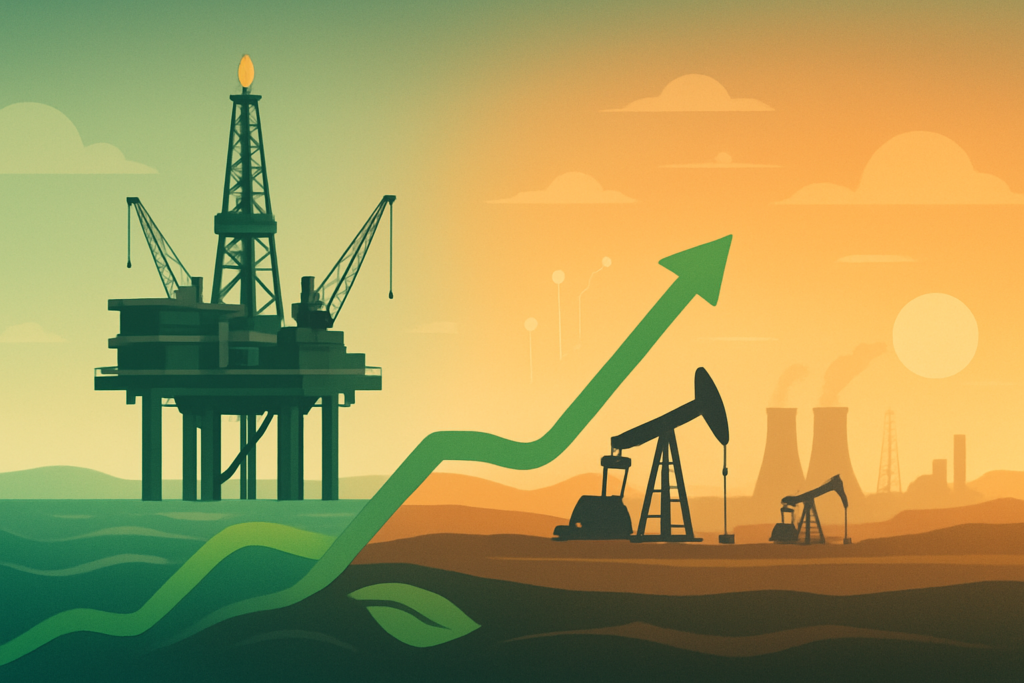
As of April 1, 2026, Chevron Corporation (NYSE: CVX) stands at a pivotal juncture in its 147-year history. Once defined by its status as a "Supermajor" in the traditional oil and gas sense, the San Ramon-headquartered giant has spent the last 24 months aggressively reshaping itself into a high-margin, low-carbon-intensity energy powerhouse. The completion of the monumental $53 billion acquisition of Hess Corporation in mid-2025 has fundamentally altered the company’s DNA, giving it a crown-jewel stake in the offshore waters of Guyana alongside a dominant position in the U.S. shale basins.
Chevron is currently in focus not just for its traditional energy output, but as a bellwether for the "orderly transition." While rivals like BP (NYSE: BP) and Shell (NYSE: SHEL) have wavered in their commitment to fossil fuels, Chevron has doubled down on advantaged, high-return oil assets while simultaneously carving out a niche in industrial-scale carbon capture and hydrogen. With a fortress balance sheet and a dividend track record that spans nearly four decades, Chevron remains the definitive "defensive growth" play in a world characterized by geopolitical volatility and surging energy demand driven by the AI revolution.
Historical Background
Chevron’s lineage is a tapestry of American industrial history, beginning in 1879 with the Pacific Coast Oil Co. Following the 1911 antitrust-forced dissolution of the Standard Oil trust, the company emerged as Standard Oil of California (Socal). For much of the 20th century, Socal was a pioneer in international exploration, famously discovering oil in Saudi Arabia in the 1930s—a venture that eventually became Saudi Aramco.
The modern iteration of Chevron was forged through three massive waves of consolidation. In 1984, the $13.3 billion acquisition of Gulf Oil marked the largest merger in corporate history at the time. This was followed by the 2001 merger with Texaco, which created a truly global integrated major. In the early 2020s, under the leadership of CEO Mike Wirth, Chevron shifted its focus toward domestic shale and consolidation, acquiring Noble Energy in 2020 and PDC Energy in 2023. The final piece of the current puzzle, the 2025 Hess merger, resolved years of legal and arbitration hurdles, solidifying Chevron's entry into the prolific Stabroek Block in Guyana and expanding its Bakken shale footprint.
Business Model
Chevron operates as an integrated energy company, managed through three primary segments that work in a symbiotic cycle of cash generation and investment:
- Upstream: This is the company’s primary engine, accounting for roughly 75% of total earnings. It involves the exploration, development, and production of crude oil and natural gas. Key focus areas include the Permian Basin (unconventional shale), the U.S. Gulf of Mexico (deepwater), Kazakhstan (Tengiz field), and now Guyana (deepwater).
- Downstream: This segment encompasses refining, marketing, and transport. Chevron’s refineries on the U.S. West and Gulf Coasts are highly sophisticated, capable of processing heavy crudes and producing high-value lubricants and chemicals. This segment acts as a natural hedge when oil prices fall, as refining margins often improve during such periods.
- Chevron New Energies (CNE): Launched in 2021 and scaled significantly by 2026, CNE focuses on lower-carbon business lines. This includes "Project Labrador," a massive blue hydrogen project, and the Bayou Bend CCS (Carbon Capture and Storage) hub. CNE is designed to leverage Chevron’s engineering expertise to serve hard-to-abate industrial sectors.
Stock Performance Overview
Over the past decade, Chevron has been a model of resilience compared to the broader energy sector (XLE).
- 10-Year Performance (2016–2026): Investors have seen a total return of approximately 140%, factoring in dividends. CVX successfully navigated the 2020 price collapse by maintaining its dividend when peers cut theirs, leading to a massive re-rating during the 2022 energy crisis.
- 5-Year Performance (2021–2026): This period saw the stock more than double from its post-pandemic lows. The stock hit all-time highs in late 2024 as the Hess merger clarity improved, and it has largely traded in a range of $160 to $195 throughout 2025 and early 2026.
- 1-Year Performance (2025–2026): The last twelve months have been characterized by "merger digestion." Following the official closing of the Hess deal in July 2025, the stock initially dipped due to share dilution but has since recovered as synergies began to hit the bottom line. CVX has slightly outperformed ExxonMobil (NYSE: XOM) in the last six months as production in the Permian Basin hit the 1 million boe/d milestone.
Financial Performance
Chevron’s FY 2025 financial results, released in January 2026, showcased the company’s "capital discipline" mantra. Despite a moderate Brent crude price environment (averaging $78/bbl in 2025), Chevron reported:
- Net Income: $12.48 billion for the full year.
- Cash Flow from Operations: A robust $33.9 billion, demonstrating high-quality earnings with strong conversion.
- Free Cash Flow: $19.2 billion, which easily covered the $12.8 billion in dividend payments.
- Shareholder Returns: In 2025, Chevron returned a staggering $27.1 billion to shareholders through dividends and $14.3 billion in buybacks, the latter made possible by the increased cash flow from the Hess assets.
- Balance Sheet: With a net debt ratio of approximately 12%, Chevron maintains one of the strongest balance sheets in the global industrial sector, providing a massive buffer against commodity price swings.
Leadership and Management
CEO Mike Wirth, who has led the company since 2018, is widely regarded as the most disciplined leader among the Big Oil CEOs. Wirth’s "higher for longer" philosophy toward capital returns has made Chevron a favorite among institutional investors.
The leadership team was further strengthened in late 2025 when John Hess, the former CEO of Hess Corp, joined the Board of Directors. His expertise in global exploration and deepwater projects is expected to be vital as Chevron integrates the Guyana assets. The governance reputation of Chevron remains high, though it faces continuous pressure from ESG-focused funds regarding its long-term scope 3 emissions targets.
Products, Services, and Innovations
Chevron is increasingly positioning itself as a technology company that happens to produce energy.
- Permian Efficiency: Chevron now uses AI-driven "Triple-Frac" technology, allowing it to fracture three wells simultaneously. This has reduced the cost per barrel in the Permian by 15% over the last three years.
- Bayou Bend CCS: This innovation is a partnership with TotalEnergies (NYSE: TTE) and Equinor (NYSE: EQNR). It is the first offshore carbon storage hub in the U.S. and has already signed several "carbon-sequestration-as-a-service" contracts with local chemical plants.
- Sustainable Aviation Fuel (SAF): Chevron’s El Segundo refinery has been converted to process significant volumes of bio-feedstocks, making Chevron one of the largest SAF suppliers to the aviation industry on the West Coast.
Competitive Landscape
Chevron’s primary rival remains ExxonMobil (NYSE: XOM). While Exxon is larger in absolute production, Chevron has historically boasted higher returns on capital employed (ROCE).
- Guyana Rivalry: In Guyana, Chevron is now a junior partner to Exxon in the Stabroek Block. This creates a unique dynamic where the two companies are fierce competitors globally but must cooperate on one of the world’s most profitable oil fields.
- European Majors: Compared to BP and Shell, Chevron is seen as a "pure-play" energy firm. While the European firms have pivoted back and forth between renewables and oil, Chevron’s consistent strategy has resulted in a valuation premium (higher P/E ratio) over its European peers.
Industry and Market Trends
The "2026 Energy Paradigm" is dominated by three trends:
- AI Power Demand: The explosion of data centers has created a massive new market for natural gas. Chevron’s recent deal with Microsoft (NASDAQ: MSFT) to provide gas-fired "behind-the-meter" power for AI clusters in Texas is a prime example of this trend.
- Consolidation: The industry has moved toward a "Barbell" structure—a few massive Supermajors and many small, niche operators, with the mid-tier being hollowed out by M&A.
- Resilient Demand: Contrary to 2020-era predictions of "peak oil," global demand reached record highs in 2025, driven by emerging market growth and the slow rollout of EV infrastructure in heavy transport.
Risks and Challenges
- Geopolitical Friction: The border dispute between Guyana and Venezuela over the Essequibo region remains a "black swan" risk. While military conflict is currently deemed unlikely, any escalation could threaten Chevron's most valuable growth asset.
- Litigation: Chevron is currently fighting hundreds of climate-related lawsuits. While it recently won a major victory in Maryland (March 2026), the U.S. Supreme Court is still weighing cases that could potentially open the floodgates for "coastal damage" liability.
- Commodity Volatility: Despite its low breakeven, a sustained drop in oil prices below $50/bbl (due to a global recession or OPEC+ discord) would force Chevron to slow its aggressive share buyback program.
Opportunities and Catalysts
- Guyana Production Ramp-Up: Production in the Stabroek Block is expected to hit 1.2 million bpd by 2027. Each new Floating Production Storage and Offloading (FPSO) vessel that comes online acts as a massive catalyst for Chevron's cash flow.
- Tengiz Expansion: The long-delayed expansion of the Tengiz field in Kazakhstan is finally nearing full capacity in mid-2026, which is expected to add 260,000 barrels per day to Chevron’s portfolio.
- Carbon Hub Commercialization: As the U.S. government’s 45Q tax credits for carbon capture become more streamlined, Chevron’s CCS investments could shift from "cost centers" to "profit centers" by late 2026.
Investor Sentiment and Analyst Coverage
Wall Street sentiment remains "Cautiously Bullish."
- Ratings: Out of 28 major analysts, 18 have a "Buy" rating, 9 have a "Hold," and 1 has a "Sell."
- Institutional Moves: Berkshire Hathaway (NYSE: BRK.B) remains a significant shareholder, with Warren Buffett frequently citing Chevron’s capital allocation as a key reason for his multi-billion dollar stake.
- Retail Sentiment: On platforms like Reddit and X, Chevron is often discussed as a "bond-proxy"—a safe place to park capital for its 3.8% yield while waiting for the next energy upcycle.
Regulatory, Policy, and Geopolitical Factors
The 2024 U.S. election results have led to a more "energy-pragmatic" regulatory environment in 2026. While environmental regulations remain strict, there has been an easing of federal leasing bans and a faster permitting process for "all-of-the-above" energy projects, including LNG export terminals and CCS hubs.
Internationally, Chevron’s license to operate in Venezuela—renewed periodically by the U.S. Treasury—remains a sensitive diplomatic tool. Currently, Chevron produces roughly 120,000 bpd in Venezuela, providing much-needed cash flow to the region while serving as a hedge against Middle Eastern supply disruptions.
Conclusion
Chevron Corporation enters the second quarter of 2026 as a formidable cash-flow machine. The integration of Hess has successfully transformed its portfolio, balancing the high-growth, high-risk potential of Guyana with the stable, manufacturing-like returns of the Permian Basin.
For the long-term investor, Chevron offers a rare combination: a 39-year history of dividend growth and a balance sheet that can withstand almost any macro shock. While the risks of climate litigation and South American geopolitical tensions are real, they are currently outweighed by the company’s operational excellence and its strategic pivot toward the "AI-Energy" nexus. Investors should watch the Q2 2026 earnings report for the first full quarter of combined Guyana production data, which will likely dictate the stock's trajectory for the remainder of the year.
This content is intended for informational purposes only and is not financial advice.