Date: February 6, 2026
Introduction
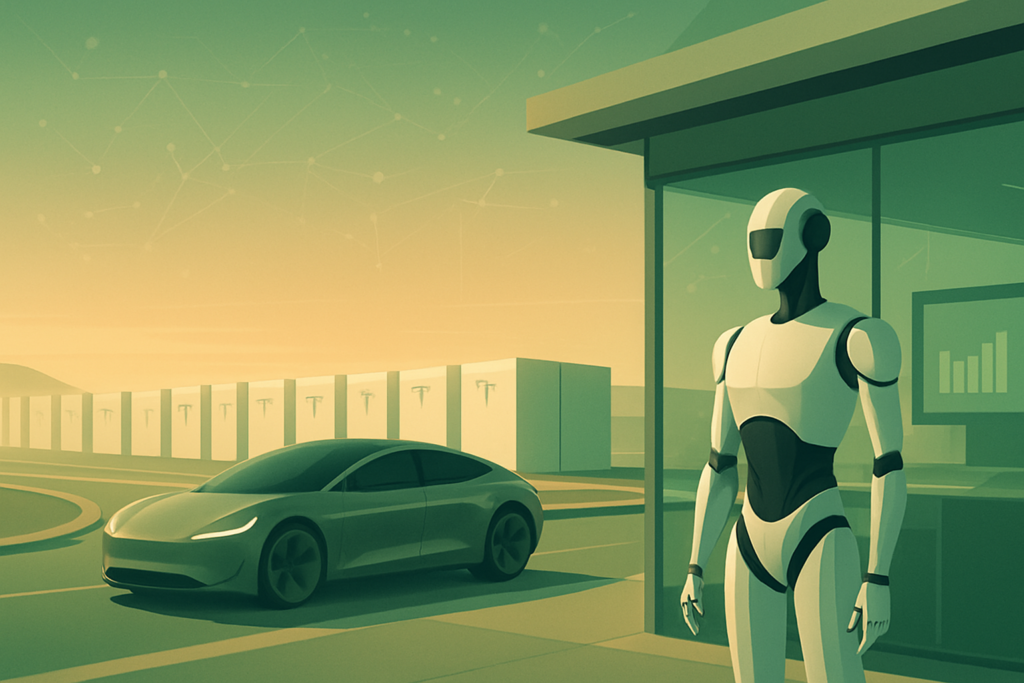
As of early 2026, Tesla (Nasdaq: TSLA) finds itself at the most critical juncture since the 2018 "Model 3 production hell." No longer just a high-growth electric vehicle manufacturer, Tesla is aggressively rebranding itself as a "Physical AI" and robotics powerhouse. This transition comes at a time when its core automotive business—the primary engine of its historic valuation—faces unprecedented pressure from Chinese competitors and a shifting regulatory landscape in the United States. With the stock trading near $400 and a market capitalization hovering around the trillion-dollar mark, the investment thesis for Tesla has fundamentally changed: it is no longer a bet on how many cars the company can sell, but on whether it can successfully commercialize autonomous mobility and humanoid robotics at scale.
Historical Background
Founded in 2003 by Martin Eberhard and Marc Tarpenning, and later spearheaded by Elon Musk, Tesla’s journey has been defined by defying the status quo. From the niche Roadster (2008) to the mass-market Model 3 (2017) and Model Y (2020), Tesla single-handedly forced the global automotive industry into the electric age. Over the last decade, the company transformed from a perennially cash-strapped startup into a highly profitable manufacturing giant with "Gigafactories" spanning three continents. However, by 2024 and 2025, the "EV honeymoon" ended. As the early adopter market saturated and traditional OEMs faced hurdles, Tesla began a strategic pivot away from traditional personal vehicle ownership toward a future defined by the "Cybercab" and the autonomous "Tesla Network."
Business Model
Tesla’s business model in 2026 is a trifecta of hardware, energy, and software services.
- Automotive: While still the largest revenue contributor, the focus has shifted from high-volume growth of existing models to the launch of the "Cybercab" (a purpose-built robotaxi) and the "Project Redwood" affordable car ($25,000).
- Energy Generation & Storage: This segment has become a cornerstone of Tesla’s profitability. Through its Megapack and Powerwall products, Tesla provides utility-scale and residential energy storage solutions. In 2025, this segment contributed nearly 25% of the company's gross profit.
- Software & AI: Tesla generates recurring revenue through Full Self-Driving (FSD) subscriptions—now priced at $99/month following the discontinuation of the one-time purchase option in early 2026—and its nascent Robotaxi network.
- Services: This includes supercharging, insurance, and vehicle maintenance.
Stock Performance Overview
Tesla’s stock performance as of February 6, 2026, reflects a narrative of extreme volatility followed by institutional consolidation.
- 1-Year Performance: The stock is up approximately 8% over the last 12 months. It saw a significant rally in late 2025, peaking at nearly $490 before cooling off in early 2026 as investors digested the retirement of the Model S and X lines.
- 5-Year Performance: Since February 2021, the stock has risen roughly 45% (split-adjusted). This period saw the stock crash during the "tech rout" of 2022 before recovering as FSD v12 and v13 showed significant technological leaps.
- 10-Year Performance: Tesla remains one of the greatest wealth-creators of the decade, with a total return exceeding 3,500% over the last ten years.
Financial Performance
In its Q4 2025 earnings report (released January 28, 2026), Tesla posted an adjusted EPS of $0.50 on revenue of $24.90 billion. While automotive revenue was relatively flat year-over-year, the company’s gross margin improved to 20.1%. This margin expansion was attributed to the high-margin Energy segment and the increased take-rate of FSD subscriptions. However, Tesla’s cash flow is under scrutiny as the company guided for a record $20 billion in Capital Expenditure (CapEx) for 2026, primarily directed toward the Dojo supercomputer and mass-production facilities for the Optimus humanoid robot.
Leadership and Management
Tesla's leadership remains its most debated characteristic. CEO Elon Musk continues to lead the company while simultaneously managing SpaceX, X (formerly Twitter), and his recent appointment to the Department of Government Efficiency (DOGE) within the U.S. executive branch. This "multi-tasking" has led to several high-profile executive departures in late 2025, including manufacturing lead Omead Afshar and Optimus engineering head Milan Kovac. The Board of Directors remains under pressure from activist shareholders to implement stricter governance and clear succession planning, especially given the "hollowing out" of the senior VP layer over the past 18 months.
Products, Services, and Innovations
The product roadmap for 2026 is the most ambitious in Tesla’s history:
- Cybercab: Scheduled for volume production in April 2026, this vehicle features no steering wheel or pedals and is designed solely for the Tesla Robotaxi network.
- Project Redwood: A $25,000 compact vehicle expected to enter mainstream production in late 2026, utilizing the "Unboxed" manufacturing process to halve production costs.
- Optimus Gen-3: Tesla has repurposed the Model S/X assembly lines in Fremont for the production of its humanoid robot. While not yet a major revenue driver, Musk expects mass production by the end of 2026.
- FSD v14: The latest software iteration focuses on human-like gestures and complex urban navigation, supporting the "unsupervised" robotaxi pilots currently active in Austin and the Bay Area.
Competitive Landscape
The competitive environment in 2026 is vastly different from the "early days" of EV dominance.
- BYD (Nasdaq: BYDDY): The Chinese giant officially surpassed Tesla in total BEV deliveries in 2025, selling 2.26 million units. BYD’s vertical integration allows it to undercut Tesla on price globally.
- Xiaomi: A new and formidable entrant, Xiaomi delivered 410,000 units in 2025 and is rapidly expanding into SUVs.
- Legacy OEMs: Ford (NYSE: F) and GM (NYSE: GM) have largely retreated from pure EV goals in favor of hybrids and EREVs (Extended Range Electric Vehicles), leaving Tesla to face off almost exclusively against Chinese manufacturers and high-end European brands like Porsche.
Industry and Market Trends
Three macro trends are defining the 2026 market:
- The Shift to "Physical AI": Investors are no longer valuing EV companies as automakers but as AI labs.
- Energy Resilience: As global power grids age, the demand for utility-scale storage (Megapacks) has skyrocketed, creating a "base load" of profit for Tesla.
- Hybrid Resurgence: A cooling interest in pure BEVs among average consumers has led to a surge in hybrid sales, a segment Tesla notably does not participate in.
Risks and Challenges
Tesla faces significant headwinds entering the mid-2020s:
- Regulatory Redesign: A new Chinese regulation effective in 2027 bans flush door handles, forcing a costly hardware redesign for Tesla's fleet in its largest international market.
- Incentive Expiry: Following the 2025 U.S. Tax Reform, the $7,500 federal EV tax credit expired on September 30, 2025, significantly raising the effective cost of a Model 3/Y for American buyers.
- Execution Risk: The pivot to Optimus and Robotaxis is high-stakes. If the Cybercab production misses its April 2026 target, the stock could face a significant de-rating.
Opportunities and Catalysts
- The Robotaxi Launch: The expansion of the Tesla Network to seven more U.S. cities in H1 2026 represents a massive untapped revenue stream.
- Next-Gen Platform: If "Project Redwood" hits its $25,000 price target, Tesla could reclaim volume leadership from BYD.
- Dojo and AI Licensing: There is persistent speculation that Tesla may eventually license its FSD software or Dojo compute power to other OEMs, mirroring the high-margin "Intel Inside" model.
Investor Sentiment and Analyst Coverage
Wall Street is deeply divided on TSLA in 2026.
- The Bulls: See Tesla as a robotics and AI company with an "infinite" TAM (Total Addressable Market) for Optimus. They point to the 20% gross margins as proof of operational excellence.
- The Bears: Focus on the 9% decline in 2025 vehicle deliveries and the aging Model 3/Y lineup. They argue that the $400 share price is a "meme valuation" that ignores the realities of the competitive automotive sector.
Regulatory, Policy, and Geopolitical Factors
The geopolitical landscape is fraught with tension. While the U.S. has ended its domestic EV credits, it has maintained high tariffs on Chinese imports, protecting Tesla’s home turf. Conversely, the EU’s "price undertaking" deal with China allows Chinese makers to remain competitive in Europe, squeezing Tesla’s margins there. Tesla’s relationship with the Chinese government remains stable but complex, as domestic "National Champion" policies increasingly favor BYD and Xiaomi.
Conclusion
Tesla enters 2026 as a company in the midst of an identity crisis—though one that could lead to a trillion-dollar payoff. By intentionally slowing its automotive growth to focus on "Physical AI" and robotics, Elon Musk is doubling down on a future where Tesla provides the labor (Optimus) and the mobility (Cybercab) of tomorrow. For investors, the stock remains a high-beta bet on the success of these frontier technologies. The key metrics to watch over the next 12 months will not be vehicle delivery counts, but the "miles between interventions" for FSD v14 and the successful ramp of the Cybercab production line in April.
This content is intended for informational purposes only and is not financial advice.