Rising demand for real-time inventory orchestration, AI-driven demand forecasting, and ultra-fast delivery models accelerates market growth at a CAGR of 14.9%
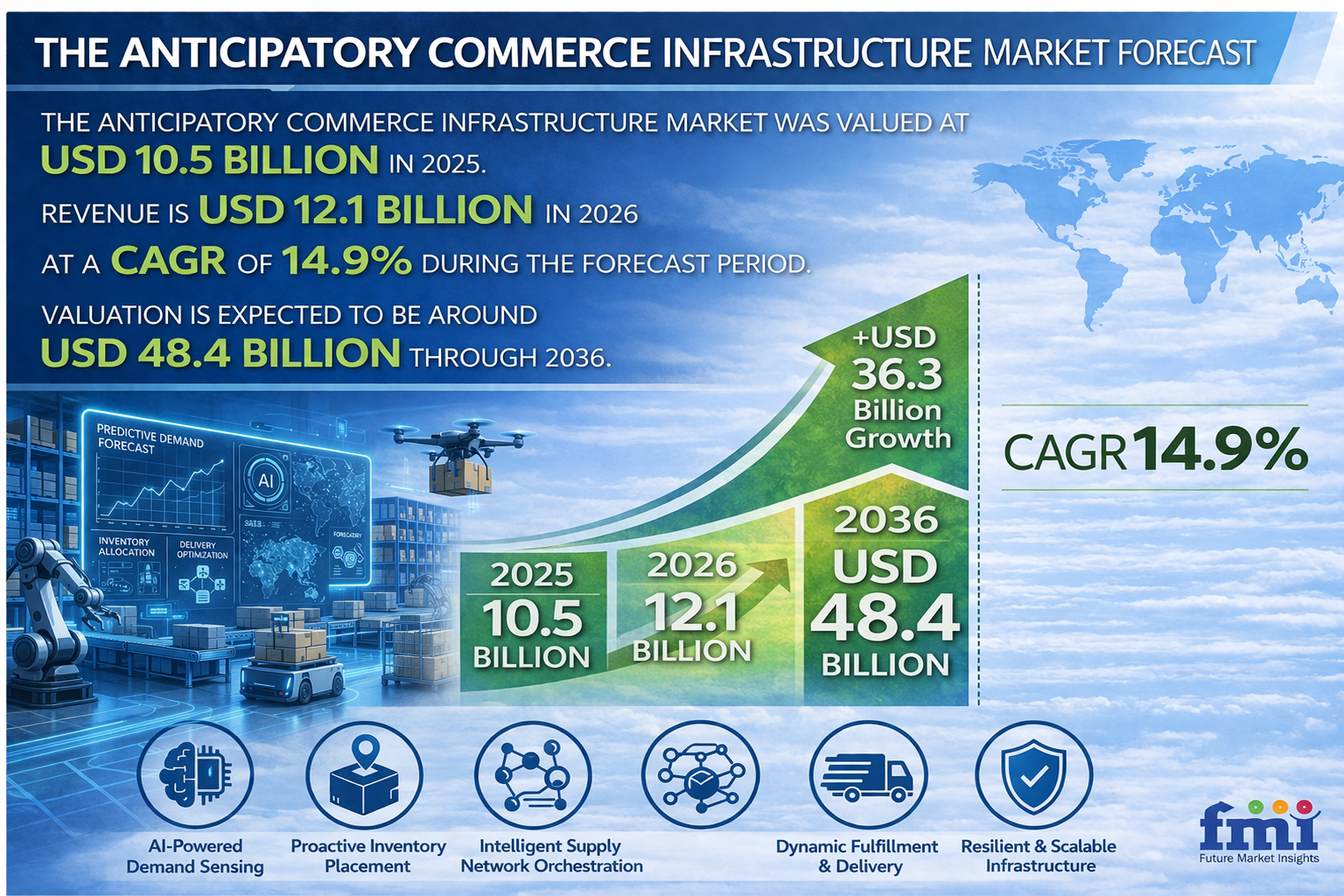
NEWARK, DE / ACCESS Newswire / April 2, 2026 / The global anticipatory commerce infrastructure market is entering a high-growth phase as retailers and fulfillment operators shift from reactive inventory models to predictive, data-driven orchestration systems. Valued at USD 10.5 billion in 2025, the market is projected to reach USD 12.1 billion in 2026 and surge to USD 48.4 billion by 2036, registering a robust CAGR of 14.9% during the forecast period.
This rapid expansion reflects a structural transformation in digital commerce operations, where fulfillment success is increasingly determined before an order is even placed. As delivery expectations compress to same-day and sub-hour windows, retailers are investing in anticipatory infrastructure that predicts demand, positions inventory, and selects optimal fulfillment nodes in real time. Traditional hub-and-spoke logistics models are proving inadequate in this environment, pushing enterprises toward decentralized, algorithm-driven fulfillment ecosystems.
Market Value Analysis: Predictive Placement Replaces Static Inventory Models
Between 2026 and 2030, adoption of anticipatory commerce platforms is expected to accelerate as retailers abandon static inventory allocation strategies. Centralized distribution models create latency that directly impacts delivery performance and profitability, particularly in high-frequency categories such as grocery and essentials.
Organizations are increasingly prioritizing:
Predictive inventory positioning based on hyper-local demand signals
Real-time order orchestration across distributed fulfillment nodes
AI-driven node selection for optimal delivery routing
Continuous inventory visibility across stores, dark stores, and automated hubs
Dynamic replenishment systems aligned with demand volatility
Failure to implement predictive placement logic results in excessive last-mile costs, inefficient stock allocation, and margin erosion-particularly in rapid delivery models where fulfillment speed directly impacts customer conversion.
From 2030 to 2036, market growth will be driven by deeper integration of machine learning models, expansion of automated fulfillment networks, and the increasing reliance on real-time decision engines to manage complex, multi-node logistics environments.
Technology Evolution: AI, Cloud, and Real-Time Data Power Anticipatory Systems
The evolution of anticipatory commerce infrastructure is being shaped by advances in artificial intelligence, cloud computing, and API-driven integration. These systems must continuously process massive volumes of transactional, behavioral, and environmental data to make accurate predictions.
Key innovations include:
Machine learning models for hyper-local demand forecasting
Real-time inventory synchronization across distributed nodes
API-based orchestration layers connecting stores, warehouses, and delivery networks
Event-driven architectures enabling instant decision-making
Integration with automation systems for seamless execution
A key challenge lies in integrating predictive engines with legacy retail systems. Many retailers operate on outdated ERP and warehouse management platforms that cannot support real-time data exchange, creating friction during deployment.
An industry analyst notes:
"In anticipatory commerce, timing is everything. The ability to predict demand and position inventory ahead of the order is what separates profitable fulfillment from unsustainable operations."
Anticipatory Infrastructure Becomes Core to Retail Profitability
As fulfillment windows shrink, anticipatory commerce systems are becoming essential for maintaining operational efficiency and protecting margins. These platforms enable retailers to transition from reactive fulfillment to proactive orchestration.
Core capabilities include:
Pre-positioning inventory closer to demand centers
Reducing last-mile delivery distances and costs
Improving order fulfillment speed and accuracy
Enabling real-time decision-making across networks
Supporting scalable, high-frequency order volumes
This transformation is redefining competitive dynamics in retail, where predictive accuracy directly influences delivery performance, cost efficiency, and customer satisfaction.
Segment Spotlight
Software Leads Component (44.0%)
Demand for predictive engines, orchestration layers, and analytics platforms drives software dominance.
Demand Forecasting Leads Function (29.0%)
High-frequency, location-level predictions are critical for anticipatory inventory placement.
Cloud Deployment Leads (63.0%)
Scalability and real-time synchronization across multiple nodes favor cloud-based infrastructure.
Grocery Leads End Use (31.0%)
Perishability and tight delivery windows make predictive fulfillment essential.
Store-Based Fulfillment Leads Model (28.0%)
Retailers leverage existing store networks as decentralized fulfillment nodes.
Regional Insights: Quick-Commerce Expansion Drives Global Adoption
The anticipatory commerce infrastructure market is expanding rapidly across regions with strong digital retail growth and high delivery expectations.
Country |
CAGR (2026-2036) |
Key Growth Drivers |
|---|---|---|
India |
17.4% |
Rapid quick-commerce expansion and dense urban demand |
China |
16.8% |
Platform-driven retail ecosystems and large-scale data utilization |
South Korea |
15.6% |
High-density urban delivery networks |
United States |
14.2% |
Mature e-commerce infrastructure and same-day delivery demand |
United Kingdom |
13.5% |
High e-commerce penetration and store network optimization |
Germany |
12.9% |
Privacy-compliant predictive analytics development |
Japan |
12.4% |
Gradual modernization of logistics systems |
Regional growth is shaped by factors such as urban density, digital adoption, infrastructure maturity, and regulatory environments.
Opportunities: Predictive Intelligence Unlocks New Revenue Streams
Key opportunities shaping the market include:
Integration of return prediction models to optimize reverse logistics
Expansion of third-party fulfillment node orchestration
Dynamic pricing linked to real-time inventory availability
Increased adoption of micro-fulfillment centers
AI-driven optimization of delivery routes and inventory allocation
These innovations are enabling retailers to move beyond cost reduction toward value creation through smarter, faster, and more responsive fulfillment systems.
Competitive Landscape: Data Depth and Integration Define Leadership
The anticipatory commerce infrastructure market is moderately fragmented, with competition driven by predictive accuracy, platform integration, and scalability.
Leading companies include:
Ocado Group
Symbotic
Manhattan Associates
Blue Yonder
Instacart
AutoStore
Fluent Commerce
Competitive differentiation is driven by:
Depth of historical data for model training
Ability to integrate with retailer systems and automation platforms
Scalability of cloud-based architectures
Flexibility through API-driven, modular solutions
Real-time orchestration capabilities across distributed networks
Future Outlook: Anticipatory Systems Become the Backbone of Digital Commerce
Looking ahead to 2036, anticipatory commerce infrastructure will evolve into the central intelligence layer of modern retail ecosystems.
Key trends include:
Shift from reactive fulfillment to predictive and autonomous orchestration
Expansion of AI-driven decision-making across supply chains
Growth of micro-fulfillment and decentralized inventory networks
Integration of predictive systems with pricing, marketing, and merchandising
Alignment of fulfillment performance with profitability metrics
As delivery expectations continue to tighten and competition intensifies, anticipatory commerce infrastructure will transition from a competitive advantage to a foundational requirement-defining the speed, efficiency, and profitability of next-generation retail operations.
For an in-depth analysis of evolving formulation trends and to access the complete strategic outlook for the Anticipatory Commerce Infrastructure Market through 2036, visit the official report page at: https://www.futuremarketinsights.com/reports/anticipatory-commerce-infrastructure-market
Browse More Technology Industry Reports:
Security Labels Market - https://www.futuremarketinsights.com/reports/security-labels-market
Digital Experience Platform (DXP) Market - https://www.futuremarketinsights.com/reports/digital-experience-platform-market
Accounts Payable Automation Market - https://www.futuremarketinsights.com/reports/accounts-payable-automation-market
Harmonic Filter Market - https://www.futuremarketinsights.com/reports/harmonic-filter-market
Insurtech Market - https://www.futuremarketinsights.com/reports/insurtech-market
About Future Market Insights (FMI)
Future Market Insights (FMI) is a leading provider of market intelligence and consulting services, serving clients in over 150 countries. Headquartered in Delaware, USA, with a global delivery center in India and offices in the UK and UAE, FMI delivers actionable insights to businesses across industries including automotive, technology, consumer products, manufacturing, energy, and chemicals.
An ESOMAR-certified research organization, FMI provides custom and syndicated market reports and consulting services, supporting both Fortune 1,000 companies and SMEs. Its team of 300+ experienced analysts ensures credible, data-driven insights to help clients navigate global markets and identify growth opportunities.
For Press & Corporate Inquiries
Rahul Singh
AVP - Marketing and Growth Strategy
Future Market Insights, Inc.
+91 8600020075
For Sales - sales@futuremarketinsights.com
For Media - Rahul.singh@futuremarketinsights.com
For web - https://www.futuremarketinsights.com/
SOURCE: Future Market Insights, Inc.
View the original press release on ACCESS Newswire