Low-odor inkjet inks are becoming essential for food safety, compliance, and traceability, driven by aseptic packaging growth, regulatory pressure, and high-speed production needs.
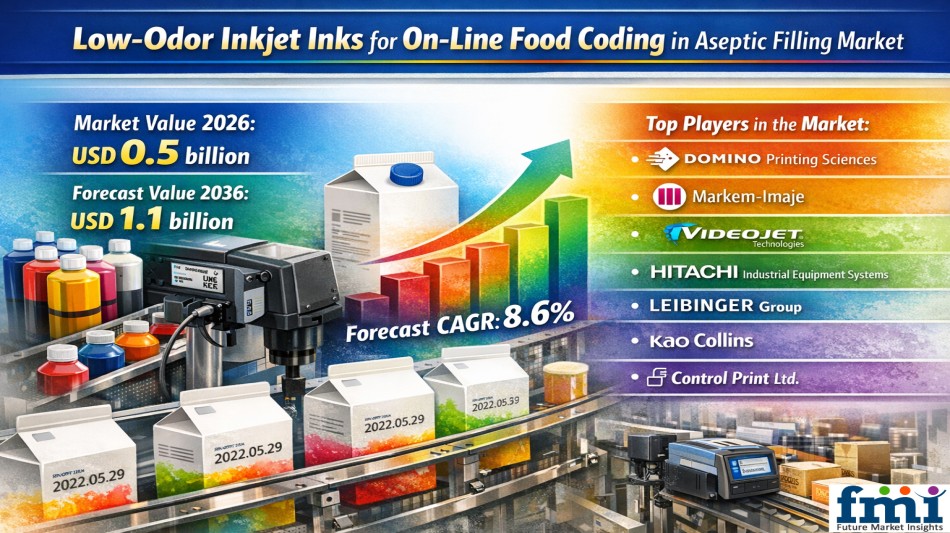
NEWARK, DE / ACCESS Newswire / March 22, 2026 / The global Low-Odor Inkjet Inks for On-Line Food Coding in Aseptic Filling market is entering a period of strategic transformation as food safety regulations, aseptic packaging expansion, and high-speed production line automation reshape coding and marking technologies. Valued at USD 0.5 billion in 2026, the market is projected to reach USD 1.1 billion by 2036, expanding at a CAGR of 8.6%. The growth trajectory reflects a structural shift across food and beverage manufacturing, where coding inks are no longer considered a simple consumable but a critical compliance, traceability, and packaging safety component.
According to a comprehensive strategic outlook by Future Market Insights (FMI), regulatory pressure on chemical migration limits, the rapid modernization of dairy and beverage aseptic filling lines, and the elimination of high-VOC solvents are collectively redefining the inkjet coding fluid industry. Manufacturers are transitioning toward low-odor, low-migration, and MEK-free ink formulations to meet evolving food safety standards and environmental compliance frameworks.
Low-Odor Inkjet Inks for On-Line Food Coding in Aseptic Filling Market Metric
Metric |
Value / Detail (2026-2036) |
|---|---|
Industry Size (2026) |
USD 0.5 Billion |
Industry Value (2036) |
USD 1.1 Billion |
CAGR |
8.6% |
Fastest Growing Market |
India |
Leading Technology |
Continuous Inkjet (CIJ) |
Discover Growth Opportunities in the Market - Get Your Sample Report Now
https://www.futuremarketinsights.com/reports/sample/rep-gb-32422
The Compliance Shift: From Standard Coding Fluids to Food-Safe Chemistry
The market is undergoing a major transition driven primarily by food-contact migration regulations, particularly across Europe and North America. Packaging lines operating aseptic filling systems must now ensure that printed lot codes, batch numbers, and expiration dates do not transfer any volatile compounds through thin packaging materials into consumable products.
This regulatory environment is fundamentally changing procurement strategies across beverage, dairy, and pharmaceutical packaging industries. Low-odor inkjet inks are increasingly becoming standard operating requirements rather than optional upgrades.
Industry analysts note that the biggest operational challenge is not simply replacing ink cartridges but redesigning entire fluid delivery systems, including pumps, seals, tubing, and manifolds, to prevent contamination between legacy solvent inks and new low-odor formulations.
High-Speed Production Lines Driving Technology Adoption
Aseptic filling lines often operate at extremely high speeds, exceeding 80,000 units per hour, particularly in dairy, beverage, and liquid food packaging. Traditional high-VOC solvent inks evaporated quickly, allowing rapid printing, but they no longer meet modern environmental and food safety standards.
Low-odor ink formulations are now engineered to deliver:
Fast curing on cold PET and HDPE bottles
Adhesion on condensation-heavy surfaces
Resistance to hydrogen peroxide sterilization
Non-migration through thin packaging walls
Compatibility with high-speed continuous inkjet printers
As a result, Continuous Inkjet (CIJ) technology remains dominant due to its massive installed base across global bottling and packaging facilities.
Evolving Cost Structure and Operational Strategy
The transition toward compliant ink chemistry is also changing the cost structure of packaging operations. While low-odor inks are typically more expensive than traditional solvent-based inks, companies are adopting them due to the high cost of non-compliance, including product recalls, retailer rejection, regulatory fines, and production downtime.
Operations managers are increasingly coordinating ink transitions with scheduled maintenance cycles to avoid contamination risks and system failures. Procurement departments are also securing long-term supply agreements to prevent chemical shortages during peak production seasons.
This shift is transforming ink suppliers from commodity vendors into strategic compliance partners.
Segment Spotlight: Ink Chemistry and Printing Technology
Ink Chemistry
Solvent-based low-odor inks continue to dominate the market due to their fast drying and strong adhesion on non-porous packaging materials. These inks are designed with alternative ester solvents that reduce volatile emissions while maintaining performance on high-speed packaging lines.
Water-based and UV-curable low-odor inks are also gaining adoption, particularly in regions with strict environmental regulations and sustainability targets.
Printing Technology
Continuous Inkjet (CIJ) technology holds the largest market share due to its widespread installation across beverage, dairy, and pharmaceutical packaging lines. Many facilities prefer upgrading fluid chemistry rather than replacing expensive printing hardware, making CIJ-compatible low-odor inks the most widely adopted solution.
Thermal Inkjet and Piezoelectric Inkjet systems are gradually expanding in new installations, especially where zero-emission printing systems are required.
Regional Powerhouses: Asia Leads Growth
While Europe and North America remain regulatory-driven markets, the fastest growth is occurring in Asia due to rapid expansion of dairy processing, beverage bottling, and aseptic packaging infrastructure.
Key Country Growth Rates (2026-2036)
India - 10.5% CAGR
China - 9.8% CAGR
Brazil - 8.3% CAGR
United States - 7.9% CAGR
Germany - 7.6% CAGR
France - 7.4% CAGR
Japan - 7.2% CAGR
India is emerging as the fastest-growing market due to rapid expansion of dairy cooperatives, modernization of packaging facilities, and adoption of continuous inkjet printing systems compatible with low-emission fluids.
China continues to grow due to export-oriented beverage manufacturing requiring strict international compliance standards.
Dynamics of the Decade: Sustainability and Zero-Migration Printing
Looking toward 2036, several major trends are expected to reshape the competitive landscape of aseptic packaging coding inks:
Eco-Friendly Ink Development: Manufacturers are developing VOC-free, water-based, and UV-curable inks to eliminate solvent emissions and improve workplace safety.
UV-LED Printing Systems: UV curing technologies eliminate solvent evaporation entirely, enabling zero-emission printing processes suitable for sterile environments.
Edible and Ingestible Ink Research:Some manufacturers are developing inks that are completely ingestible, eliminating migration concerns entirely for food-contact packaging applications.
Recycling Compatibility: Ink chemistries are being redesigned to wash off easily during PET recycling processes, improving packaging sustainability.
Competitive Landscape
The competitive environment in the low-odor inkjet inks market is highly specialized due to strict chemical validation requirements and compatibility with existing printing hardware. Companies with approved toxicology dossiers, printer compatibility knowledge, and global supply networks hold significant competitive advantages.
Ink manufacturers must ensure that fluid viscosity, drying speed, and adhesion characteristics match specific printer hardware configurations precisely. This creates high barriers to entry for new suppliers.
Major beverage and dairy companies are consolidating purchasing agreements globally, favoring suppliers that can provide consistent chemical formulations across multiple continents, local technical support, and reliable supply chain infrastructure.
Key Players in the Low-Odor Inkjet Inks for On-Line Food Coding in Aseptic Filling Market
Domino Printing Sciences
Markem-Imaje
Videojet Technologies
Hitachi Industrial Equipment Systems
LEIBINGER Group
Kao Collins
Control Print Ltd
These companies compete primarily on chemical formulation expertise, printer compatibility, regulatory compliance certifications, and global technical support capabilities.
Outlook: The Future of Food Packaging Coding Fluids
The low-odor inkjet inks market is expected to grow steadily over the next decade as food safety regulations tighten and aseptic packaging adoption continues to expand globally. The industry is transitioning from traditional solvent-based coding fluids toward specialized chemical engineering solutions designed for sterile packaging environments.
By 2036, low-migration, low-emission, and recyclable ink chemistries will become standard across global aseptic filling operations. Suppliers that can deliver compliant chemistry, printer compatibility, and global supply reliability will dominate the market.
For an in-depth analysis of evolving formulation trends and to access the complete strategic outlook for the Low-Odor Inkjet Inks for On-Line Food Coding in Aseptic Filling Market through 2036, visit the official report page at: https://www.futuremarketinsights.com/reports/low-odor-inkjet-inks-for-on-line-food-coding-in-aseptic-filling-market
Explore More Research Reports by FMI
Travel-Ready Sanitizer and Disinfectant Packaging Market - https://www.futuremarketinsights.com/reports/travel-ready-sanitizer-and-disinfectant-packaging-market
Cosmetic Glass Ampoule Market - https://www.futuremarketinsights.com/reports/cosmetic-glass-ampoule-market
Peggable Packaging for IT Accessories Market - https://www.futuremarketinsights.com/reports/peggable-packaging-for-it-accessories-market
Transit Packaging Solutions for IT Hardware Accessories Market - https://www.futuremarketinsights.com/reports/transit-packaging-solutions-for-it-hardware-accessories-market
Elastic Palletizing Bands Market - https://www.futuremarketinsights.com/reports/elastic-palletizing-bands-market
About Future Market Insights (FMI)
Future Market Insights (FMI) is a leading provider of market intelligence and consulting services, serving clients in over 150 countries. Headquartered in Delaware, USA, with a global delivery center in India and offices in the UK and UAE, FMI delivers actionable insights to businesses across industries including automotive, technology, consumer products, manufacturing, energy, and chemicals.
An ESOMAR-certified research organization, FMI provides custom and syndicated market reports and consulting services, supporting both Fortune 1,000 companies and SMEs. Its team of 300+ experienced analysts ensures credible, data-driven insights to help clients navigate global markets and identify growth opportunities.
For Press & Corporate Inquiries
Rahul Singh
AVP - Marketing and Growth Strategy
Future Market Insights, Inc.
+91 8600020075
For Sales - sales@futuremarketinsights.com
For Media - Rahul.singh@futuremarketinsights.com
For web - https://www.futuremarketinsights.com/
SOURCE: Future Market Insights, Inc.
View the original press release on ACCESS Newswire