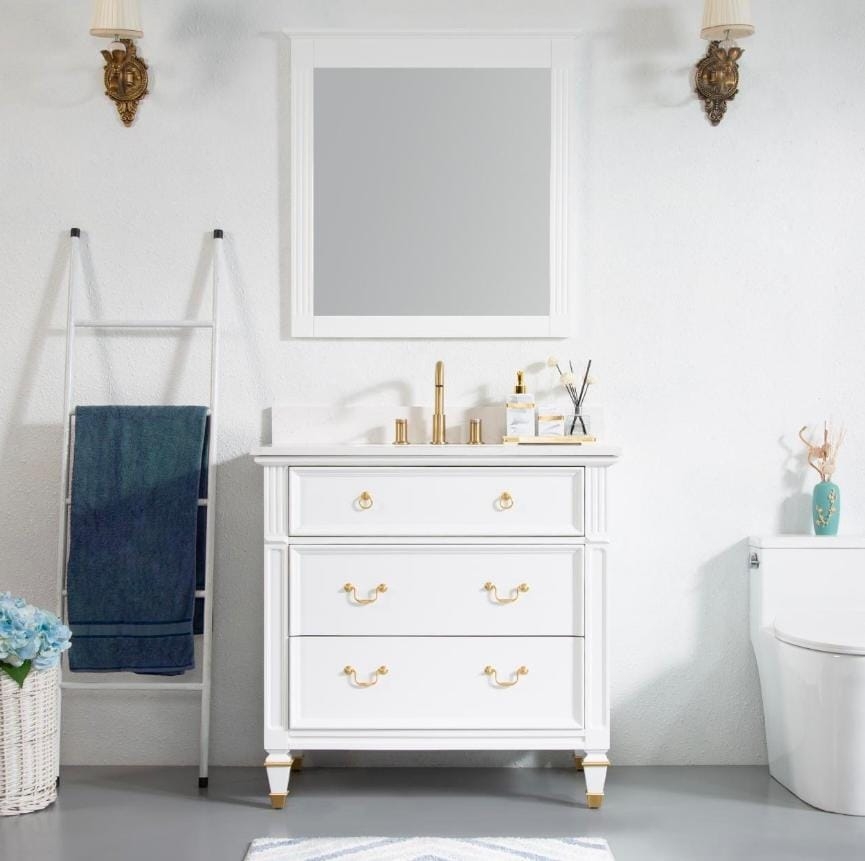
A white bathroom vanity is having a moment, not because it’s “safe,” but because it acts like a clean canvas in bathrooms that are getting more complex—bigger showers, layered lighting, bolder hardware, and mixed materials. With homeowner remodeling outlays projected to hit $524 billion in early 2026 (a record level), bathrooms continue to compete for budget, and the vanity remains the visual anchor you see and use every day.
Why white works right now
Recent renovation research shows spending is still substantial: the median spend was $13,000 for all bathroom renovations in 2024, while major remodels (at least the shower upgraded) had a median of $22,000, with larger bathrooms (100+ sq ft) investing even more. That reality pushes many projects toward “high-impact, low-regret” choices, and white vanities fit that brief: easy to coordinate, easy to refresh with accessories, and forgiving when surrounding finishes change.
But “white” only looks premium when you design the edges around it—clearances, lighting, counter thickness, hardware contrast, and the rhythm of surrounding lines.
Start with layout: inches first, style second.
A beautiful bathroom vanity that pinches circulation will feel wrong every single morning. Use these planning benchmarks to keep the space comfortable:
-
Clear floor space in front of fixtures: plan 30" from the front edge of fixtures to any opposite wall/obstacle for a comfortable layout; many codes allow 21" minimum in front of a lavatory/toilet/tub, and 24" minimum at a shower entry.
-
Lavatory to side obstacle: keep the lavatory centerline at least 20" from a side wall or tall obstacle for breathing room (code minimum shown as 15" in many cases).
-
Double sink spacing: the distance between lavatory centerlines should be at least 36" for comfortable shared use.
If you want the room to feel “European hotel calm,” the single most significant move is protecting that 30" zone in front of the vanity. White looks sharper when the space around it isn’t cramped.
Choose the vanity size that matches real habits, not just the wall.
In current remodels, 47% of upgraded vanities are 48" wide or less, while larger sizes still have a substantial share (48" at 19%, 60" at 14%, and over 72" at 13%). That split is useful: it suggests many bathrooms still need compact efficiency, but when there’s room, people are committing to generous countertop landing space.
Design tip:
-
If the wall can take a larger vanity but traffic is tight, consider a floating look (lighter visually) or a slimmer top profile—white cabinetry plus a “thinner” counter edge reads less bulky.
Accessibility-minded option (without shouting “accessible”):
Suppose you’re planning for seated use; knee/toe clearances matter. Guidance for knee/toe space commonly targets at least 27" high knee clearance, with toe space around 9" high and additional depth rules depending on how far the space extends under the counter. A white vanity paired with a furniture-style open area (or a removable base panel) can look intentional and refined.
Countertops: let the top do the talking
A white vanity doesn’t have to carry the whole design. Let the counter be the “featured finish.”
Among upgraded vanities, engineered quartz leads countertop selections at 45%, followed by natural stone options like quartzite (20%), granite (14%), and marble (13%).
Pairing ideas that stay timeless:
-
White vanity + quartz with subtle veining: keeps the room bright while adding movement.
-
White vanity + quartzite: higher contrast and more depth; great for warm metal hardware.
-
White vanity + honed marble look: soft, classic, and very “spa,” especially with warm lighting.
Pro move: run a short backsplash (or full-height splash behind the faucet) in the same slab as the counter. It makes a white vanity feel custom even when the cabinet is stock.
Hardware and faucet: add contrast where your hand touches
White cabinets can look flat if all nearby finishes are also pale. Hardware is the easiest way to create definition.
In upgraded vanities, homeowners strongly favor bar pulls (58%), and the leading handle finish is brushed nickel (32%), followed by black (18%) and brushed gold (14%).
How to pick (fast):
-
Want crisp + modern: black pulls on white.
-
Want soft + high-end: brushed nickel with warm lighting and a light stone top.
-
Want boutique-hotel warmth: brushed gold, creamy walls, and textured tile.
For faucets, water efficiency is now a mainstream expectation. WaterSense-labeled bathroom sink faucets use a maximum of 1.5 gallons per minute, compared with a 2.2 gpm federal baseline, while maintaining performance.
That matters in design terms because you can choose a more sculptural spout or a widespread set without feeling wasteful.
Light it like a face, not like a hallway.
White reflects light—great when it’s flattering, harsh when it’s not.
Best practice around a white vanity:
-
Use two vertical lights flanking the mirror (or a wide, well-diffused bar) to reduce shadows.
-
Keep bulbs consistent (same color temperature) so the white doesn’t shift from “clean” to “blue” or “yellow.”
-
Add a low-level night light (toe-kick LED or a dimmable sconce setting). White cabinetry makes this look exceptionally polished because the glow reads intentional, not messy.
Build texture around the white so it doesn’t feel “builder basic”
Texture is the antidote to flat white-on-white bathrooms.
Easy texture wins:
-
Fluted or reeded accents (even on one panel or mirror frame)
-
Matte tile with tight grout joints
-
Natural fibers (tray, stool, hamper) to warm up the scene.
-
A contrasting paint sheen: eggshell walls + satin trim can subtly outline the architecture.
Storage features that quietly upgrade daily life
People are prioritizing function upgrades, and vanity features show it. Soft-close is now close to expected: 78% choose soft-close drawers, and 75% select soft-close doors.
If you’re designing around a white vanity, treat organization as part of the aesthetic:
-
Put tall items (hair tools, sprays) in a dedicated pull-out zone.
-
Use drawer dividers so the inside looks as clean as the outside—white cabinets make clutter feel louder.
A practical, “can’t-mess-it-up” checklist
-
Protect 30" of clear space in front of the vanity whenever possible.
-
Choose vanity width based on how you’ll share the sink—double lavs: 36" between centerlines.
-
Let the countertop carry character: quartz/quartzite/marble looks pair exceptionally well with white.
-
Use hardware for contrast (black/nickel/gold trends are all strong).
-
Pick an efficient faucet (WaterSense max 1.5 gpm) and spend the “style budget” on form and finish.
Media Contact
Company Name: WellFor
Email: Send Email
Country: United States
Website: https://www.wellfor.com/