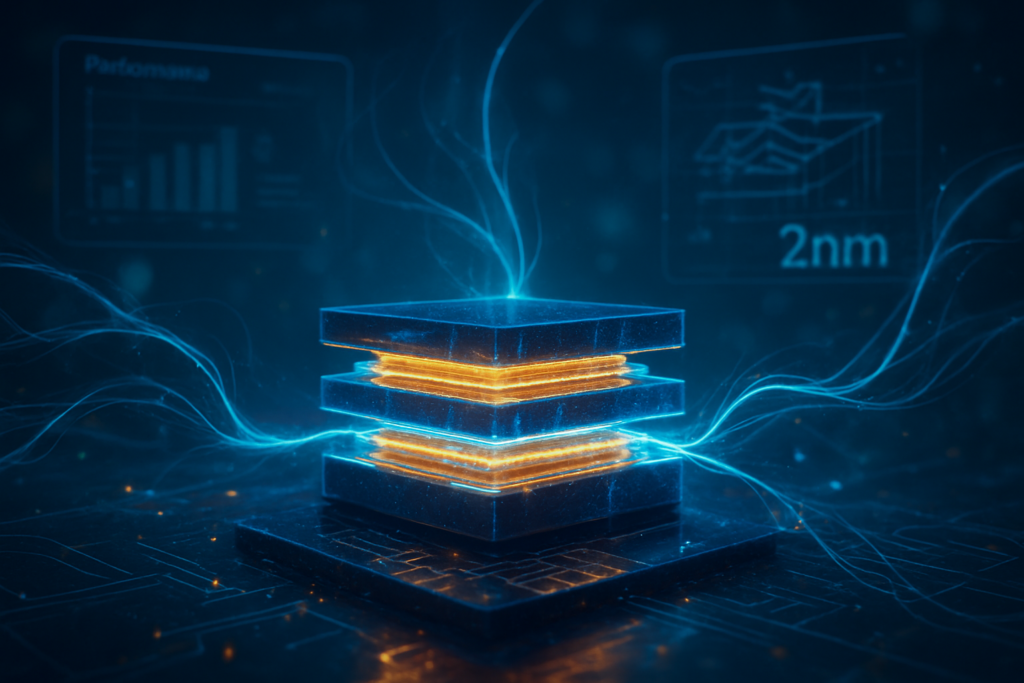
As of January 8, 2026, the global semiconductor industry has officially crossed into the 2nm era, marking the most significant architectural shift in a decade. The transition from the long-standing FinFET (Fin Field-Effect Transistor) structure to Gate-All-Around (GAA) nanosheets has transformed from a theoretical goal into a high-volume manufacturing reality. This leap is not merely a numerical iteration; it represents a fundamental redesign of how silicon processes data, arriving just in time to meet the insatiable power demands of the generative AI boom.
The race for 2nm dominance is currently a three-way sprint between Taiwan Semiconductor Manufacturing Company (NYSE: TSM), Samsung Electronics (KRX: 005930), and Intel (NASDAQ: INTC). While TSMC has maintained its lead in volume and yield, the introduction of GAA technology has leveled the playing field, allowing challengers to contest the "performance-per-watt" crown that is essential for the next generation of large language models (LLMs) and autonomous systems.
The Death of FinFET and the Birth of GAA
The technical cornerstone of the 2nm generation is the industry-wide adoption of Gate-All-Around (GAA) transistor architecture. For over ten years, the industry relied on FinFET, where the gate contacted the channel on three sides. However, as transistors shrunk toward the 3nm limit, FinFETs began to suffer from severe "short-channel effects" and power leakage. GAA solves this by wrapping the gate around all four sides of the channel—essentially using horizontal "nanosheets" stacked on top of one another. This provides superior electrical control, reducing leakage current by up to 75% compared to previous generations and allowing for continued voltage scaling down to 0.5V.
TSMC’s N2 process, which entered mass production in late 2025, currently leads the market with reported yields nearing 80%. The N2 node offers a 10–15% increase in clock speed at the same power level or a 25–30% reduction in power consumption compared to the 3nm (N3E) process. Meanwhile, Samsung has utilized its Multi-Bridge Channel FET (MBCFET)—a proprietary version of GAA—to achieve a 25% improvement in power efficiency for its SF2 node. Intel has entered the fray with its 18A (1.8nm) process, which utilizes "PowerVia" backside power delivery, a technique that moves power wiring to the back of the wafer to reduce interference and boost performance.
Initial reactions from the AI research community have been overwhelmingly positive, particularly regarding the thermal efficiency of these chips. Data center operators have noted that the 30% reduction in power consumption at the chip level could translate into hundreds of millions of dollars in utility savings for massive AI clusters. However, the cost of this innovation is steep: a single 2nm wafer from TSMC is now priced at approximately $30,000, a 50% increase over 3nm wafers, forcing a "two-tier" market where only the wealthiest tech giants can afford the bleeding edge.
A High-Stakes Game for Tech Giants
The immediate beneficiaries of the 2nm breakthrough are the "Hyper-scalers" and premium consumer electronics firms. Apple (NASDAQ: AAPL) has once again secured the lion's share of TSMC’s initial N2 capacity, utilizing the node for its A20 and A20 Pro chips in the iPhone 18 series, as well as upcoming M-series Mac processors. By being the first to market with 2nm, Apple maintains a significant lead in on-device AI performance, enabling more complex "Apple Intelligence" features to run locally without cloud dependency.
In the enterprise sector, NVIDIA (NASDAQ: NVDA) has locked in substantial 2nm capacity for its next-generation "Vera Rubin" AI accelerators. For NVIDIA, the move to 2nm is a strategic necessity to maintain its dominance in the AI hardware market. As LLMs grow in size, the bottleneck has shifted from raw compute to energy density; 2nm chips allow NVIDIA to pack more CUDA cores into a single rack while keeping cooling requirements manageable. Similarly, Advanced Micro Devices (NASDAQ: AMD) is leveraging 2nm for its Instinct accelerator line to close the gap with NVIDIA in the high-performance computing (HPC) space.
Interestingly, the 2nm era has seen a shift in customer loyalty. Samsung’s SF2 process has secured a landmark supply agreement with Tesla (NASDAQ: TSLA) for its next-generation Full Self-Driving (FSD) chips. Tesla’s move suggests that Samsung’s lower wafer pricing—roughly 20% cheaper than TSMC—is becoming an attractive alternative for companies that need high performance but are sensitive to the escalating costs of the 2nm node. Intel Foundry has also scored wins, securing Microsoft (NASDAQ: MSFT) and Amazon (NASDAQ: AMZN) as lead customers for custom AI silicon on its 18A node, marking a major milestone in Intel's quest to become a world-class foundry.
Geopolitics and the AI Power Wall
The transition to 2nm is more than a technical milestone; it is a critical pivot point in the broader AI landscape. We are currently witnessing a "Power Wall" where the energy requirements of AI data centers are outpacing the growth of electrical grids. The 2nm generation is the industry's primary weapon against this crisis. By delivering 30% better efficiency, these chips allow for the continued scaling of AI models without a linear increase in carbon footprint.
Furthermore, the 2nm race is inextricably linked to global geopolitics. With TSMC’s "Gigafabs" in Hsinchu and Kaohsiung producing the world’s most advanced chips, the concentration of 2nm manufacturing in Taiwan remains a point of intense strategic concern for Western governments. This has spurred the rapid expansion of "sub-2nm" facilities in the United States and Europe, supported by the CHIPS Act. The success of Intel’s 18A node is seen by many as a litmus test for the viability of a diversified global supply chain that is less dependent on a single geographic region.
Comparatively, the move to 2nm mirrors the transition to 7nm in 2018, which catalyzed the first wave of mobile AI. However, the stakes are now much higher. While 7nm enabled Siri and Google Assistant, 2nm is the engine for autonomous agents and real-time generative video. The concerns regarding "yield gaps" between TSMC and its competitors also highlight a growing divide in the industry: the "Silicon Haves" (those who can afford 2nm) and the "Silicon Have-Nots" (those relegated to older, less efficient nodes).
The Road to 1.4nm and Beyond
Looking ahead, the 2nm node is expected to be the "long-tail" node of the late 2020s, much like 28nm was in the previous decade. However, research into the 1.4nm (A14) and 1nm (A10) nodes is already well underway. TSMC has already begun scouting locations for its A14 pilot lines, which are expected to enter risk production by late 2027. These future nodes will likely move beyond simple nanosheets to "Complementary FET" (CFET) architectures, which stack n-type and p-type transistors on top of each other to further increase density.
The near-term challenge remains the escalating cost of Extreme Ultraviolet (EUV) lithography. The next generation of "High-NA" EUV machines, costing over $350 million each, is required for sub-2nm manufacturing. This capital intensity suggests that the number of companies capable of designing and manufacturing at these levels will continue to shrink. Experts predict that by 2030, we may see a "foundry duopoly" or even a "monopoly" if competitors cannot keep pace with TSMC’s aggressive R&D spending.
A New Chapter in Silicon History
The arrival of 2nm manufacturing in early 2026 represents a triumphant moment for materials science and engineering. By successfully implementing Gate-All-Around transistors at scale, the semiconductor industry has defied the skeptics who predicted the end of Moore’s Law. TSMC remains the undisputed leader in volume and reliability, but the revitalized efforts of Samsung and Intel ensure that the competitive fires will continue to drive innovation.
For the AI industry, 2nm is the oxygen that will allow the current fire of innovation to keep burning. Without the efficiency gains provided by GAA architecture, the environmental and economic costs of AI would likely have plateaued. As we move through 2026, the focus will shift from "can we build it?" to "how can we use it?" Watch for a surge in ultra-efficient AI laptops, 8K real-time video generation on mobile devices, and a new generation of robots that can think for hours on a single charge. The 2nm era is not just a milestone; it is the foundation of the next decade of digital transformation.
This content is intended for informational purposes only and represents analysis of current AI developments.
TokenRing AI delivers enterprise-grade solutions for multi-agent AI workflow orchestration, AI-powered development tools, and seamless remote collaboration platforms.
For more information, visit https://www.tokenring.ai/.