
Medical device company Integra LifeSciences (NASDAQ: IART) met Wall Street’s revenue expectations in Q2 CY2026, but sales were flat year on year at $418.8 million. The company expects next quarter’s revenue to be around $417.5 million, close to analysts’ estimates. Its non-GAAP profit of $0.56 per share was 15.8% above analysts’ consensus estimates.
Is now the time to buy Integra LifeSciences? Find out by accessing our full research report, it’s free.
Integra LifeSciences (IART) Q2 CY2026 Highlights:
- Revenue: $418.8 million vs analyst estimates of $417.7 million (flat year on year, in line)
- Adjusted EPS: $0.56 vs analyst estimates of $0.48 (15.8% beat)
- Adjusted EBITDA: $78.41 million vs analyst estimates of $73.52 million (18.7% margin, 6.7% beat)
- The company reconfirmed its revenue guidance for the full year of $1.67 billion at the midpoint
- Management reiterated its full-year Adjusted EPS guidance of $2.45 at the midpoint
- Operating Margin: 4.6%, down from 7.9% in the same quarter last year
- Free Cash Flow was $10.5 million, up from -$11.23 million in the same quarter last year
- Organic Revenue was flat year on year (beat)
- Market Capitalization: $1.54 billion
"Our second-quarter performance reflects meaningful progress on our most important priorities. We are improving supply reliability, advancing quality, and returning products to market with discipline. The Braintree facility is now producing and ramping to support the planned SurgiMend relaunch later this year," said Stuart Essig, Chairman and CEO of Integra LifeSciences.
Company Overview
Founded in 1989 as a pioneer in regenerative medicine technology, Integra LifeSciences (NASDAQ: IART) develops and manufactures medical technologies for neurosurgery, wound care, and surgical reconstruction, including regenerative tissue products and surgical instruments.
Revenue Growth
A company’s long-term performance is an indicator of its overall quality. Any business can put up a good quarter or two, but many enduring ones grow for years. Unfortunately, Integra LifeSciences’s 1.8% annualized revenue growth over the last five years was tepid. This fell short of our benchmarks and is a poor baseline for our analysis.
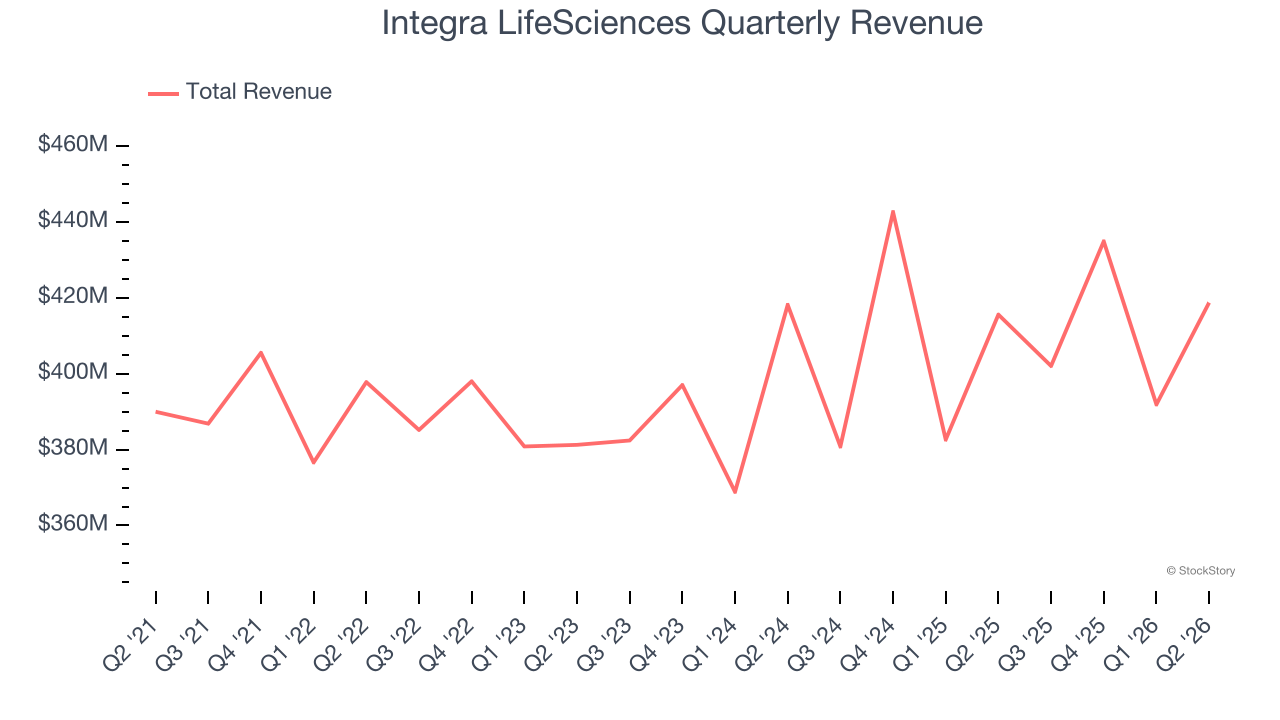
Long-term growth is the most important, but within healthcare, a half-decade historical view may miss new innovations or demand cycles. Integra LifeSciences’s annualized revenue growth of 2.6% over the last two years aligns with its five-year trend, suggesting its demand was consistently weak. 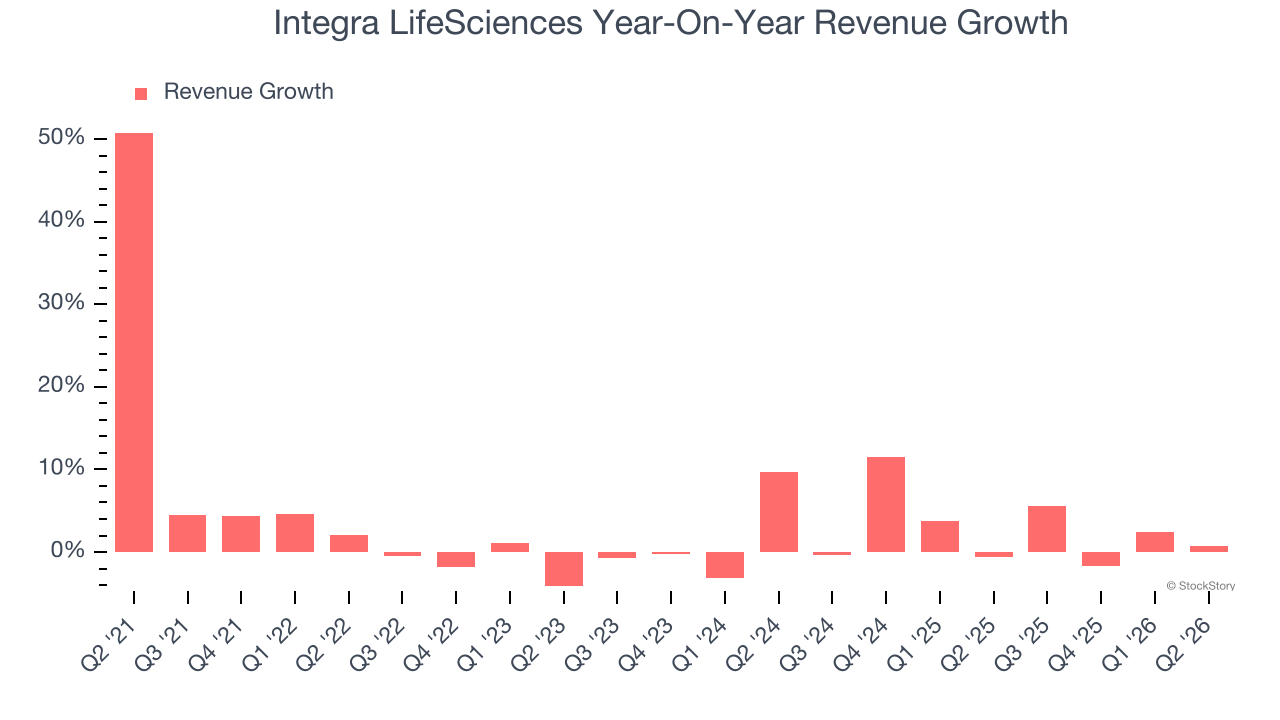
We can better understand the company’s sales dynamics by analyzing its organic revenue, which strips out one-time events like acquisitions and currency fluctuations that don’t accurately reflect its fundamentals. Over the last two years, Integra LifeSciences’s organic revenue averaged 2.1% year-on-year growth. Because this number aligns with its two-year revenue growth, we can see the company’s core operations (not acquisitions and divestitures) drove most of its results. 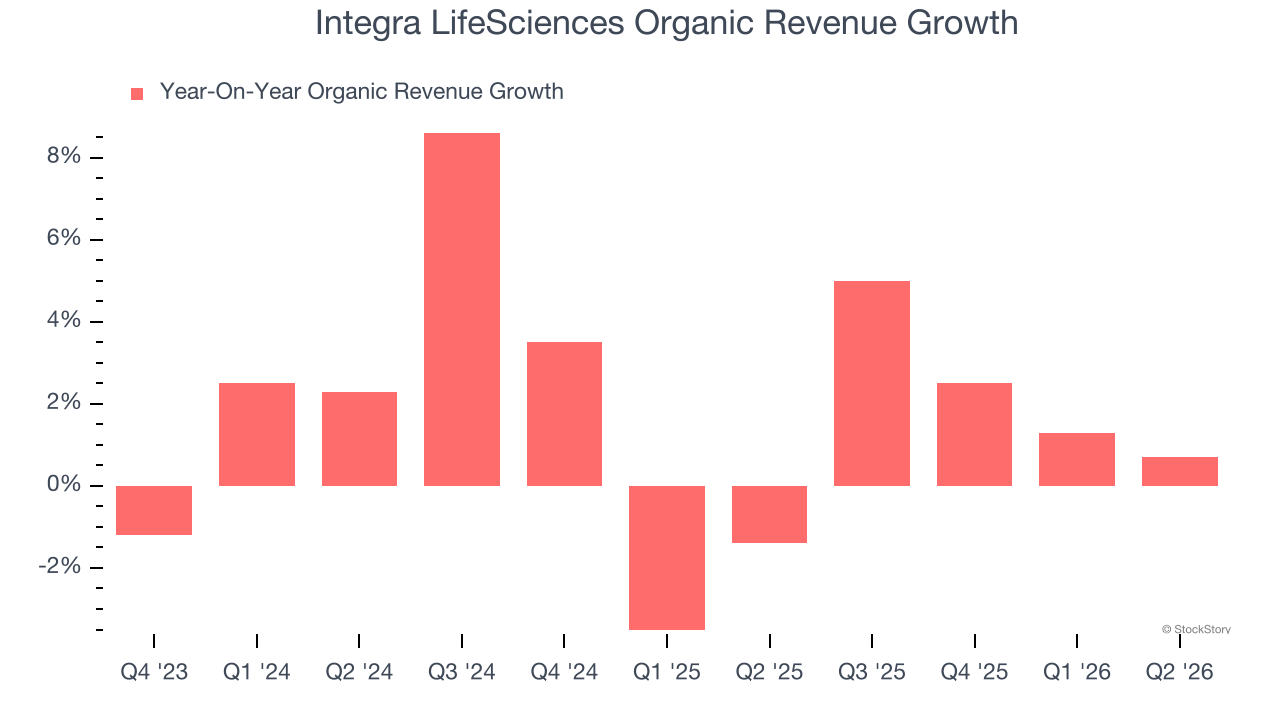
This quarter, Integra LifeSciences’s $418.8 million of revenue was flat year on year and in line with Wall Street’s estimates. Company management is currently guiding for a 3.8% year-on-year increase in sales next quarter.
Looking further ahead, sell-side analysts expect revenue to grow 3.3% over the next 12 months, similar to its two-year rate. This projection is underwhelming and suggests its newer products and services will not accelerate its top-line performance yet.
ONE MORE THING: 3 Hidden Platforms Growing 3X Faster than Amazon, Google, and PayPal. Amazon, Google, and Meta all followed the same playbook: Dominate an ignored market. Build an unbeatable moat. Scale until you’re unstoppable.
These three platforms are running that exact playbook right now. The early investors in Amazon made fortunes. The early investors in these could do the same. Get All 3 Stocks Here for FREE.
Adjusted Operating Margin
Integra LifeSciences has managed its cost base well over the last five years. It demonstrated solid profitability for a healthcare business, producing an average adjusted operating margin of 19.2%.
Analyzing the trend in its profitability, Integra LifeSciences’s adjusted operating margin decreased by 8.5 percentage points over the last five years. The company’s two-year trajectory also shows it failed to get its profitability back to the peak as its margin fell by 4.6 percentage points. This performance was poor no matter how you look at it - it shows its expenses were rising and it couldn’t pass those costs onto its customers.
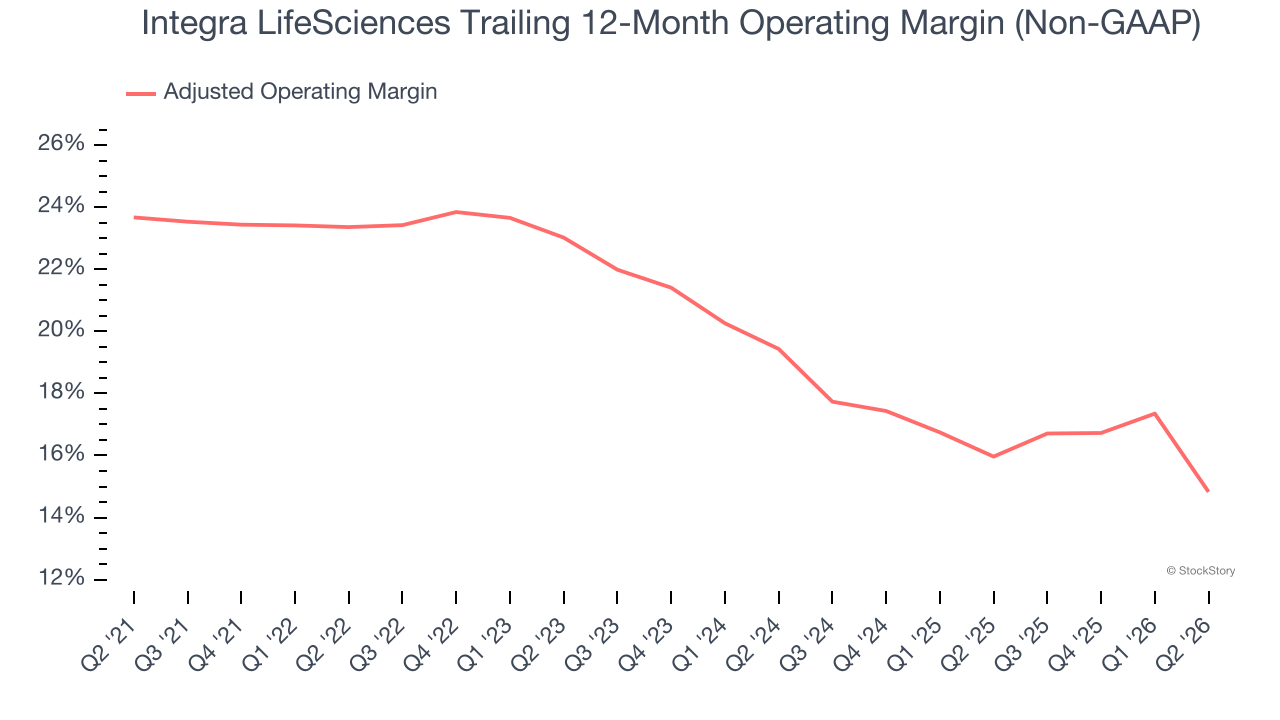
This quarter, Integra LifeSciences generated an adjusted operating margin profit margin of 4.6%, down 9.9 percentage points year on year. This contraction shows it was less efficient because its expenses increased relative to its revenue.
Earnings Per Share
Revenue trends explain a company’s historical growth, but the long-term change in earnings per share (EPS) points to the profitability of that growth — for example, a company could inflate its sales through excessive spending on advertising and promotions.
Sadly for Integra LifeSciences, its EPS declined by 4.6% annually over the last five years while its revenue grew by 1.8%. This tells us the company became less profitable on a per-share basis as it expanded due to non-fundamental factors such as interest expenses and taxes.
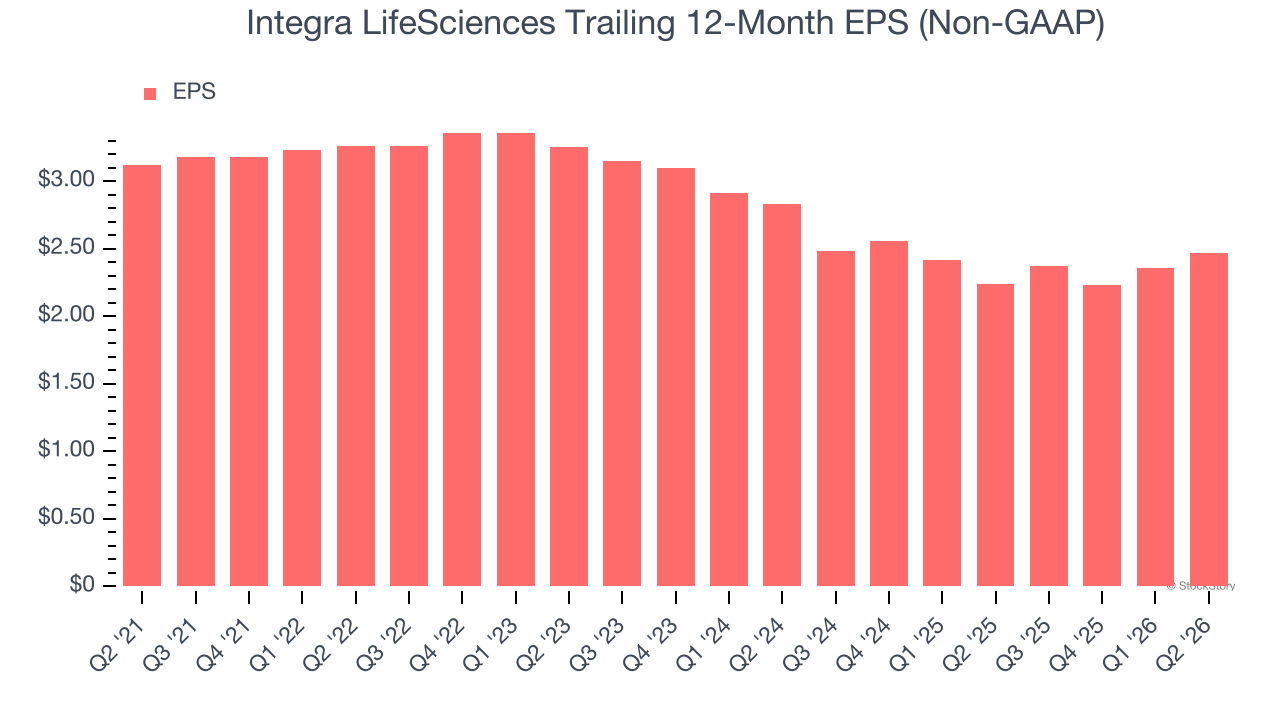
Diving into the nuances of Integra LifeSciences’s earnings can give us a better understanding of its performance. As we mentioned earlier, Integra LifeSciences’s adjusted operating margin declined by 8.5 percentage points over the last five years. This was the most relevant factor (aside from the revenue impact) behind its lower earnings; interest expenses and taxes can also affect EPS but don’t tell us as much about a company’s fundamentals.
In Q2, Integra LifeSciences reported adjusted EPS of $0.56, up from $0.45 in the same quarter last year. This print easily cleared analysts’ estimates, and shareholders should be content with the results. Over the next 12 months, Wall Street expects Integra LifeSciences’s full-year EPS to grow 5.9% from $2.47 to $2.61.
Key Takeaways from Integra LifeSciences’s Q2 Results
It was good to see Integra LifeSciences beat analysts’ EPS expectations this quarter. We were also happy its EPS guidance for next quarter outperformed Wall Street’s estimates. On the other hand, its revenue guidance for next quarter was in line. Overall, this print had some key positives. The stock remained flat at $19.75 immediately after reporting.
Is Integra LifeSciences an attractive investment opportunity at the current price? What happened in the latest quarter matters, but not as much as longer-term business quality and valuation, when deciding whether to invest in this stock. We cover that in our actionable full research report which you can read here (it’s free).