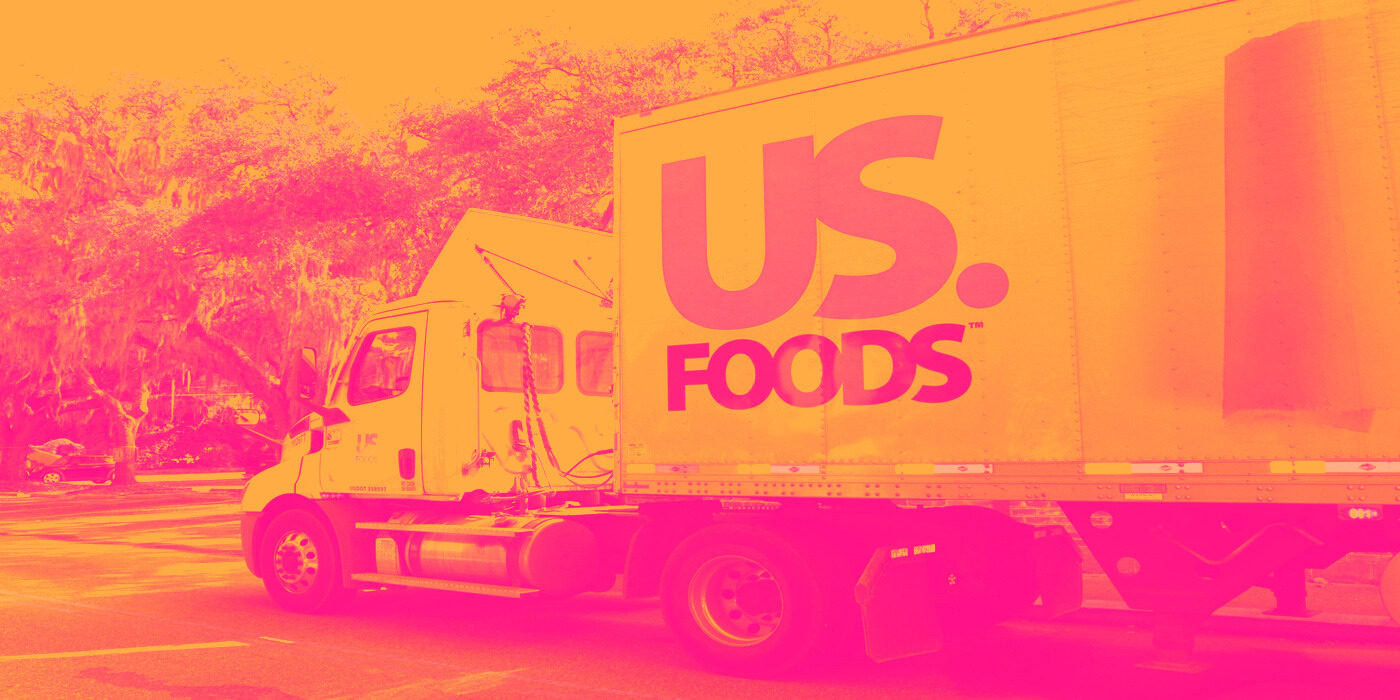
US Foods' first quarter saw a negative market response as both revenue and non-GAAP earnings per share missed Wall Street expectations. Management attributed the underperformance to external factors, notably severe winter weather and heightened fuel costs, which led to nearly double the distribution center closure days compared to last year. CEO David E. Flitman described the period as one of "significant weather-related challenges and increased macro uncertainty," emphasizing that these headwinds pressured both sales volumes and operational productivity. Despite these issues, US Foods continued to expand market share with independent restaurants and health care customers, supported by digital initiatives and ongoing operational improvements.
Is now the time to buy USFD? Find out in our full research report (it’s free for active Edge members).
US Foods (USFD) Q1 CY2026 Highlights:
- Revenue: $9.61 billion vs analyst estimates of $9.66 billion (2.8% year-on-year growth, 0.5% miss)
- Adjusted EPS: $0.78 vs analyst expectations of $0.81 (3.6% miss)
- Adjusted EBITDA: $413 million vs analyst estimates of $423.8 million (4.3% margin, 2.5% miss)
- Operating Margin: 2.2%, in line with the same quarter last year
- Sales Volumes rose 1.4% year on year, in line with the same quarter last year
- Market Capitalization: $18.75 billion
While we enjoy listening to the management's commentary, our favorite part of earnings calls are the analyst questions. Those are unscripted and can often highlight topics that management teams would rather avoid or topics where the answer is complicated. Here is what has caught our attention.
Our Top 5 Analyst Questions From US Foods’s Q1 Earnings Call
- Jeffrey Andrew Bernstein (Barclays) questioned the impact of fuel prices on both profitability and customer demand. CEO David E. Flitman emphasized the industry’s resilience and pointed to continued share gains despite macro and fuel pressures.
- Edward Joseph Kelly (Wells Fargo) sought clarity on guidance drivers and the influence of fuel and traffic trends. CFO Dirk J. Locascio specified that sustained high fuel prices and weak macro trends would steer results toward the lower end of guidance.
- Lauren Danielle Silberman (Deutsche Bank) asked about the split between weather and fuel impacts on expenses. Locascio detailed that both contributed equally, while surcharges cover a portion of fuel costs but lag real-time increases.
- John Edward Heinbockel (Guggenheim) probed wallet penetration and compensation changes. Flitman cited improvements in lines per customer and shared optimism about the new commission structure’s long-term benefits.
- Alexander Russell Slagle (Jefferies) inquired about the Signature program’s potential to boost hospitality segment growth. Flitman positioned Signature as a key catalyst, analogizing its value to the Vitals program in health care.
Catalysts in Upcoming Quarters
Looking ahead, the StockStory team will be monitoring (1) the effect of fuel prices and macro sentiment on case volume growth, (2) early signs of impact from the new variable sales compensation structure, and (3) the adoption and productivity benefits from AI-powered tools like MenuIQ and the UMOS platform. Progress on expanding the Pronto delivery service and continued gains in private label penetration will also be critical markers of execution.
US Foods currently trades at $85.17, down from $92.05 just before the earnings. Is the company at an inflection point that warrants a buy or sell? Find out in our full research report (it’s free).
High-Quality Stocks for All Market Conditions
ONE MORE THING: Top 5 Growth Stocks. The biggest stock winners almost always had one thing in common before they ran. Revenue growing like crazy. Meta. CrowdStrike. Broadcom. Our AI flagged all three. They returned 315%, 314%, and 455%, respectively.
Find out which 5 stocks it's flagging for this month - FREE. Get Our Top 5 Growth Stocks for Free HERE.
Stocks that have made our list include now familiar names such as Nvidia (+1,326% between June 2020 and June 2025) as well as under-the-radar businesses like the once-small-cap company Comfort Systems (+782% five-year return). Find your next big winner with StockStory today.