Oil and gas producer ConocoPhillips (NYSE: COP) reported Q1 CY2026 results beating Wall Street’s revenue expectations, but sales fell by 6.1% year on year to $16.05 billion. Its GAAP profit of $1.78 per share was 4.9% above analysts’ consensus estimates.
Is now the time to buy ConocoPhillips? Find out by accessing our full research report, it’s free.
ConocoPhillips (COP) Q1 CY2026 Highlights:
- Revenue: $16.05 billion vs analyst estimates of $14.33 billion (6.1% year-on-year decline, 12.1% beat)
- EPS (GAAP): $1.78 vs analyst estimates of $1.70 (4.9% beat)
- Free Cash Flow Margin: 8.4%, down from 16% in the same quarter last year
- Oil production: down -4.7% year on year
- Market Capitalization: $156.3 billion
Company Overview
Operating the famous Prudhoe Bay field discovered in 1968 that transformed Alaska's economy, ConocoPhillips (NYSE: COP) explores for and produces crude oil, natural gas, and liquefied natural gas across North America, Europe, Asia, and Africa.
Revenue Growth
Cyclical industries such as Energy can make mediocre companies look great for a time, but a long-term view reveals which businesses can actually withstand and adapt to changing conditions. Over the last five years, ConocoPhillips grew its sales at an excellent 19.3% compounded annual growth rate. Its growth surpassed the average energy upstream and integrated energy company and shows its offerings resonate with customers, a great starting point for our analysis.
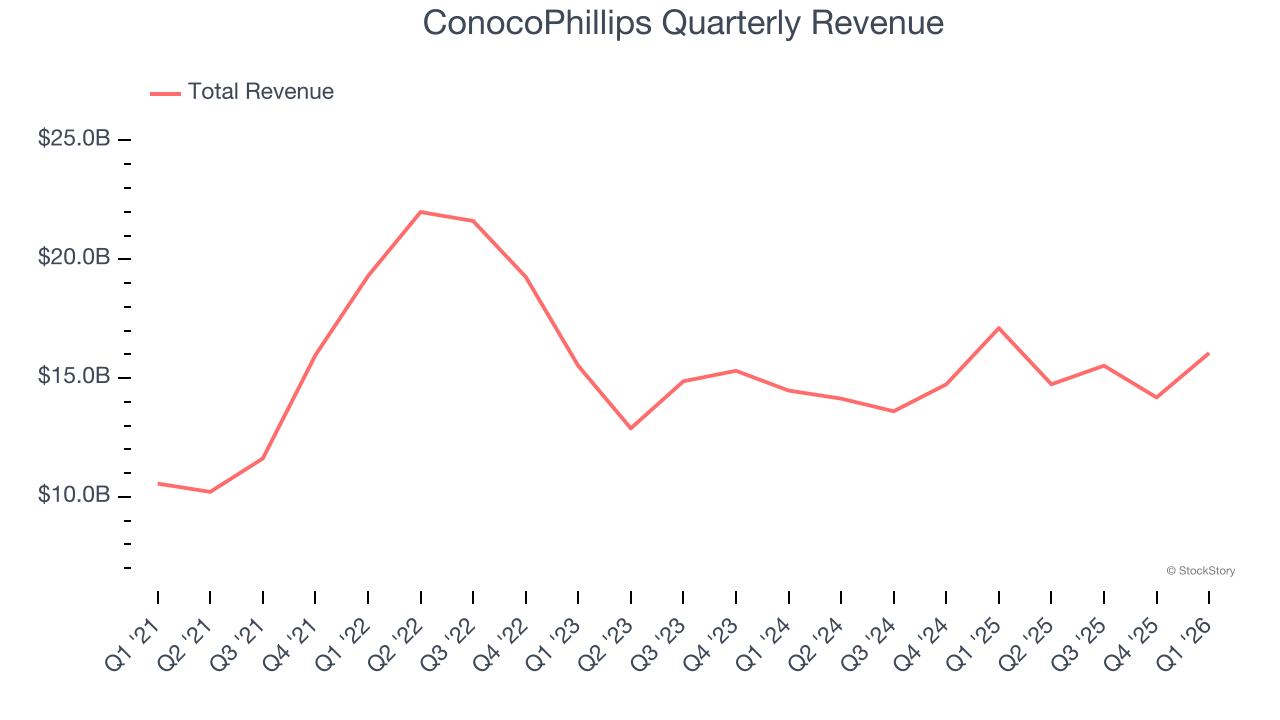
Even a long stretch in Energy can be shaped by a single commodity cycle, so extending the view to ten years adds another perspective and reveals which companies are built to grow regardless of the pricing regime. ConocoPhillips’s annualized revenue growth of 8% over the last ten years is below its five-year trend, but we still think the results suggest decent demand.
Revenue provides useful context, but it is heavily influenced by commodity prices and acquisitions. Production volumes, by contrast, reveal whether the underlying asset base is actually growing. Over the last two years, ConocoPhillips’s oil production averaged 10.3% year-on-year growth while its natural gas production averaged 12.9% year-on-year growth. 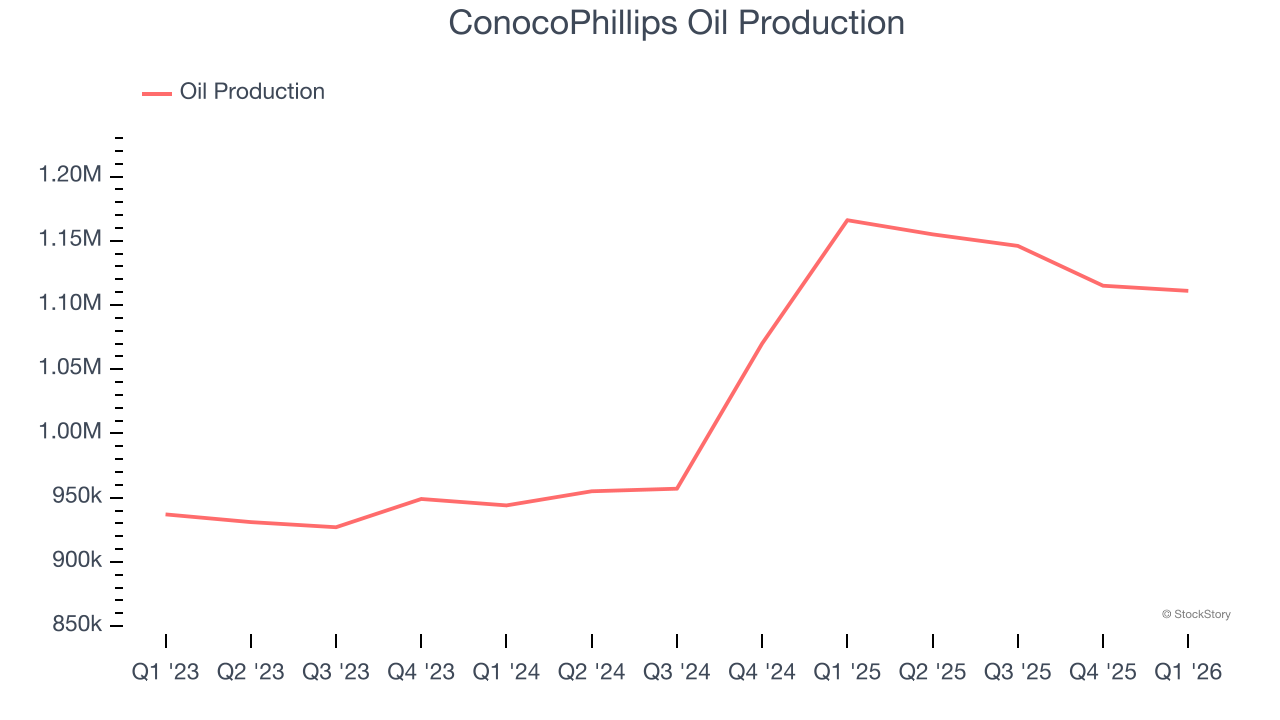
This quarter, ConocoPhillips’s revenue fell by 6.1% year on year to $16.05 billion but beat Wall Street’s estimates by 12.1%. This quarter, ConocoPhillips’s Oil production fell by 4.7% year on year.
ALSO WORTH WATCHING: Nvidia’s Quiet Partner. Nvidia’s chips cost a hundred grand. The connectors that make them work cost even more. One company makes them all.
Every AI server needs specialized infrastructure the chip companies don’t make. High-speed cables. Power connectors. Thermal sensors. This 90-year-old company built a monopoly on it. The AI boom just started. This stock is still flying under the radar. Claim The Stock Ticker Here for FREE.
Adjusted EBITDA Margin
Adjusted EBITDA margin strips out accounting distortions tied to depletion and historical drilling spend, providing a clearer view of the cash-generating power of the underlying asset base before financing and reinvestment decisions.
ConocoPhillips has managed its cost base well over the last five years. It demonstrated solid profitability for an upstream and integrated energy business, producing an average EBITDA margin of 43.1%.
Analyzing the trend in its profitability, ConocoPhillips’s EBITDA margin decreased by 5.3 percentage points over the last year. This raises questions about the company’s expense base because its revenue growth should have given it leverage on its fixed costs, resulting in better economies of scale and profitability.
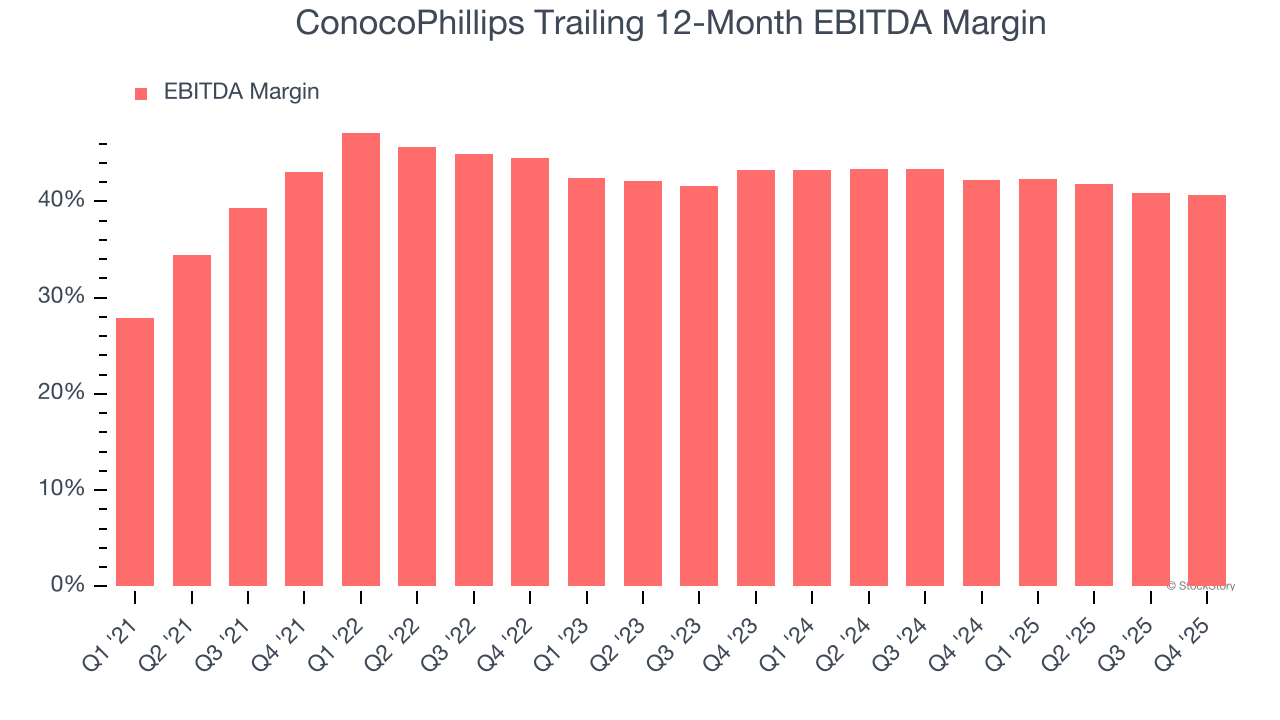
in line with the same quarter last year. This indicates the company’s overall cost structure has been relatively stable.
Cash Is King
As mentioned above, adjusted EBITDA ignores capital structure and drilling expenditure decisions. These are two huge aspects of an Energy producer, so in order to understand a comprehensive picture of business quality, an investor needs to account for these. Said differently, adjusted EBITDA margins could be solid but free cash flow is abysmal because decline rates of the asset are extreme and the drilling is expensive. Free cash flow tells you about not only the economics of the production that has happened but how much it costs to stay in business as well (further drilling or extraction).
ConocoPhillips has shown robust cash profitability, giving it an edge over its competitors and the ability to reinvest or return capital to investors. The company’s free cash flow margin averaged 17.3% over the last five years, quite impressive for an upstream and integrated energy business.
While the level of free cash flow margins is important, their consistency matters just as much.
ConocoPhillips’s ratio of quarterly free cash flow volatility to WTI Crude price volatility over the past five years was 3.8 (lower is better), indicating unusually strong insulation from commodity swings. This stability supports superior capital access in downturns and positions ConocoPhillips to act as a consolidator when weaker peers are forced to retrench.
You may be asking why we wait until the free cash flow line to perform this stability analysis versus commodity prices. Why not compare revenue or EBITDA to WTI in the case of ConocoPhillips? Because what ultimately matters is not how much revenue or profit you earn when prices are high but how much cash you can generate when prices are low. Free cash flow is the superior metric because it includes everything from hedging prowess to growth and maintenance capex to management behavior during good times and bad.
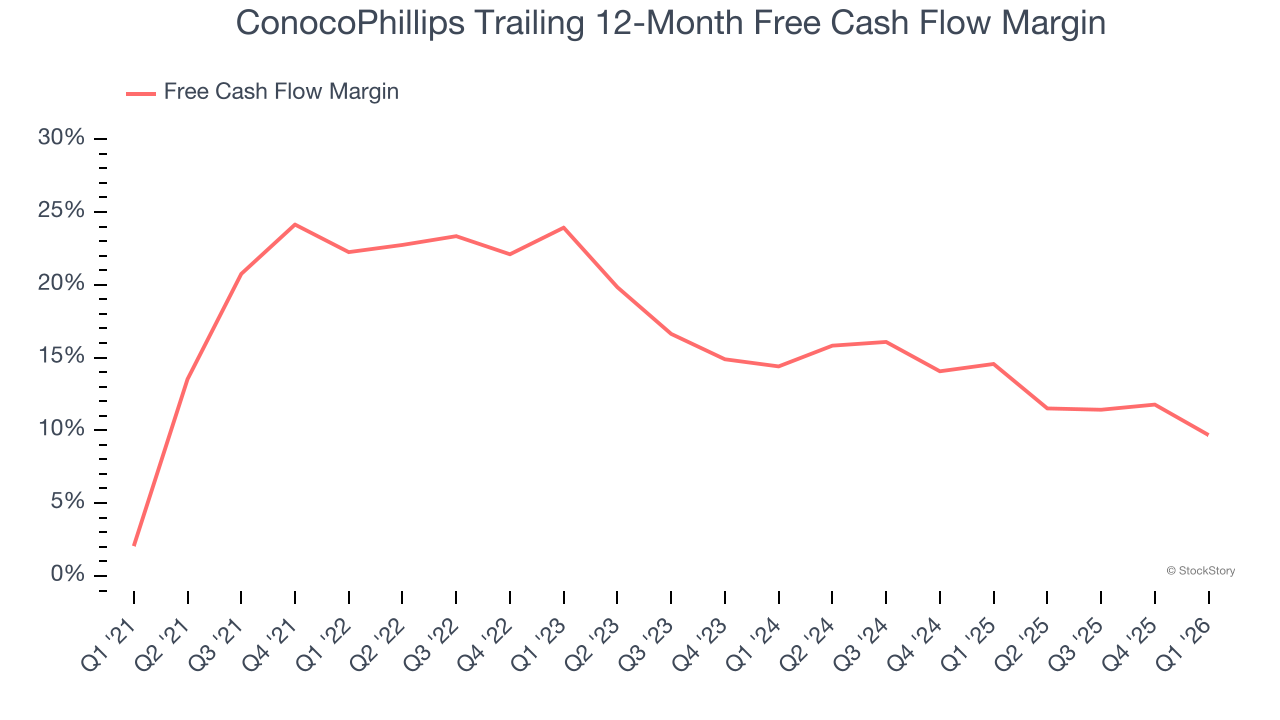
ConocoPhillips’s free cash flow clocked in at $1.35 billion in Q1, equivalent to a 8.4% margin. The company’s cash profitability regressed as it was 7.6 percentage points lower than in the same quarter last year, which isn’t ideal considering its longer-term trend.
Key Takeaways from ConocoPhillips’s Q1 Results
We were impressed by how significantly ConocoPhillips blew past analysts’ revenue expectations this quarter. We were also glad its EPS outperformed Wall Street’s estimates. Zooming out, we think this was a good print with some key areas of upside. The market seemed to be hoping for more, and the stock traded down 3.8% to $123.41 immediately following the results.
So do we think ConocoPhillips is an attractive buy at the current price? When making that decision, it’s important to consider its valuation, business qualities, as well as what has happened in the latest quarter. We cover that in our actionable full research report which you can read here (it’s free).