Financial services giant State Street (NYSE: STT) reported revenue ahead of Wall Street’s expectations in Q1 CY2026, with sales up 15.6% year on year to $3.80 billion. Its non-GAAP profit of $2.84 per share was 7.5% above analysts’ consensus estimates.
Is now the time to buy State Street? Find out by accessing our full research report, it’s free.
State Street (STT) Q1 CY2026 Highlights:
- Assets Under Management: $5.62 trillion vs analyst estimates of $5.78 trillion (20.5% year-on-year growth, 2.7% miss)
- Revenue: $3.80 billion vs analyst estimates of $3.68 billion (15.6% year-on-year growth, 3.3% beat)
- Pre-tax Profit: $969 million (25.5% margin)
- Adjusted EPS: $2.84 vs analyst estimates of $2.64 (7.5% beat)
- Market Capitalization: $39.31 billion
Company Overview
Dating back to 1792 when Boston's Long Wharf was the center of global shipping and trade, State Street (NYSE: STT) provides custody, investment management, and other financial services to institutional investors like pension funds, asset managers, and central banks worldwide.
Revenue Growth
A company’s long-term sales performance is one signal of its overall quality. Any business can have short-term success, but a top-tier one grows for years. Regrettably, State Street’s revenue grew at a tepid 4.6% compounded annual growth rate over the last five years. This fell short of our benchmark for the financials sector and is a tough starting point for our analysis.
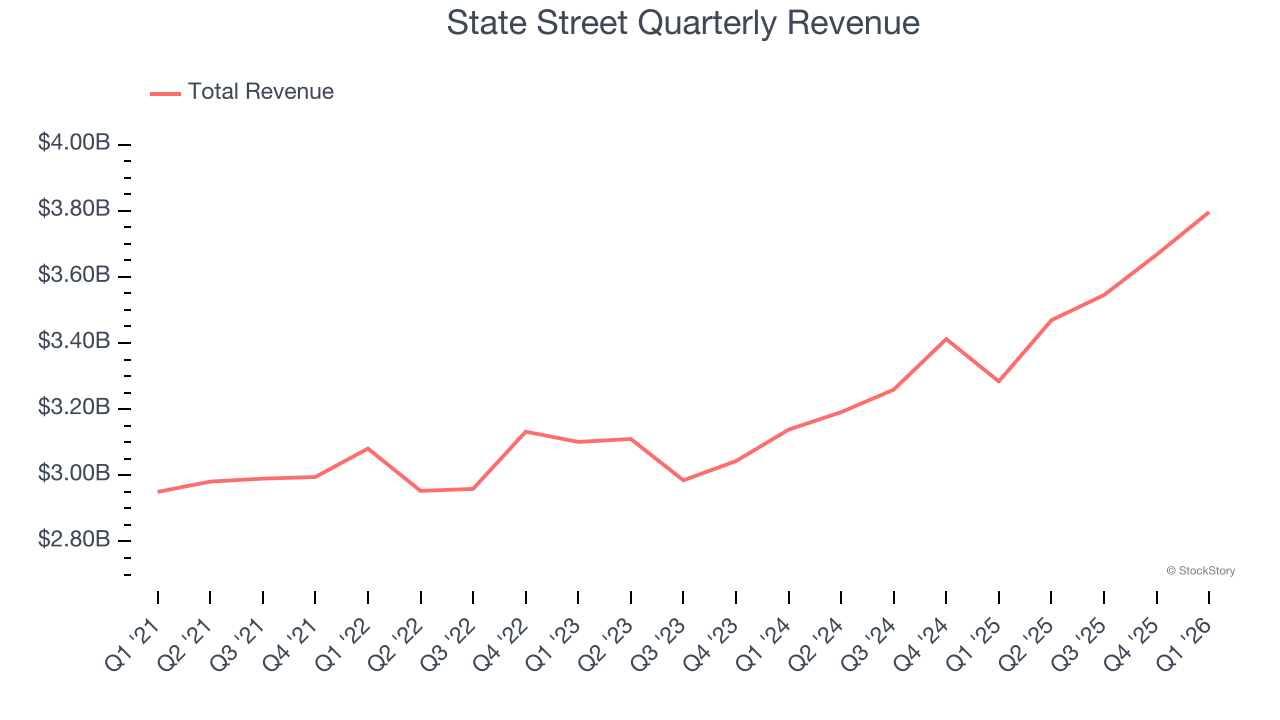
Long-term growth is the most important, but within financials, a half-decade historical view may miss recent interest rate changes and market returns. State Street’s annualized revenue growth of 8.6% over the last two years is above its five-year trend, suggesting some bright spots. 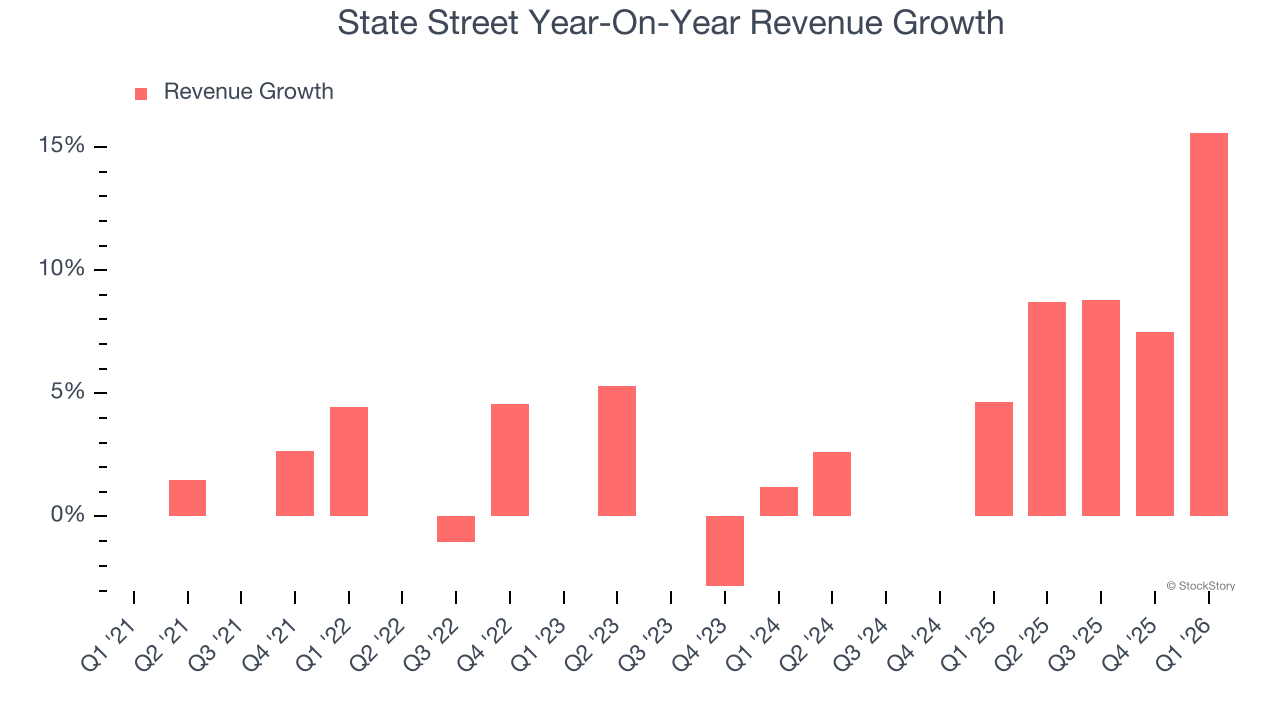 Note: Quarters not shown were determined to be outliers, impacted by outsized investment gains/losses that are not indicative of the recurring fundamentals of the business.
This quarter, State Street reported year-on-year revenue growth of 15.6%, and its $3.80 billion of revenue exceeded Wall Street’s estimates by 3.3%.
ALSO WORTH WATCHING: Nvidia’s Quiet Partner. Nvidia’s chips cost a hundred grand. The connectors that make them work cost even more. One company makes them all.
Every AI server needs specialized infrastructure the chip companies don’t make. High-speed cables. Power connectors. Thermal sensors. This 90-year-old company built a monopoly on it. The AI boom just started. This stock is still flying under the radar. Claim The Stock Ticker Here for FREE.
Assets Under Management (AUM)
Assets Under Management (AUM) is the cornerstone of a financial firm's investment division, representing all client capital under its stewardship. Management fees on this AUM create reliable, recurring revenue that maintains stability even when investment performance struggles, though prolonged poor returns can eventually affect asset retention and growth.
State Street’s AUM has grown at an annual rate of 10.5% over the last five years, slightly better than the broader financials industry and faster than its total revenue. When analyzing State Street’s AUM over the last two years, we can see that growth accelerated to 17.1% annually. Fundraising or short-term investment performance were net contributors for the company over this shorter period since assets grew faster than total revenue. Keep in mind that asset growth can be erratic and seasonal, so we don't rely on it too heavily for our business quality analysis.
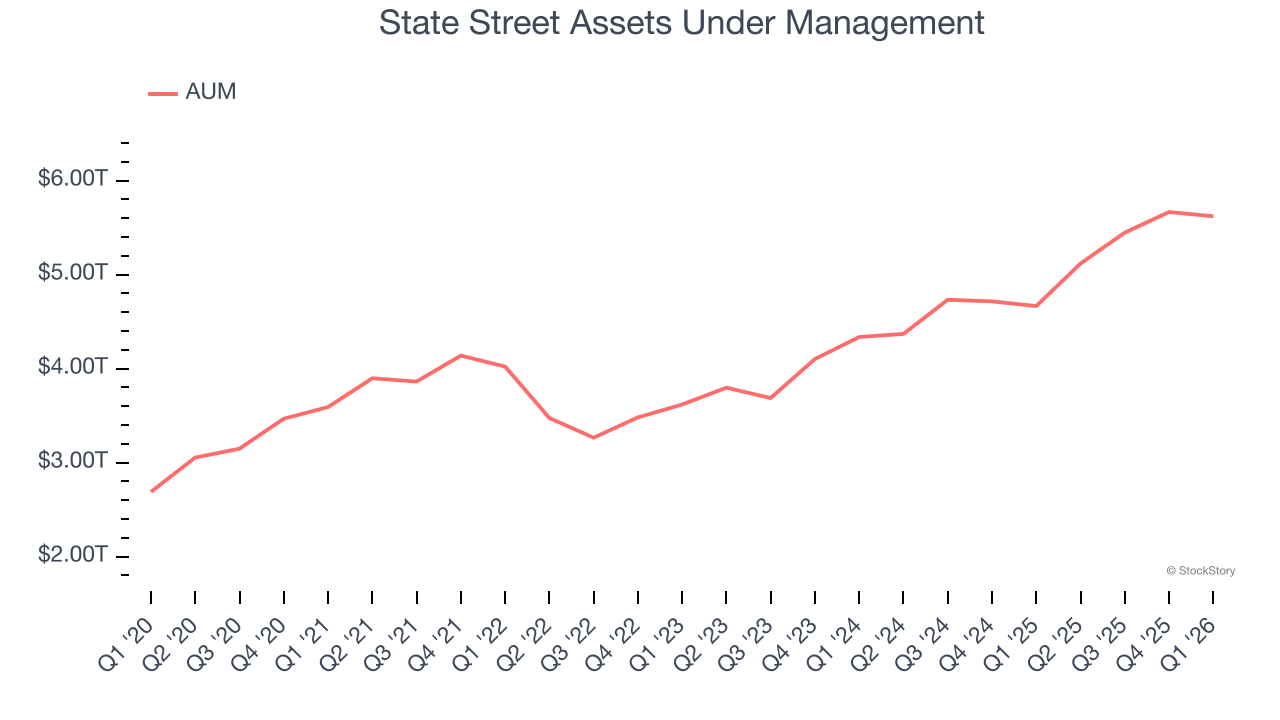
State Street’s AUM punched in at $5.62 trillion this quarter, falling 2.7% short of analysts’ expectations. This print was 20.5% higher than the same quarter last year.
Key Takeaways from State Street’s Q1 Results
It was encouraging to see State Street beat analysts’ revenue expectations this quarter. We were also glad its EPS outperformed Wall Street’s estimates. On the other hand, its AUM missed. Overall, we think this was a decent quarter with some key metrics above expectations. The stock traded up 2.1% to $144.92 immediately following the results.
Sure, State Street had a solid quarter, but if we look at the bigger picture, is this stock a buy? We think that the latest quarter is only one piece of the longer-term business quality puzzle. Quality, when combined with valuation, can help determine if the stock is a buy. We cover that in our actionable full research report which you can read here (it’s free).