Cloud storage company Dropbox (NASDAQ: DBX) reported Q3 2026 results topping the market’s revenue expectations, but revenue was flat year on year at $637.3 million. Its non-GAAP profit of $0.88 per share was 20.9% above analysts’ consensus estimates.
For more on Dropbox, read our full research report, available free.
Dropbox (DBX) Q3 2026 highlights:
- Revenue $637.3 million vs S&P analysts’ consensus estimates of $629.8 million (flat year on year, 1.2% beat)
- Adjusted EPS $0.88 vs S&P analysts’ consensus estimates of $0.73 (20.9% beat)
- Adjusted operating income $268.8 million vs analysts’ consensus estimates of $242.5 million (42.2% margin, 10.8% beat)
- Operating margin 27.5%, in line with the same quarter last year
- Free cash flow margin 39.5%, up from 37.2% in the previous quarter
- Annual recurring revenue $2.56 billion (flat year on year, beat)
- Billings $626.3 million at quarter end, in line with the same quarter last year
- Market capitalization $7.85 billion
“Q3 was another beat-and-raise quarter, with revenue growth excluding FormSwift and non-GAAP operating margin both ahead of our guidance, marking our fifth consecutive quarter of year-over-year revenue growth excluding FormSwift,” said Ashraf Alkarmi, co-Chief Executive Officer of Dropbox. “We’re executing on our strategy to become the trusted, independent content foundation for the AI era, and I’m excited about the opportunity in front of us. We’re making our customers’ content smarter and more useful by connecting Dropbox to the AI tools they already use. And with DBX Agent Cloud and our agreement to acquire Tigris, we’re putting the infrastructure we’ve built over nearly two decades to work for companies building AI applications, opening a new avenue for growth.”
Revenue growth
A company’s long-term performance is an indicator of its overall quality. Any business can deliver a good quarter or two, but the best consistently grow over the long haul. Over the last five years, Dropbox grew its revenue at a weak 3.9% compounded annual growth rate, falling short of the software sector standard.
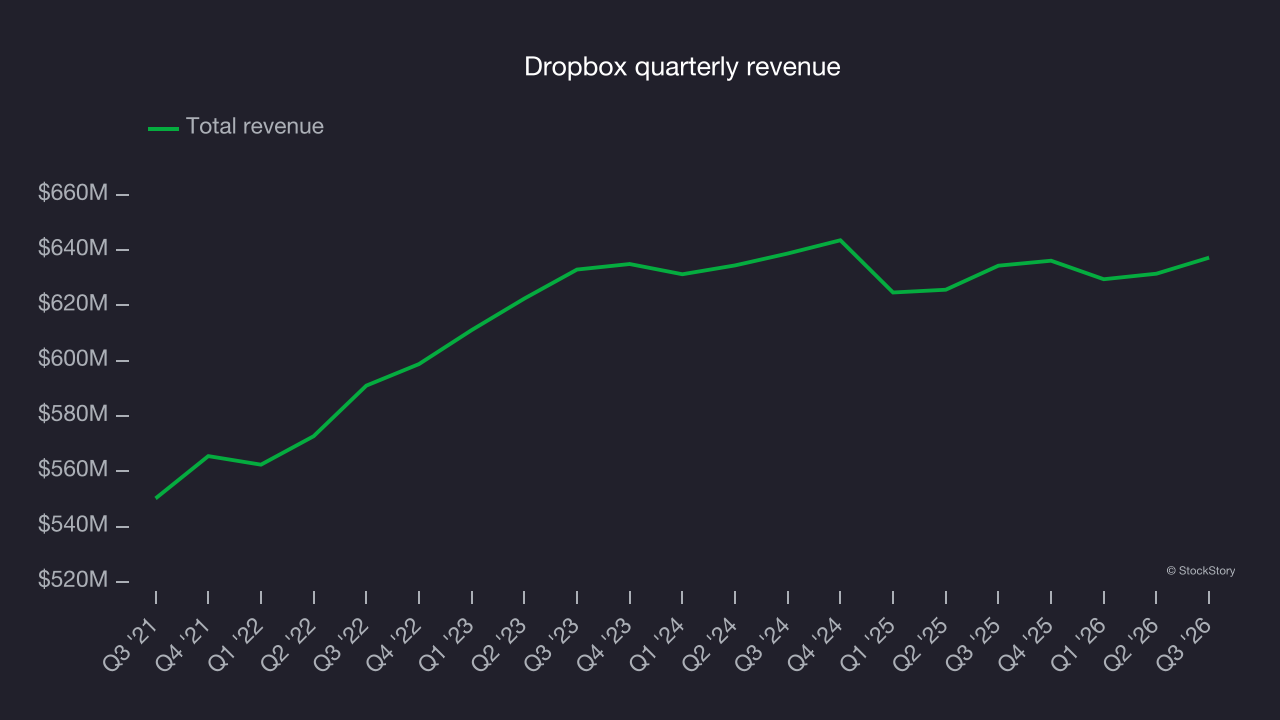
Long-term growth is the most important, but within software, a half-decade historical view may miss new innovations or demand cycles. Dropbox’s recent performance shows its demand has slowed as its revenue was flat over the last two years. 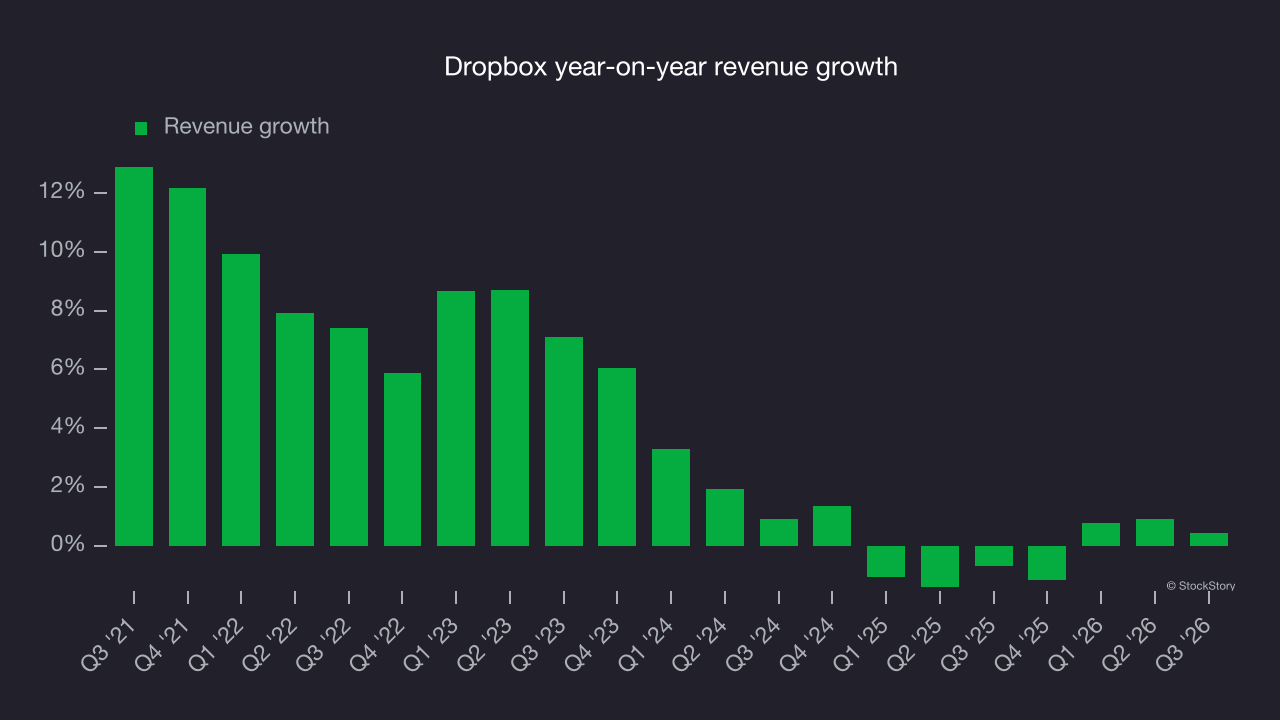
This quarter, Dropbox’s $637.3 million of revenue was flat year on year but beat Wall Street’s consensus estimates by 1.2%.
Looking ahead, sell-side analysts expect revenue to remain flat over the next 12 months, according to S&P. This projection is underwhelming and suggests its newer products and services will not lead to better top-line performance yet.
Annual recurring revenue
While reported revenue for a software company can include low-margin items like implementation fees, annual recurring revenue, or ARR, is the sum of the next 12 months of contracted revenue purely from software subscriptions – the high-margin, predictable revenue streams that underpin the value of software-as-a-service businesses.
Over the last year, Dropbox failed to grow its ARR, which came in at $2.56 billion in the latest quarter. This performance mirrored its total revenue, showing the company faced challenges in winning long-term deals and renewals. It also suggests there may be increasing competition or market saturation. 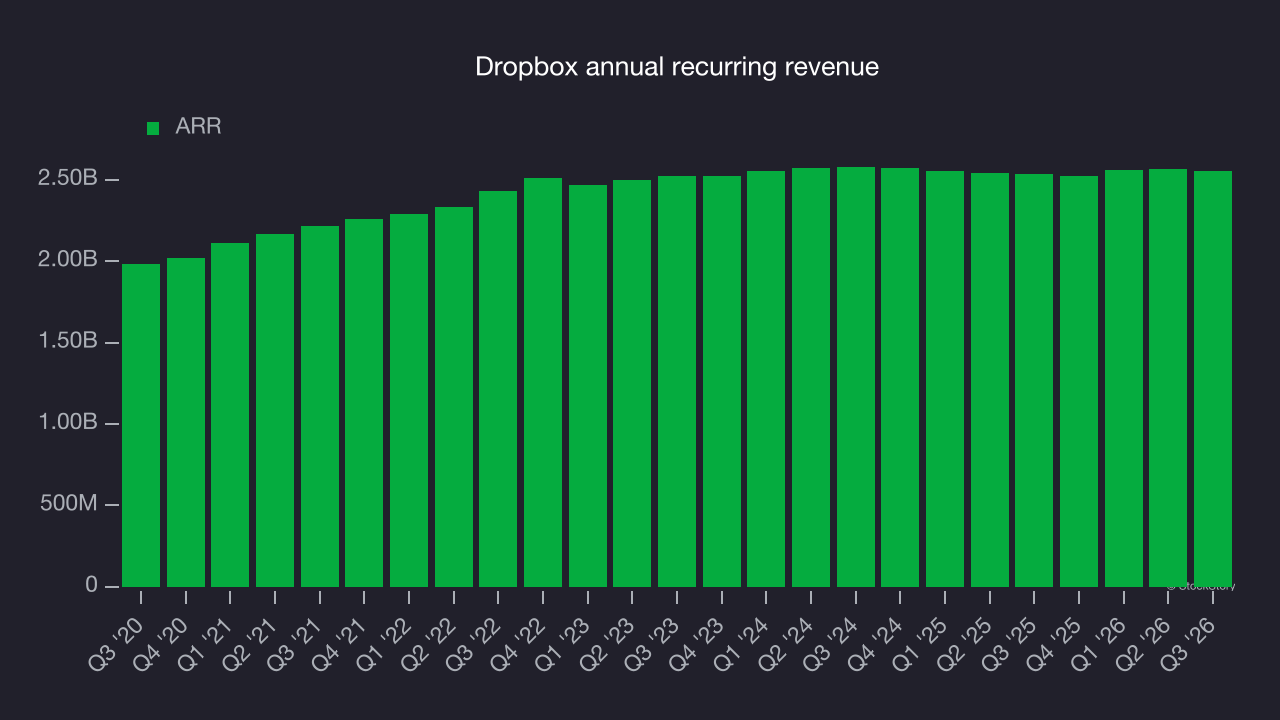
Customer acquisition efficiency
The customer acquisition cost, or CAC, payback period measures the months a company needs to recoup the money spent on acquiring a new customer. This metric helps assess how quickly a business can break even on its sales and marketing investments.
It’s relatively expensive for Dropbox to acquire new customers as its CAC payback period was 89.2 months this quarter. The company’s slow recovery of its sales and marketing expenses indicates it operates in a highly competitive market and must invest to stand out, even if the return on that investment is low.
Key takeaways from Dropbox’s Q3 results
Dropbox’s adjusted operating income beat analysts’ consensus estimates by a wide margin in Q3, and annual recurring revenue also came in narrowly ahead of Wall Street’s consensus. Those beats made for a solid quarter, with shares rising 2.4% to $36.62 immediately after the report.
Dropbox had a solid quarter, but that alone doesn’t determine whether the stock is a buy. That decision should consider the bigger picture of valuation and business quality, as well as the latest earnings. For more on Dropbox, read the full research report here (it’s free).