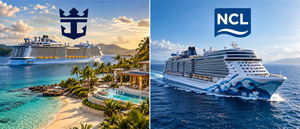
Cruise vacation company Royal Caribbean (NYSE: RCL) met Wall Street’s revenue expectations in Q3 2026, with sales up 8.8% year on year to $5.59 billion. Its non-GAAP profit of $6.57 per share was 3% above analysts’ consensus estimates.
Is now the time to buy RCL? Find out in our full research report (it’s free for active Edge members).
Royal Caribbean (RCL) Q3 2026 highlights:
- Revenue $5.59 billion vs S&P analysts’ estimates of $5.61 billion (8.8% year-on-year growth, in line)
- Adjusted EPS $6.57 vs S&P analysts’ estimates of $6.38 (3% beat)
- Adjusted EBITDA $2.54 billion vs analyst estimates of $2.46 billion (45.4% margin, 3.2% beat)
- Adjusted EPS guidance Management slightly raised its full-year adjusted EPS guidance to $17.90 at the midpoint
- Operating margin 33.5%, in line with the same quarter last year
- Passenger cruise days up 1.34 million year on year
- Market capitalization $79.79 billion
StockStory’s take
Royal Caribbean’s third quarter was marked by a positive market reaction as the company delivered results that aligned with Wall Street’s revenue expectations and outperformed on adjusted earnings per share. Management highlighted accelerating demand for cruise vacations, citing higher passenger cruise days and strong onboard spending, particularly in Europe and the Caribbean. CEO Jason Liberty attributed the success to a combination of increased capacity, high guest satisfaction, and effective use of technology and loyalty programs to deepen customer engagement. He stated, “Travel remains the number one leisure category where consumers intend to increase spending.”
Looking ahead, Royal Caribbean’s guidance is shaped by its expanded vacation ecosystem, including the pending investment in Sandals and Beaches Resorts and the ongoing integration of loyalty, technology, and data capabilities. Management emphasized the potential for cross-brand engagement to drive repeat travel and higher lifetime value, with Liberty noting, “We are building a portfolio that serves more of [our guests’] needs across more occasions.” CFO Naftali Holtz cautioned that while the contribution from the Sandals acquisition will be immaterial initially, synergies are expected to accumulate over time as the company leverages scale and operational experience.
Key insights from management’s remarks
Management pointed to strong onboard revenue, booking momentum, and strategic investments as key factors behind the quarter’s performance, while highlighting the Sandals and Beaches Resorts partnership as a new growth avenue.
- Onboard Revenue Momentum: Increased guest spending on experiences, amenities, and services during cruises, especially in European and Caribbean markets, drove stronger-than-expected yield growth. Management credited new ship launches and enhanced onboard offerings for this trend.
- Booking Acceleration: The company saw mid-teens year-over-year growth in booking volumes since the last earnings call, with future sailings for 2027 already pacing ahead of prior years. This reflects both high repeat rates and successful attraction of new-to-brand guests.
- Loyalty Ecosystem Expansion: Initiatives such as Status Match and the integration of rewards across brands deepened guest engagement. Management noted that cross-brand travelers are generating higher average per diems, signaling the effectiveness of these loyalty programs.
- Sandals and Beaches Resorts Investment: The pending acquisition of a 50% stake in Sandals and Beaches introduces Royal Caribbean to the fast-growing all-inclusive resort segment, providing strategic access to a broader share of guests’ vacation spending. Management clarified that the earnings impact for 2027 will be immaterial depending on the closing date, and that synergies are expected to accrue over time, not immediately.
- Operational Efficiency and Cost Control: Net cruise costs per available passenger cruise day (APCD), excluding fuel, decreased due to ongoing efficiency improvements and favorable timing of certain expenses. This supported margin performance despite elevated fuel and currency costs.
Drivers of future performance
Royal Caribbean’s outlook is underpinned by continued demand strength, new product integration, and disciplined cost management, while management acknowledges fuel and geopolitical risks.
- Integrated Vacation Platform: The addition of Sandals and Beaches Resorts is expected to deepen customer relationships, increase repeat travel, and raise the share of vacation spending captured. Management believes that linking cruise and resort offerings through loyalty and data will drive cross-selling opportunities and enhance overall margins over time.
- Capacity and Yield Growth: Moderate increases in cruise capacity, combined with ongoing yield improvements from new ships and destination offerings, are central to the company’s growth strategy. Management expects yield growth to be more pronounced in the second half of next year, with product mix and deployment timing as key variables.
- Cost and External Headwinds: While cost discipline remains a focus, management cited elevated fuel prices and currency fluctuations as ongoing risks. The company is increasing hedges to manage fuel exposure and expects further efficiency gains, but geopolitical events and macroeconomic volatility could impact future results.
Catalysts in upcoming quarters
Looking ahead, the StockStory team will be monitoring (1) the integration progress and early cross-selling impact of the pending Sandals and Beaches Resorts partnership, (2) continued momentum in advance bookings and the balance between new and repeat guests, and (3) cost discipline in the face of fuel and currency volatility. Additional signposts include the performance of new ships and destinations, and the expansion of the loyalty ecosystem across cruise and resort brands.
Royal Caribbean currently trades at $309.25, up from $280.67 just before the earnings. In the wake of this quarter, is it a buy or sell? The answer lies in our full research report (it’s free).
Stocks that trumped tariffs
ONE MORE THING: Top 6 Stocks for This Week. This market is separating quality stocks from expensive ones fast. AI is taking down whole sectors with no warning. In a rotation this fast, you need more than a list of good companies.
Our AI system flagged Palantir before it ran 1,662% between October 2022 and February 2026. AppLovin before it ran 753% between February 2024 and February 2026. Nvidia before it ran 1,178% between January 2023 and February 2026. Each week it produces 6 new names that pass the same tests. Get Our Top 6 Stocks for Free HERE.
Stocks that have made our list include now familiar names such as Nvidia (+1,460% between June 2020 and June 2025) as well as under-the-radar businesses like the once-micro-cap company Kadant (+214% between June 2020 and June 2025). Find your next big winner with StockStory today.