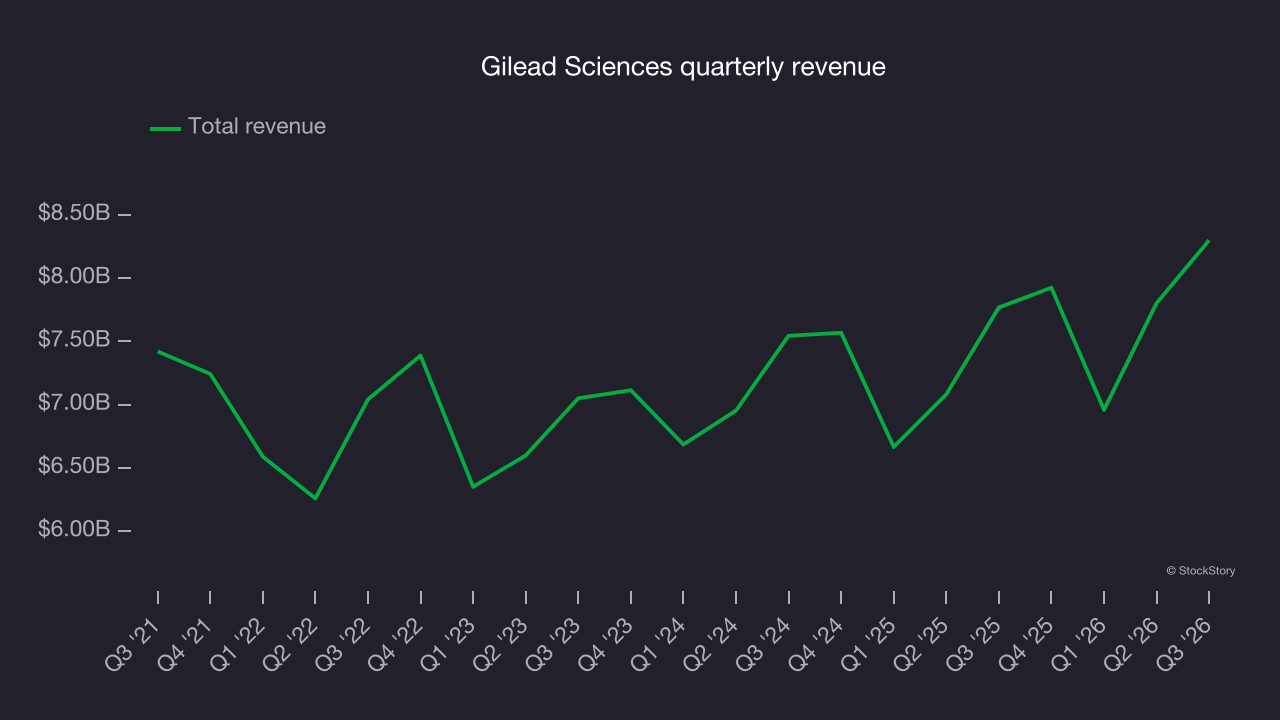
Biopharmaceutical company Gilead Sciences (NASDAQ: GILD) beat Wall Street’s revenue expectations in Q3 2026, with revenue up 6.8% year on year to $8.3 billion. The company’s full-year revenue guidance of $31.15 billion at the midpoint came in 1.3% above analysts’ consensus estimates. Its non-GAAP profit of $2.55 per share was 16.2% above analysts’ consensus estimates.
For more on Gilead Sciences, read our free full research report.
Gilead Sciences (GILD) Q3 2026 highlights:
- Revenue $8.3 billion vs S&P analysts’ consensus estimates of $7.81 billion (6.8% year-on-year growth, 6.3% beat)
- Adjusted EPS $2.55 vs S&P analysts’ consensus estimates of $2.19 (16.2% beat)
- Adjusted operating income $4.17 billion vs analysts’ consensus estimates of $3.70 billion (50.2% margin, 12.7% beat)
- Revenue guidance The company lifted its revenue guidance for the full year to $31.15 billion at the midpoint from $30.25 billion, a 3% increase
- Adjusted EPS guidance Management lowered its full-year adjusted EPS guidance to -$1.03 at the midpoint, a 116% decrease
- Operating margin 41.7%, down from 42.8% in the same quarter last year
- Free cash flow margin 57.8%, up from 51% in the same quarter last year
- Market capitalization $197.4 billion
“Gilead delivered an exceptional third quarter, with our strongest year-over-year base business growth in more than a decade, reflecting the strength, breadth and durability of our business,” said Daniel O’Day, Gilead’s Chairman and Chief Executive Officer. “Our performance enabled us to raise our full year base business revenue guidance again this quarter, bringing the total increase to $1.6 billion since the start of 2026. Our HIV business grew 18% and HIV prevention sales nearly doubled year-over-year. With multiple ongoing and potential launches across HIV and Oncology, important progress in Inflammation and a disciplined operating model, Gilead is well positioned for business growth and impact for patients.”
Revenue growth
Examining a company’s long-term performance can provide clues about its quality. Even a weak business can perform well for one or two quarters, but a high-quality one grows for years. Gilead Sciences’s revenue grew at a tepid 2.4% annualized rate over the last five years, falling short of our benchmarks.
Long-term growth matters most, but within healthcare, a half-decade historical view may miss recent innovations or disruptive industry trends. Gilead Sciences’s annualized revenue growth of 4.6% over the last two years is above its five-year trend, a positive sign. 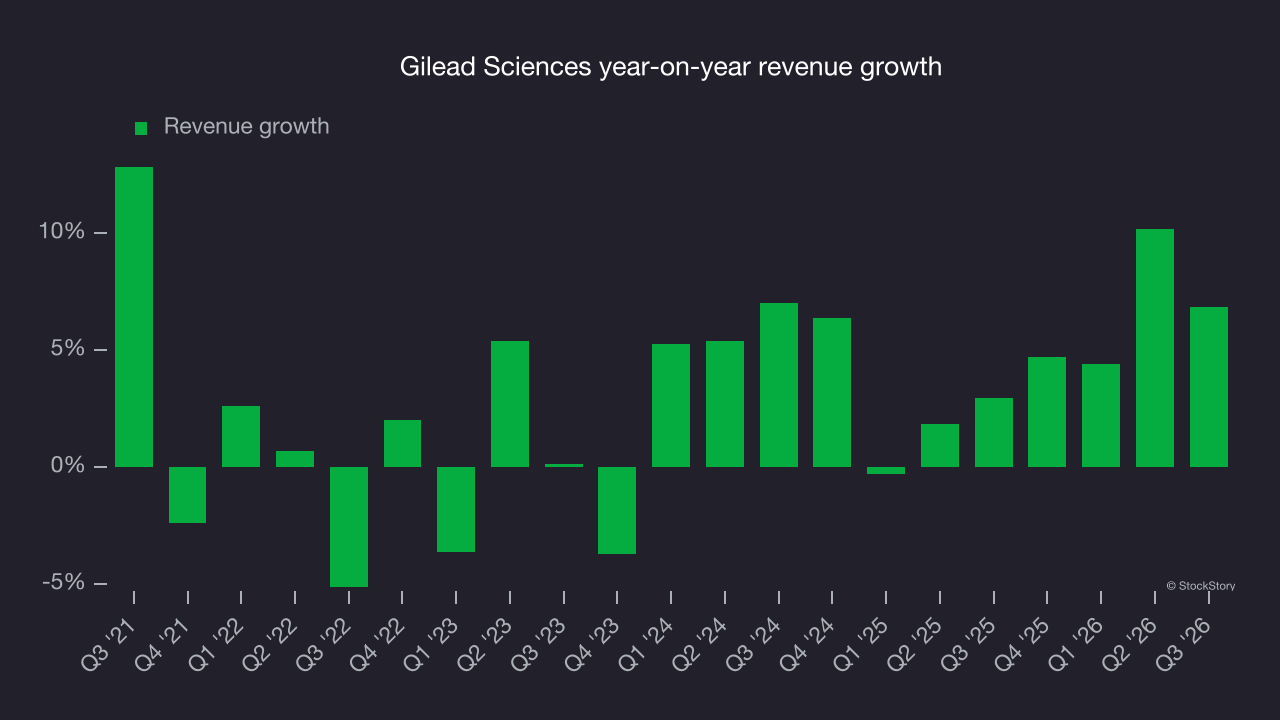
Analyzing HIV, the company’s most important segment, provides more insight into its revenue dynamics. Over the last two years, Gilead Sciences’s HIV revenue averaged 5.2% year-on-year growth. 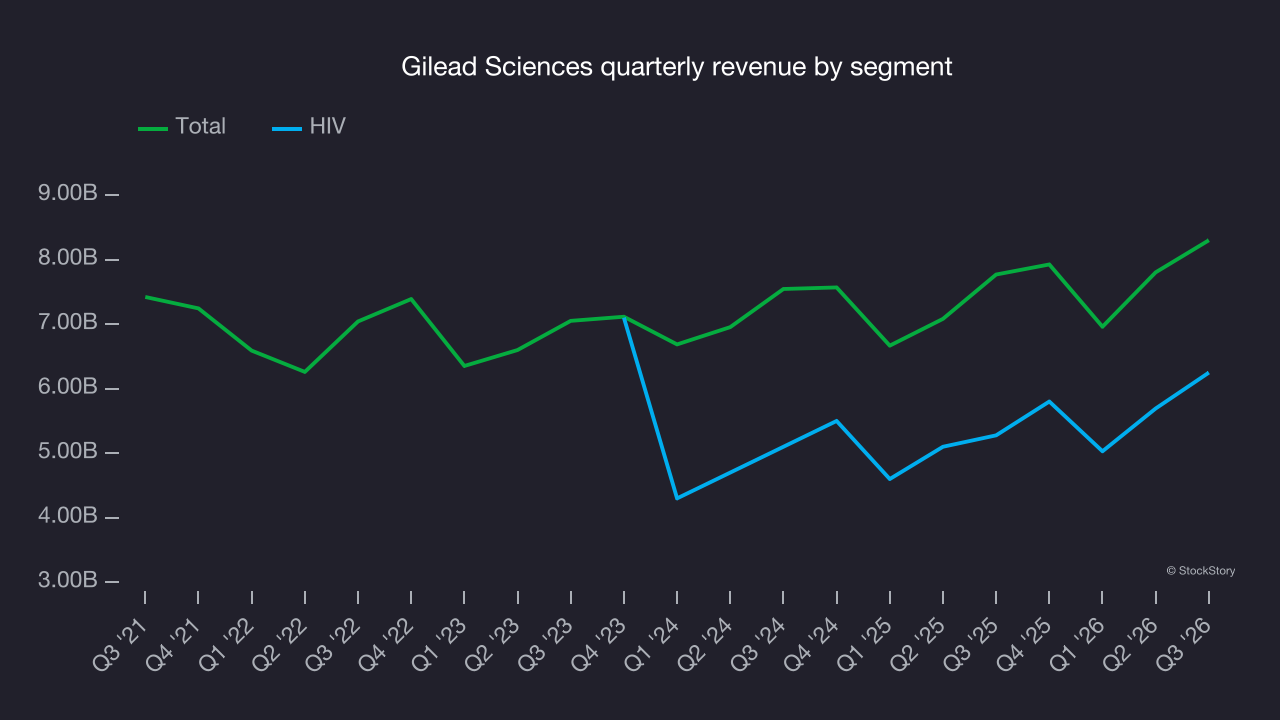
This quarter, Gilead Sciences reported year-on-year revenue growth of 6.8%, and its $8.3 billion of revenue exceeded Wall Street’s consensus estimates by 6.3%.
Looking ahead, sell-side analysts expect revenue to grow 3.1% over the next 12 months, according to S&P, a slight deceleration versus the last two years. This projection is underwhelming and suggests its products and services will see some demand headwinds.
Adjusted operating margin
Gilead Sciences has performed well over the last five years. It demonstrated strong profitability for a healthcare business, with an average adjusted operating margin of 32.2%.
Gilead Sciences’s adjusted operating margin decreased by 30.2 percentage points over the last five years. The company’s two-year trajectory also shows it failed to return profitability to its peak, as its margin fell by 18.5 percentage points. This poor performance shows its expenses were rising and it couldn’t pass those costs on to its customers.
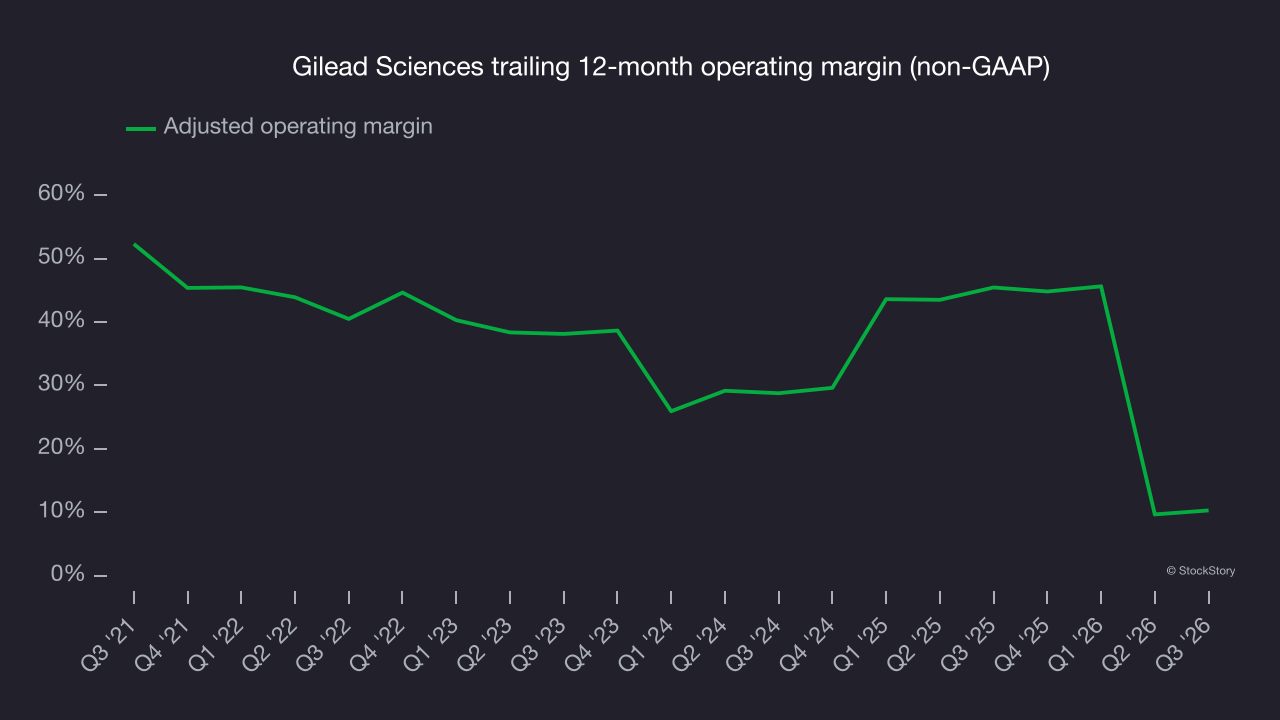
This quarter, Gilead Sciences generated an adjusted operating margin of 50.2%, in line with the same quarter last year. This indicates the company’s overall cost structure has been relatively stable.
Earnings per share
Revenue trends explain a company’s historical growth, but the long-term change in earnings per share (EPS) points to the profitability of that growth. For example, a company could inflate its revenue through excessive spending on advertising and promotions.
Gilead Sciences’s EPS declined by 15.3% annually over the last five years while its revenue grew by 2.4%. This tells us the company became less profitable on a per-share basis as it expanded.
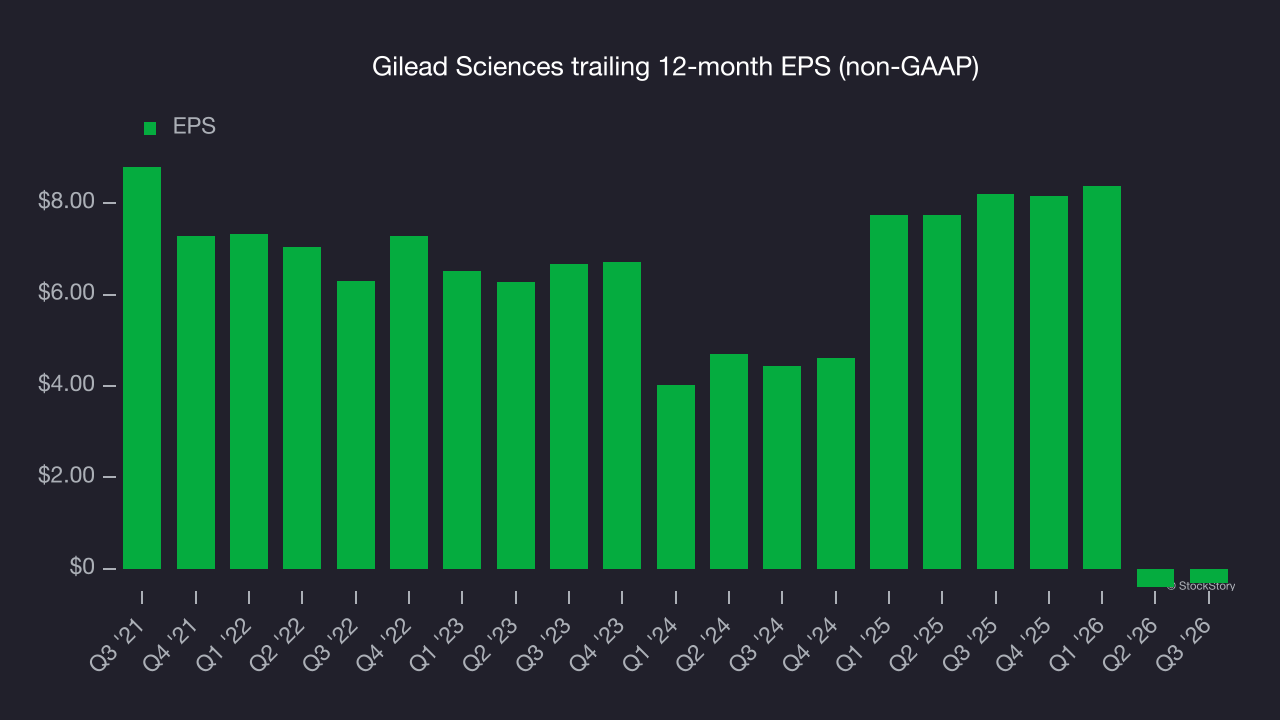
Diving into the nuances of Gilead Sciences’s earnings can give us a better understanding of its performance. As we mentioned earlier, Gilead Sciences’s adjusted operating margin was flat this quarter but declined by 30.2 percentage points over the last five years. This was the most relevant factor (aside from the revenue impact) behind its lower earnings; interest expenses and taxes can also affect EPS but don’t tell us as much about a company’s fundamentals.
In Q3, Gilead Sciences reported adjusted EPS of $2.55, up from $2.47 in the same quarter last year. This was well above analysts’ consensus estimates, a positive result for shareholders. Wall Street expects earnings to improve over the next 12 months. Analysts forecast Gilead Sciences’s full-year EPS will turn positive, rising from negative $0.31 to positive $9.14, according to S&P.
Key takeaways from Gilead Sciences’s Q3 results
Gilead Sciences delivered a sizable revenue beat and topped Wall Street’s EPS estimates in Q3, but its full-year EPS guidance fell short. The quarter had some key positives, led by revenue well above analysts’ consensus estimates. Shares rose 4.3% to $169 immediately after the report.
Gilead Sciences reported solid earnings, but one quarter doesn’t necessarily make the stock a buy. The latest quarter matters, but not nearly as much as longer-term fundamentals and valuation when deciding whether to buy the stock. For more on these factors, read the full research report here (it’s free).