Chicken producer Pilgrim’s Pride (NASDAQ: PPC) fell short of the market’s revenue expectations in Q3 2026, with revenue falling 2.2% year on year to $4.65 billion. Its non-GAAP profit of $0.49 per share was 9.7% below analysts’ consensus estimates.
For more on Pilgrim's Pride, read our full research report, available free.
Pilgrim's Pride (PPC) Q3 2026 highlights:
- Revenue $4.65 billion vs S&P analysts’ consensus estimates of $4.69 billion (2.2% year-on-year decline, 0.8% miss)
- Adjusted EPS $0.49 vs S&P analysts’ consensus estimates of $0.54 (9.7% miss)
- Adjusted EBITDA $316.3 million vs analysts’ consensus estimates of $340.3 million (6.8% margin, 7.1% miss)
- Operating margin 4.1%, down from 10.4% in the same quarter last year
- Free cash flow -$4.54 million, down from $276.5 million in the same quarter last year
- Market capitalization $6.45 billion
“During the quarter, our differentiated portfolio of chicken products continued to experience strong demand as affordability and convenience continues to be priority among consumers across all regions,” said Fabio Sandri, Pilgrim’s President and CEO. “We remain focused on our investments and strategies to drive profitable growth and adapt our portfolio to changing conditions.”
Revenue growth
A company’s long-term performance is an indicator of its overall quality. Even a weak business can perform well for one or two quarters, but a high-quality one grows for years.
With $18.33 billion in revenue over the past 12 months, Pilgrim's Pride is larger than most consumer staples companies and benefits from economies of scale, enabling it to gain more leverage on its fixed costs than smaller competitors. Its size also gives it negotiating leverage with distributors, allowing its products to reach more shelves. However, its scale is a double-edged sword because there are only a finite number of major retail partners, placing a ceiling on its growth. To accelerate revenue growth, Pilgrim's Pride likely needs to optimize its pricing or focus on new products and international expansion.
Pilgrim's Pride grew its revenue at a sluggish 2.6% compounded annual growth rate over the last three years. This shows it failed to generate a meaningful increase in demand.
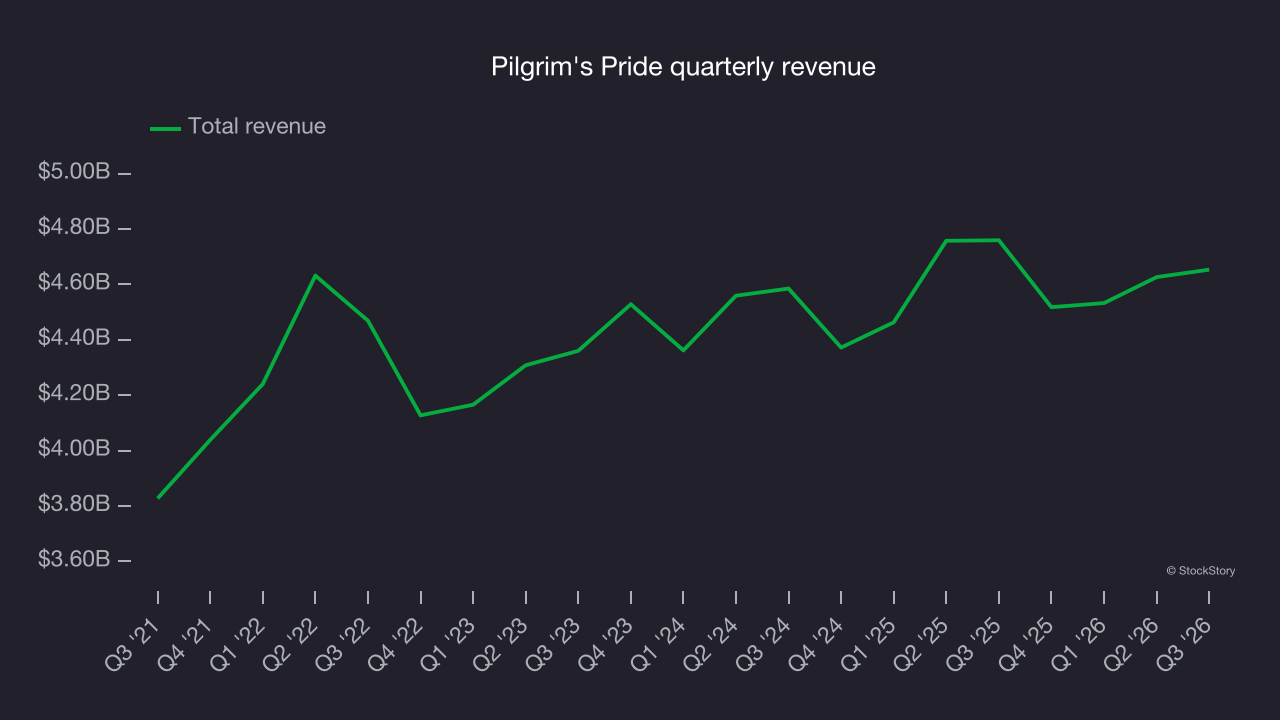
This quarter, Pilgrim's Pride missed Wall Street’s consensus estimates and reported an uninspiring 2.2% year-on-year revenue decline, generating $4.65 billion of revenue.
Looking ahead, sell-side analysts expect revenue to grow 1.4% over the next 12 months, according to S&P, similar to its three-year rate. This projection is underwhelming and indicates its products will see some demand headwinds.
Free cash flow
Free cash flow matters because accounting profits alone can’t pay the bills.
Pilgrim's Pride has shown weak cash profitability relative to peers over the last two years, giving the company fewer opportunities to return capital to shareholders. Its free cash flow margin averaged 2.3%, below the expected level for a consumer staples business.
Pilgrim's Pride’s margin dropped by 4.4 percentage points over the last year. Almost any decline is undesirable given its already low cash conversion. If the trend continues, it could signal the company is in the middle of an investment cycle.
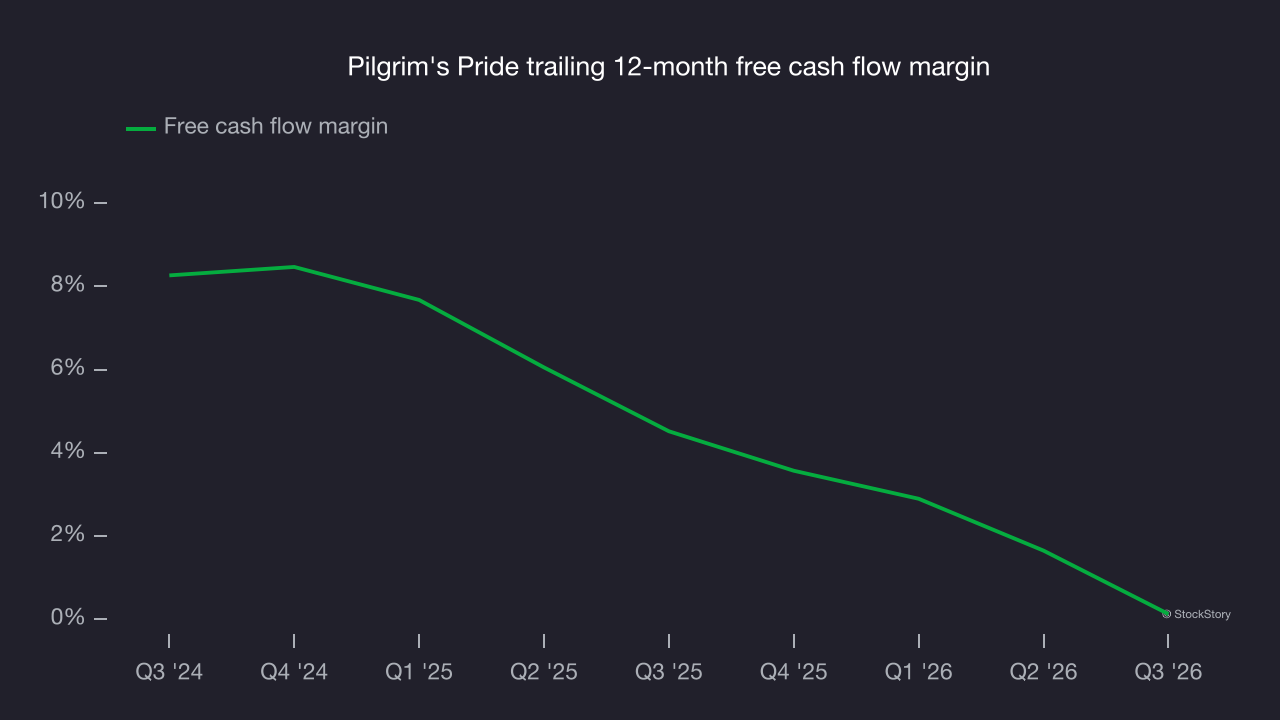
Pilgrim's Pride broke even on free cash flow in Q3. Its cash profitability declined by 5.9 percentage points from the same quarter last year, suggesting its historical struggles have continued.
Key takeaways from Pilgrim's Pride’s Q3 results
Misses on both EBITDA and gross margin left Pilgrim's Pride with few positives in a weaker quarter. Both measures fell short of Wall Street’s consensus estimates. Shares remained flat at $26.39 immediately after the release.
Pilgrim's Pride’s latest quarter matters, but not nearly as much as longer-term fundamentals and valuation when deciding if the stock is a buy. For more on Pilgrim's Pride, read our full research report here (it’s free).