Electronic components manufacturer CTS Corporation (NYSE: CTS) announced better-than-expected revenue in Q3 2026, with revenue up 4.6% year on year to $149.6 million. The company’s full-year revenue guidance of $585 million at the midpoint came in 2% above analysts’ consensus estimates. Its non-GAAP profit of $0.77 per share was 17.9% above analysts’ consensus estimates.
For more on CTS, read our free full research report.
CTS (CTS) Q3 2026 highlights:
- Revenue $149.6 million vs S&P analysts’ consensus estimates of $145.9 million (4.6% year-on-year growth, 2.5% beat)
- Adjusted EPS $0.77 vs S&P analysts’ consensus estimates of $0.65 (17.9% beat)
- Adjusted EBITDA $37 million vs analysts’ consensus estimates of $33.41 million (24.7% margin, 10.7% beat)
- Revenue guidance The company lifted its revenue guidance for the full year to $585 million at the midpoint from $575 million, a 1.7% increase
- Adjusted EPS guidance Management raised its full-year adjusted EPS guidance to $2.83 at the midpoint, a 7.8% increase
- Operating margin 17.1%, up from 14.8% in the same quarter last year
- Free cash flow margin 27.5%, up from 16.9% in the same quarter last year
- Market capitalization $1.54 billion
“CTS delivered another strong quarter, with sales increasing 5% year over year, driven by continued strength across our increasingly diversified portfolio. Diversified end-market sales grew 7% and now represent 60% of total sales, while Transportation sales also posted modest growth,” said Pratik Trivedi, CEO of CTS Corporation. “Our disciplined execution is delivering profitable growth, record margins and strong cash generation. The acquisition of Millar further advances our diversification strategy, especially in the medical end market, and enhances our opportunity to create sustainable long-term value.”
Revenue growth
A company’s long-term revenue performance can indicate its overall quality. Any business can post a good quarter or two, but the best consistently grow over the long haul.
With $570.9 million in revenue over the past 12 months, CTS is a small player in the business services space, which sometimes brings disadvantages compared to larger competitors benefiting from economies of scale and numerous distribution channels.
CTS’s 2.5% annualized revenue growth over the last five years was sluggish. This shows it failed to generate substantial demand.
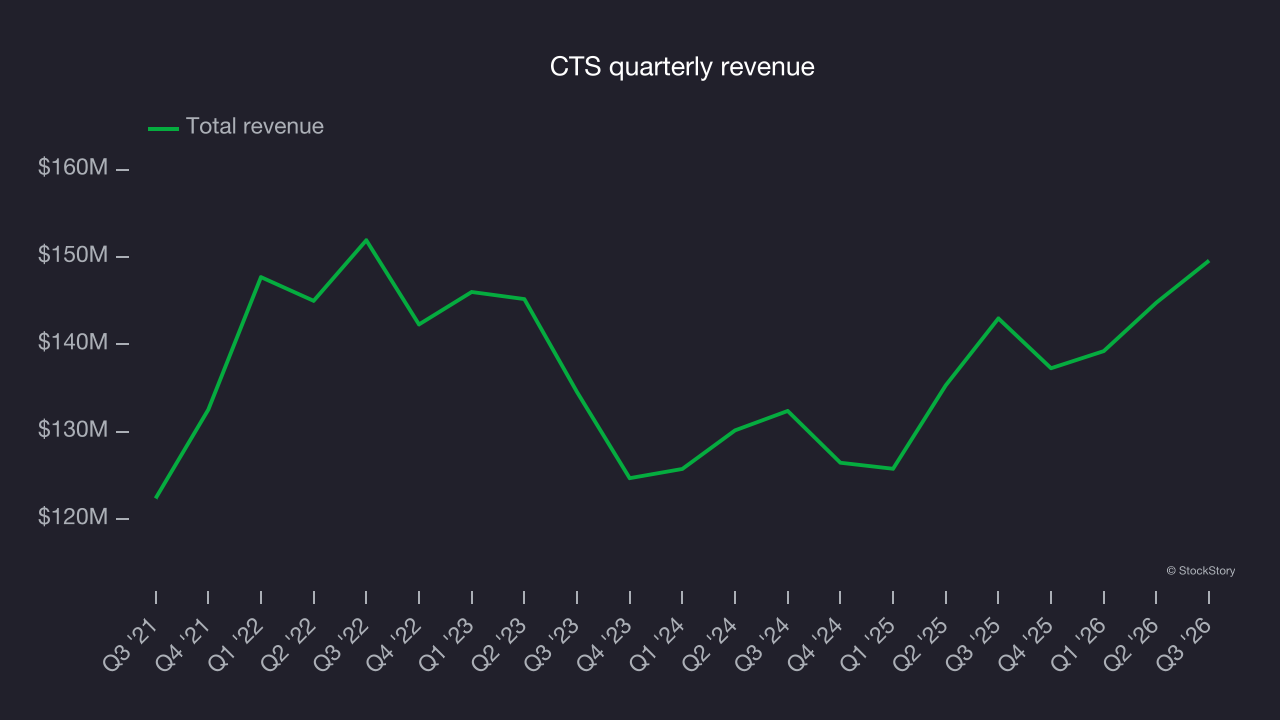
Long-term growth matters most, but within business services, a half-decade historical view may miss recent innovations or disruptive industry trends. CTS’s annualized revenue growth of 5.5% over the last two years is above its five-year trend, suggesting some bright spots. 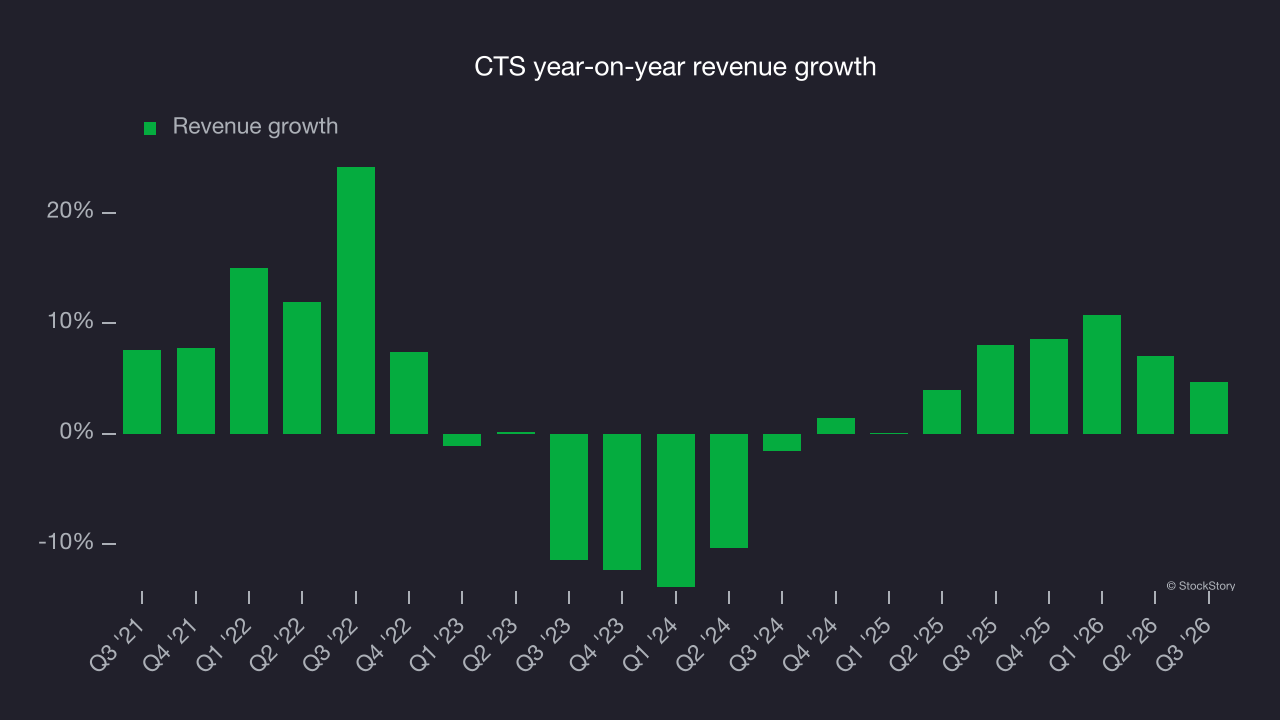
This quarter, CTS reported modest year-on-year revenue growth of 4.6% but beat Wall Street’s consensus estimates by 2.5%.
Looking ahead, sell-side analysts expect revenue to grow 4.9% over the next 12 months, according to S&P, similar to its two-year rate. This underwhelming projection implies its newer products and services will not lead to better top-line performance yet.
Adjusted operating margin
CTS has performed well over the last five years. It demonstrated strong profitability for a business services company, with an average adjusted operating margin of 21.4%.
Looking at the trend in its profitability, CTS’s adjusted operating margin decreased by 21.1 percentage points over the last five years. This raises questions about the company’s expense base because its revenue growth should have given it leverage on its fixed costs, resulting in better economies of scale and profitability.
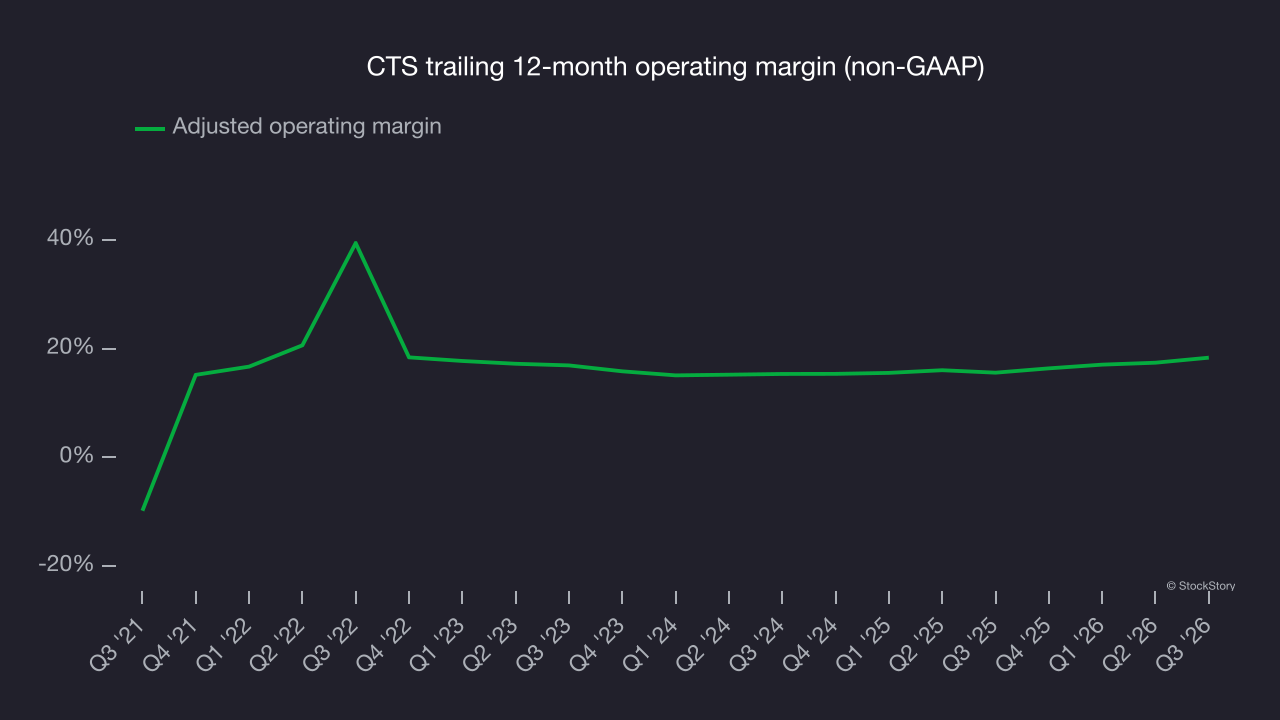
In Q3, CTS generated an adjusted operating margin of 19.3%, up 3.6 percentage points year on year. This increase was a positive development and shows it was more efficient.
Earnings per share
Revenue trends explain a company’s historical growth, but the long-term change in earnings per share (EPS) points to the profitability of that growth. For example, a company could inflate its revenue through excessive spending on advertising and promotions.
CTS’s EPS grew at an 8% compounded annual growth rate over the last five years, higher than its 2.5% annualized revenue growth. This indicates the company became more profitable on a per-share basis as it expanded.
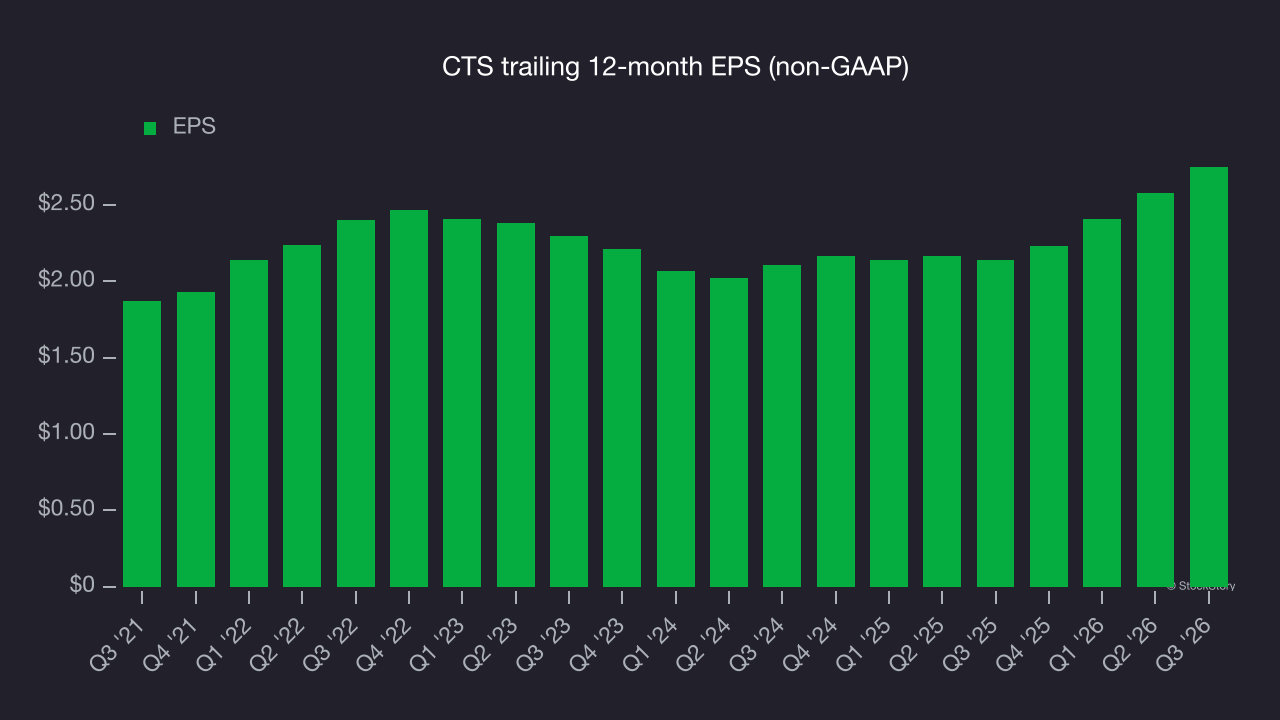
Examining CTS’s quality of earnings can provide a better understanding of its performance. A five-year view shows that CTS has repurchased its stock, shrinking its share count by 10.7%. This indicates its EPS outperformed its revenue not because of increased operational efficiency but because of financial engineering, as buybacks boost per share earnings. 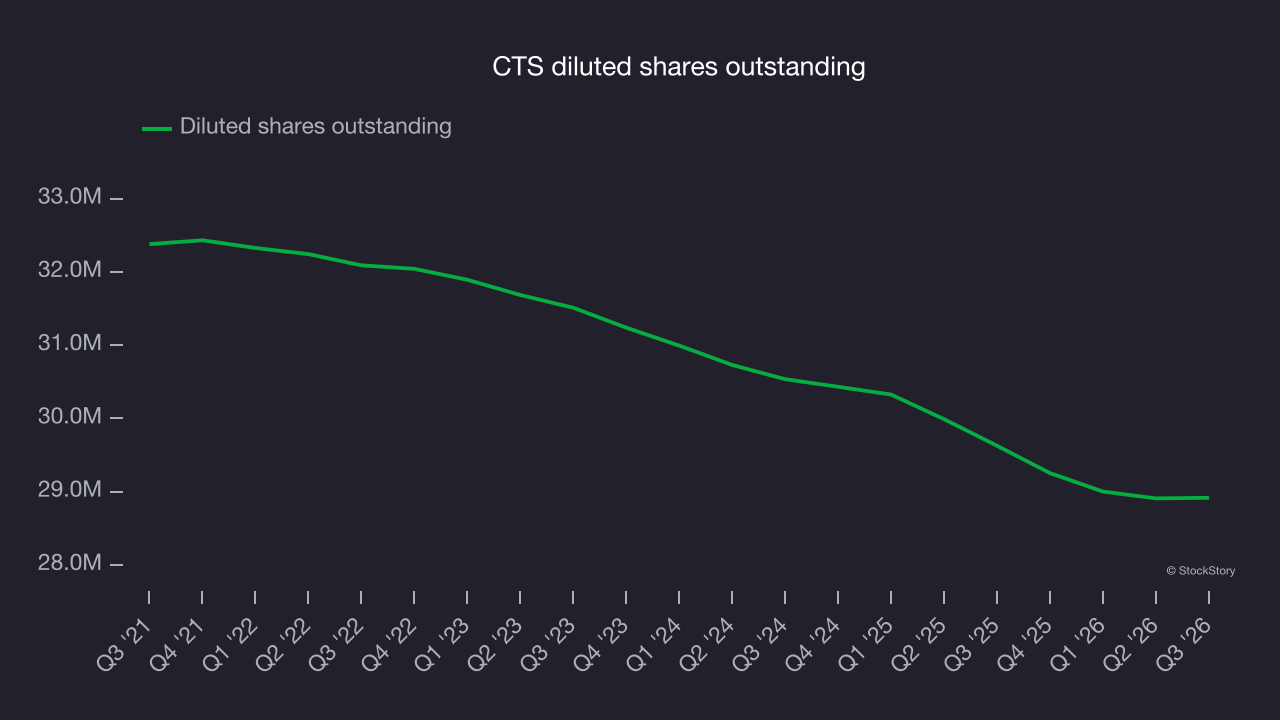
As with revenue, analyzing EPS over a shorter period can reveal changes in the business.
For CTS, its two-year annual EPS growth of 14.2% was higher than its five-year trend. This acceleration made it one of the faster-growing business services companies in recent history.
In Q3, CTS reported adjusted EPS of $0.77, up from $0.60 in the same quarter last year. This comfortably exceeded analysts’ consensus estimates. Over the next 12 months, Wall Street expects CTS’s full-year EPS to stay about the same, moving from $2.75 to $2.76, according to S&P.
Key takeaways from CTS’s Q3 results
CTS delivered a strong quarter, with an EPS beat and full-year EPS guidance that came in well above Wall Street’s consensus estimates. Shares surged 6.4% to $57.38 immediately after the results.
CTS had a solid quarterly earnings result, but assessing the stock as an investment requires a broader view. The latest quarter matters, but not nearly as much as longer-term fundamentals and valuation when deciding whether the stock is a buy. For more on CTS, read our full research report here (it’s free).