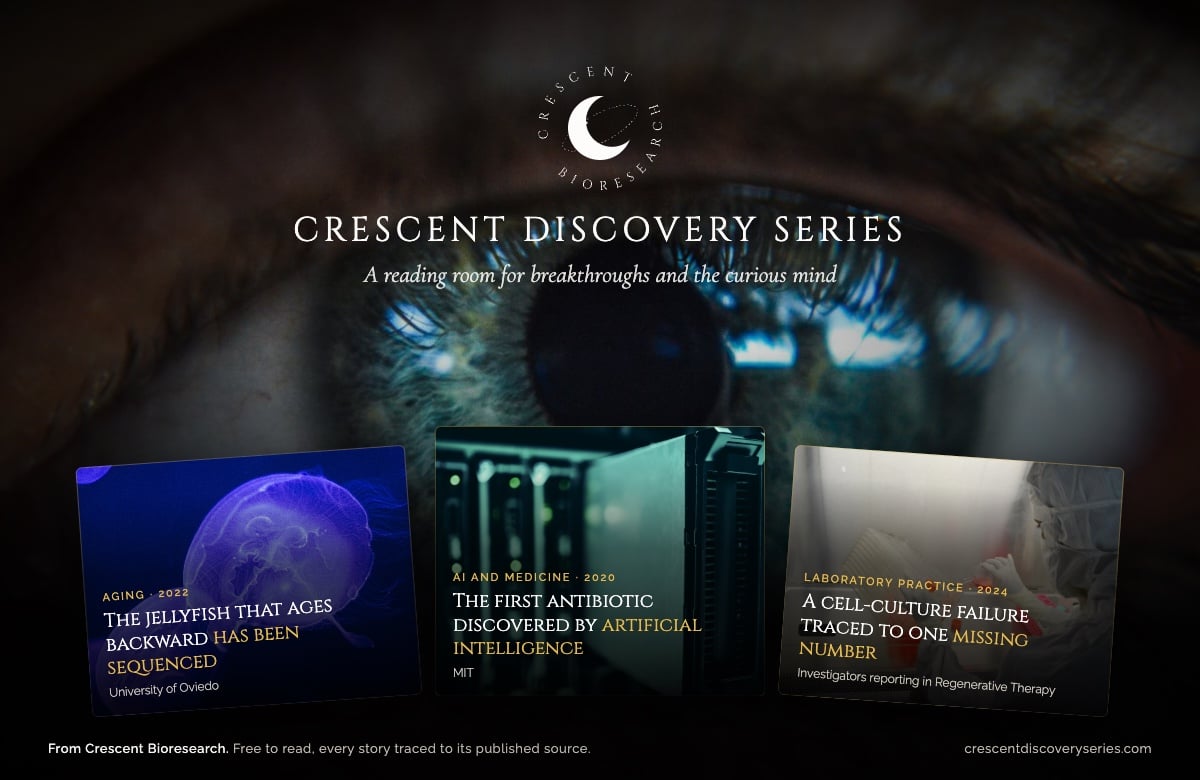
Crescent Bioresearch has launched the Crescent Discovery Series, a free public platform that explains scientific breakthroughs in plain language, traces each to its published source, and invites readers to send the questions about science and the world they have always wondered about.
ALBANY, N.Y., Oct. 30, 2026 — Crescent Bioresearch, a supplier of laboratory compounds, today announced the launch of the Crescent Discovery Series, a free public platform built to give anyone access to verified scientific information. The series gathers the breakthroughs reshaping what is known about the body, the mind and the natural world, explains each one in plain language, and ties every story to the published research behind it. It also opens a direct line to the company: readers can send in the questions that have always puzzled them about science and the world, and receive answers drawn from the published literature.
What the Crescent Discovery Series is
The Crescent Discovery Series is a reading room for science, open to everyone. Each entry takes one discovery, a finding that changed what researchers believed was true, and tells the story of how it came to be known: the question that started the work, the people who pursued it, what they measured and what changed as a result. Every story closes with its full citation and, where the original paper is available online, a direct link to it, so a reader can always move from the explanation to the evidence.
The platform is written for the curious, not only for specialists. A student meeting a subject for the first time, a parent who saw a headline and wanted the rest of the story, and a working researcher looking for the source of a claim should each find something worth reading. The writing is direct and free of jargon, and the science is never simplified to the point of being wrong.
Why Crescent Bioresearch started it
Crescent Bioresearch was founded on a single observation: no research can be trusted unless the material behind it is exactly what its label says. That conviction shapes how the company works, and the Discovery Series carries it beyond the laboratory.
Science reaches most people in fragments: a headline with no source, a claim passed along without the study behind it, a finding stripped of the context that gives it meaning. Verified information exists, but much of it sits behind dense journals and technical language that keep the public at a distance. Crescent Bioresearch started the series to close that distance, giving the public a dependable place to satisfy their curiosity, find answers to their questions and follow the breakthroughs changing science, each one traced back to where it was first published.
Running the series also keeps the company close to the questions people actually ask. Those questions are often the same ones that set research in motion, and listening to them is part of how a research supplier stays connected to the purpose of the work it supports.
What readers will find
Topics of interest span across the brain and mind, infection and the immune system, cancer, aging, pain, the biology of the body’s organs, artificial intelligence in medicine, and the practice of laboratory science itself. Readers can follow a single thread or move freely between them, and the collection of discoveries can be filtered by topic.
The discoveries reach from early twentieth-century findings to research published this year, drawn from journals such as Nature, Science, Cell, The Lancet and the New England Journal of Medicine. They include an antibiotic first identified by an artificial intelligence model at MIT; the genome of a jellyfish able to return to an earlier stage of its life; a gene that explained why one woman could not feel pain; and a laboratory study that traced cell-culture failures to a supplement whose certificate printed no measured endotoxin value.
Each entry follows the same shape, so a reader always knows where to look: a headline that states the finding, a short line naming the investigators or institution behind it, a plain account of the question, the method and the result, and the full citation at the end. Readers can save favorites as they go, and an interactive feature on the home page pairs each visitor with a number and the breakthrough attached to it, an invitation to read something outside one’s usual interests.
How the public takes part
The series is built as a conversation, not a broadcast. The home page opens on a single question: what has the reader always wondered? Beneath it sits an open box where anyone can type a question and send it to Crescent Bioresearch through Instagram with one tap. Questions can also be sent by email to discovery@crescentbioresearch.com.
No question is too small or too large. Why ice floats on water, why the sky is blue, how a memory is stored, why some creatures seem not to age: the questions that have puzzled people for as long as they have looked closely at the world are exactly the ones the series is meant to receive. Where the published literature holds an answer, the series finds it and returns it with its source, so the reader receives the evidence along with the explanation. Where science has not yet settled the matter, the series says so plainly. Questions that recur, or that lead somewhere unexpected, can become new entries.
A standard of verified information
Every story in the series is held to one standard: it must point back to the research it describes. Claims arrive with their sources, findings are described as their authors reported them, and nothing is presented as settled that the evidence does not support.
Where to start
The Crescent Discovery Series is free to read and requires no account. Readers can begin on the home page, browse every discovery by topic, or send a question from the Ask a question box.
SOURCES CITED
Stokes, J. M., et al. (2020), Cell, the antibiotic identified by an artificial intelligence model. Pascual-Torner, M., et al. (2022), PNAS, the Turritopsis dohrnii genome. Habib, A. M., et al. (2019), British Journal of Anaesthesia, the FAAH-OUT gene. Uehara, K., et al. (2024), Regenerative Therapy, endotoxin in cell-culture medium.
ABOUT CRESCENT BIORESEARCH
Crescent Bioresearch is a supplier of laboratory compounds, founded around a framework of critical assessment. It works with research entities nationwide in pursuit of preserving the integrity of scientific research through its transparency approach. Follow the Crescent Discovery Series to dive into the latest breakthroughs and findings within prominent literature.
Media Contact:
Name: Media Relations Department
Company: Crescent Bioresearch
Email: media@crescentbioresearch.com
Website: https://crescentbioresearch.com/links