Argon Fieldnotes has launched an independent Gemini 4 guide at https://gemini4.net/ to help developers and technical decision-makers assess Google's Gemini 4 Argon announcement. The guide organizes the available evidence around practical adoption questions: what the model is, who can access it, how announced pricing works, and which claims still require testing. It is an editorial resource, not a Google product, an API provider, or a way to obtain early model access.
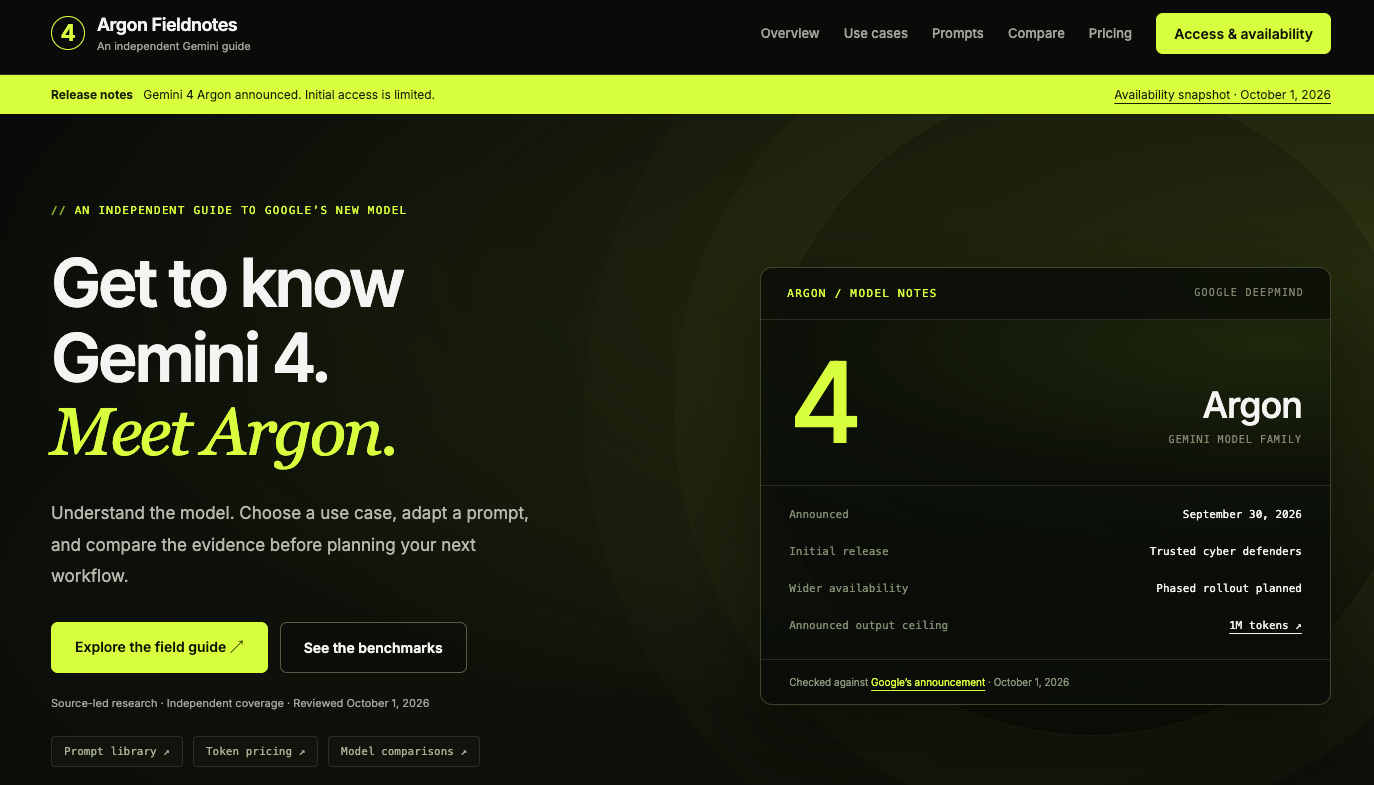
Google announced Gemini 4 Argon on September 30, 2026, describing a frontier model intended for complex professional tasks. According to Google's announcement, initial access is limited to trusted cyber defenders through its Fairwind Program, with a wider rollout planned. Argon Fieldnotes makes that distinction prominent. An announced model, a listed token rate, and a working entitlement for a particular account are different things; readers are directed to verify the release channel they intend to use before planning an integration.
The guide brings together a model overview, an access snapshot, pricing explanations, use-case articles, prompt templates, benchmark context, safety guidance, and model comparisons. Each section is designed to answer a specific decision rather than repeat a launch headline. The overview separates the model from the application around it, including tools, permissions, and interfaces. The access section distinguishes Google's current limited release from proposed future channels, while the pricing section treats published rates as budgeting inputs rather than proof that an API request can already be made.
For teams exploring a coding workflow, the site describes how to select a bounded repository task, define the allowed tools, and check a resulting patch with relevant tests. Its document-research and business-workflow guides likewise recommend source checks and acceptance criteria before a result is used. These are editorial evaluation methods, not claims that Argon Fieldnotes has run the model on those tasks. The accompanying prompt library includes original templates for coding, document research, and information extraction; the site labels those templates as untested on Argon.
Benchmark coverage is presented with its provenance attached. Argon Fieldnotes reproduces selected values from Google's published model material and points readers to the evaluation methodology. It notes that individual tests can use different harnesses, settings, and result sources. The site does not combine benchmark percentages into a single score or describe provider-published comparisons as independently replicated findings. Instead, it asks readers to choose a task that resembles their own work and record accepted results, attempts, review effort, and costs in that setting.
Pricing receives similar treatment. The guide displays the introductory and later input and output token rates announced by Google and provides hypothetical cost examples. It explains that a token subtotal excludes items such as tools, infrastructure, taxes, and retries, and that a listed cache discount depends on eligibility. A team evaluating a real workload would still need channel-specific billing documentation and its own measured usage. The guide's purpose is to make assumptions visible before a budget becomes an implementation commitment.
The site's safety material separates Google's statements about model safeguards from the controls an organization must set for its own workflow. It discusses permission boundaries, review of consequential actions, and the possibility that retrieved documents or web pages contain instructions aimed at an agent. These are deployment questions that remain relevant even if a model performs well on a benchmark. The guide does not claim that a prompt alone can enforce access restrictions or that a provider's safety work eliminates application-level risk.
Readers researching Argon Fieldnotes Gemini 4 can also follow a dated source library that identifies the official announcement, Google DeepMind's model page, and the evaluation methodology used in the initial edition. Argon Fieldnotes states that it has not completed a hands-on Argon API request, replicated the published benchmarks, or measured latency and billing itself. Its editorial policy calls for product claims to be attributed to primary sources and for corrections to update the relevant article and source record together. This lets readers distinguish a provider announcement, an editorial interpretation, and a first-hand measurement.
Argon Fieldnotes is intended as a starting point for careful evaluation, not a substitute for official documentation or an access check. As release channels and model documentation change, developers can use the guide to identify what to verify next: the exact model identifier, account eligibility, supported tools, effective pricing, and performance on representative tasks. The independent Gemini 4 resource is available at Gemini 4.net. Gemini and related names belong to their respective owners; Argon Fieldnotes is not affiliated with Google or Google DeepMind.
About Argon Fieldnotes:
Argon Fieldnotes is a guide to Google’s Gemini 4 Argon model, featuring insights on its features, use cases, pricing, and safety measures. It offers benchmarks, adaptable prompts, and comparisons to other models for effective workflow planning.
###
For more information about Argon Fieldnotes, contact the company here:
Argon Fieldnotes
Tabe
gptproto.official@gmail.com
Hong Kong