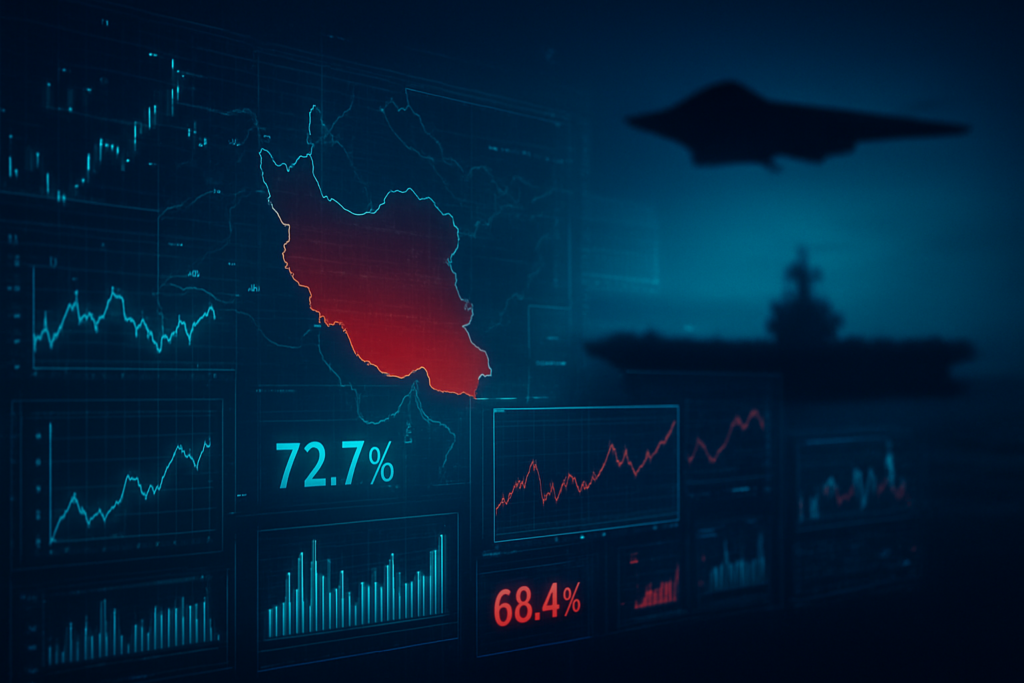
As of January 14, 2026, prediction markets are flashing a severe warning signal for the Middle East, with traders pricing in an overwhelming likelihood of a direct military strike on Iran by the United States or Israel this year. Current odds on major decentralized platforms have surged to a staggering 83% for a U.S. strike by June 2026, marking a significant departure from the more cautious rhetoric seen in traditional diplomatic circles.
This spike in activity follows a turbulent 2025 that saw regional tensions reach a boiling point, including the "12-Day War" in June and the subsequent collapse of several Iranian-aligned regional proxies. While traditional polling often struggles to capture the nuances of rapidly evolving geopolitical crises, prediction markets are operating as a real-time "war room," aggregating the collective intelligence of global participants who are putting millions of dollars on the line to forecast the next move in a high-stakes game of brinkmanship.
The Market: What's Being Predicted
The most liquid markets regarding this conflict are currently hosted on Polymarket, where the "U.S. strikes Iran by June 30, 2026" contract has seen its volume balloon to over $22 million. The odds on this specific outcome have experienced a dramatic climb, rising from 48% in the first week of January to the current 83%. Simultaneously, a shorter-term market on whether Israel will strike Iranian soil by January 31, 2026, is currently hovering around 53%, suggesting that traders believe a multi-national or U.S.-led operation is more likely than a unilateral Israeli action in the immediate future.
On the regulated U.S. side, Kalshi has seen significant interest in markets related to Iranian leadership stability. The contract for "Ali Khamenei out as Supreme Leader by end of 2026" is trading at a 66% probability. This correlation between military action and regime change suggests that traders aren't just betting on a singular strike, but on a broader campaign designed to fundamentally alter the Iranian political landscape.
Resolution criteria for these markets are remarkably precise to ensure "truth signals" for participants. A "strike" is typically defined as a kinetic military operation—missiles, drones, or manned aircraft—originating from Israeli or U.S. forces that impacts targets on Iranian soil. Cyberattacks and proxy engagements, while common, are explicitly excluded from the resolution, ensuring that the odds reflect actual direct military escalation.
Why Traders Are Betting
The "smart money" is currently reacting to a series of escalatory triggers that defined the late months of 2025. Following the re-implementation of the "Maximum Pressure" campaign by the current U.S. administration, Iran’s nuclear breakout time was reportedly reduced to zero, prompting fears of a nuclear-armed Tehran. Defense contractors like Lockheed Martin (NYSE: LMT) and Northrop Grumman (NYSE: NOC) have seen increased focus as traders monitor the deployment of specialized hardware, such as the B-2 Spirit and B-21 Raider stealth bombers, which were utilized in the limited strikes of June 2025.
Traders are also closely watching the domestic situation within Iran. In late 2025, the Iranian Rial plummeted to a historic low of 1.4 million to $1 USD, sparking the "Bazaar Revolts." Prediction market participants appear to be betting that the U.S. and Israel will view this internal fragility as a strategic window of opportunity to degrade Iran’s nuclear and military infrastructure while the regime is preoccupied with civil unrest.
Large-scale "whale" activity has been noted on Polymarket, with several high-net-worth accounts taking six-figure positions in favor of a strike. These moves often precede major news breaks, leading some to speculate that prediction markets are capturing "insider" cues or early-warning signals from intelligence communities that haven't yet been confirmed by mainstream media outlets.
Broader Context and Implications
This trend highlights the growing reliance on prediction markets over traditional expert analysis. While a standard political analyst might be hesitant to predict a full-scale war due to reputational risks, prediction market participants are incentivized solely by accuracy. Research from late 2025 indicates that these markets have maintained an accuracy rate of roughly 76% in predicting kinetic actions, outperforming traditional expert panels which often hover around 68%.
The real-world implications of these odds are profound. When prediction markets hit an 80%+ threshold for military conflict, it often triggers a cascade of economic shifts. Oil futures typically see a "conflict premium," and defense stocks become highly volatile. For the first time, prediction markets are being used by hedge funds and risk managers as a primary hedging tool against geopolitical "black swan" events.
However, the regulatory environment remains complex. While Kalshi has paved the way for legal event contracts in the U.S., decentralized platforms like Polymarket still operate in a legal gray area for American participants. Despite this, the volume and liquidity of these markets have become too large for regulators or policymakers to ignore, effectively creating a "shadow" intelligence agency that operates in the public eye.
What to Watch Next
In the coming weeks, several key milestones could send these odds even higher or cause a sharp correction. The International Atomic Energy Agency (IAEA) is scheduled to release a "special report" on Iranian enrichment levels by January 25. If the report confirms a nuclear weaponization milestone, traders expect the 83% odds to move toward the high 90s.
Military drills in the Persian Gulf and troop movements across U.S. bases in Qatar and Bahrain are also being tracked via satellite imagery by traders on social platforms. Any sign of "readiness" beyond standard training exercises will likely be priced into the markets within minutes. Furthermore, the upcoming 2026 State of the Union address will be a pivotal moment for participants to gauge the administration's appetite for a prolonged engagement.
Bottom Line
Prediction markets are signaling that the era of "strategic patience" with Tehran has likely ended. The high probability of a 2026 military strike reflects a market consensus that the diplomatic and economic escalations of 2025 have failed to resolve the nuclear issue, leaving kinetic action as the perceived "inevitable" next step for the U.S. and Israeli leadership.
As a tool for geopolitical forecasting, these platforms have proven themselves to be faster and often more accurate than traditional models. By forcing participants to have "skin in the game," prediction markets filter out the noise of partisan rhetoric and media bias, providing a cold, hard look at the probability of conflict. Whether these markets are a self-fulfilling prophecy or a vital early warning system, one thing is clear: the "wisdom of the crowd" is currently betting on a year of unprecedented fire and fury in the Middle East.
This article is for informational purposes only and does not constitute financial or betting advice. Prediction market participation may be subject to legal restrictions in your jurisdiction.
PredictStreet focuses on covering the latest developments in prediction markets.
Visit the PredictStreet website at https://www.predictstreet.ai/.