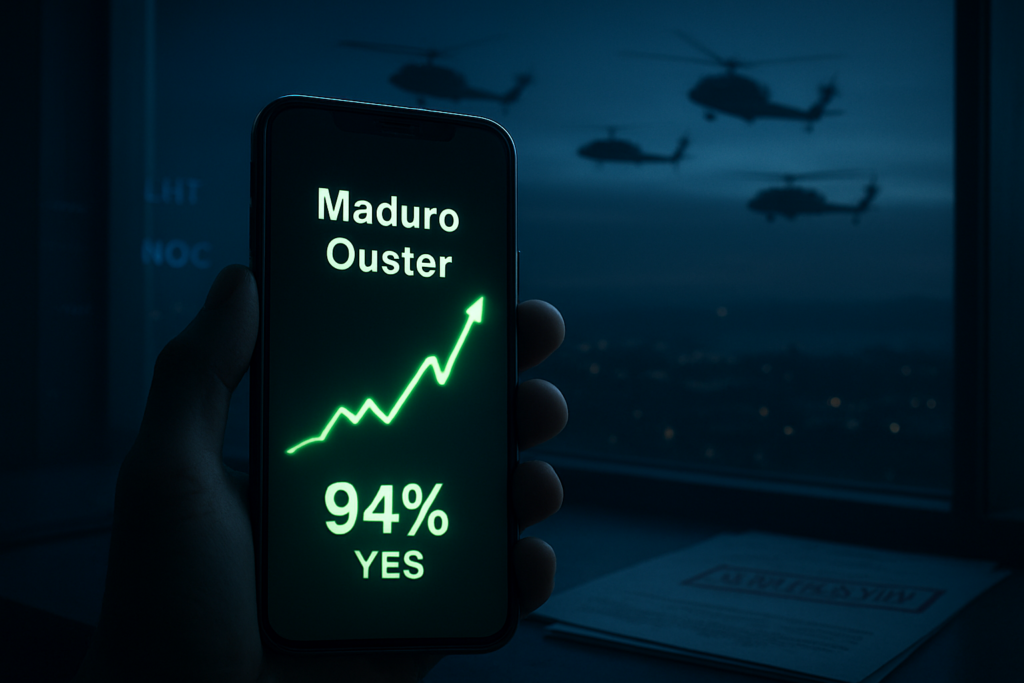
On January 3, 2026, as U.S. Special Forces launched "Operation Absolute Resolve" to apprehend Venezuelan President Nicolás Maduro, the world watched in shock. But on the decentralized prediction platform Polymarket, the shock had already been priced in. Just hours before the first Delta Force boots hit the ground in Caracas, an anonymous user liquidated a massive position, turning a $34,000 wager into a staggering $436,000 windfall. The "impeccable" timing of the trade, executed while the market gave Maduro’s removal a mere 6% probability, has sent shockwaves through the prediction market industry and caught the eye of federal investigators.
Today, January 14, 2026, the fallout has reached a boiling point. As the U.S. Senate demands an immediate investigation into the payout, the incident has become a lightning rod for critics who argue that prediction markets are becoming high-stakes playgrounds for individuals with access to classified military and diplomatic intelligence. With a $400,000 payout now at the center of a geopolitical scandal, the question is no longer whether prediction markets can forecast the future, but whether they are being used to profit from its secrets.
The Market: What's Being Predicted
The controversy centers on a specific contract hosted on Polymarket: "Will Nicolás Maduro be out of power by January 31, 2026?" For much of late 2025, this market was a sleepy corner of the platform, with shares trading at roughly 7 cents (representing a 7% probability). Most geopolitical analysts viewed Maduro’s grip on power as firm, despite ongoing sanctions and internal unrest. However, the liquidity in this market spiked dramatically in the final 48 hours of December 2025, as a newly created account under the handle "Burdensome-Mix" began aggressively buying "Yes" shares.
While Polymarket operated as the primary hub for this speculative activity, the regulated U.S. exchange Kalshi also hosted a similar market (Series: KXMADUROOUT). On Kalshi, the odds remained relatively stable until the early morning hours of January 3, when prices began to surge just ahead of the official 4:21 a.m. ET announcement from the White House. The discrepancy between the two platforms has highlighted the differences in oversight; Kalshi operates under the watchful eye of the Commodity Futures Trading Commission (CFTC), while Polymarket’s decentralized nature has historically made it more difficult to police for "informed" trading.
The resolution of the market was not without its own drama. While the "Ouster" contract was settled quickly following Maduro’s appearance in a Manhattan federal court on January 5, a secondary market regarding a potential "U.S. Invasion" of Venezuela became mired in a bitter dispute. Polymarket initially refused to pay out "Yes" bettors for the invasion contract, arguing that a targeted special forces raid did not constitute a full-scale territorial invasion—a technicality that left many retail traders furious and further muddied the platform's reputation.
Why Traders Are Betting
The primary driver behind the sudden market movement was not public sentiment, but rather a suspected leak of "material non-public information." Before the raid, traditional forecasting methods—including intelligence briefs from major consultancies and public diplomatic channels—showed no indication that a military strike was imminent. In fact, most experts believed the U.S. was pursuing a policy of containment rather than direct intervention.
The "Burdensome-Mix" account represents what many in the industry call "whale activity," but with a darker undertone. By investing approximately $34,000 into a high-risk contract that the broader public deemed a "long shot," the user demonstrated a level of confidence that suggests access to the Pentagon’s operational timeline for Operation Absolute Resolve. This has led to a comparison between prediction markets and traditional equity markets; when Maduro was captured, defense giants like Lockheed Martin (NYSE: LMT) and Northrop Grumman (NYSE: NOC) saw immediate stock rallies of 8% and 2.7% respectively, but those moves happened after the news broke. The Polymarket trade, by contrast, happened before.
Traders on these platforms are often a mix of hobbyist geeks and professional arbitrageurs. However, the Maduro payout has highlighted a third category: the "insider trader." While traditional forecasting focuses on aggregated public data, this event suggests that prediction markets are increasingly being used as a way to "monetize" secrets. The surge in gold prices to over $4,300 per ounce and the rally of energy companies like Valero (NYSE: VLO) and Phillips 66 (PSX) further confirm that the markets were reacting to the raid, but only the prediction markets seemed to have a "tell" in the hours preceding the mission.
Broader Context and Implications
The "Maduro Bet" is being viewed as a watershed moment for the regulation of prediction markets. It has exposed a significant "insider information" loophole that current laws are ill-equipped to handle. In response, Congressman Ritchie Torres (D-NY) has introduced the Public Integrity in Financial Prediction Markets Act, which would specifically ban federal officials, political appointees, and military personnel from wagering on outcomes they may have a hand in shaping.
This event also reveals a paradoxical truth about prediction markets: their greatest strength—their ability to incorporate "all available information"—is also their greatest regulatory liability. If a market is "accurate" because it contains leaked classified data, it loses its status as a public sentiment tool and becomes a national security risk. The CFTC, led by Chair Michael Selig, is now under immense pressure from a bipartisan group of 12 U.S. Senators to determine if Polymarket’s security protocols are sufficient to prevent such manipulation.
Historically, prediction markets have been praised for their accuracy in elections and corporate mergers. However, the intersection of these markets with kinetic military operations like Operation Absolute Resolve creates a new ethical frontier. If speculators can profit from the movement of troops, the incentive to leak or even influence military strategy increases exponentially. This has led to renewed calls for platforms to adopt the same rigorous anti-manipulation standards as the NYSE or Nasdaq.
What to Watch Next
In the coming weeks, all eyes will be on the Department of Justice and the CFTC as they attempt to unmask the owner of the "Burdensome-Mix" account. If the trail leads back to a government or military official, it could lead to the first major criminal prosecution for "prediction market insider trading." This would set a legal precedent that could redefine how these platforms operate globally.
Furthermore, the "Invasion" versus "Ouster" dispute on Polymarket is expected to go to a formal arbitration or a community vote. The outcome of this dispute will be a major test for the decentralized governance models that many of these platforms use. If the platform is seen as "moving the goalposts" to avoid a large payout, it could lead to a mass exodus of liquidity toward more regulated competitors like Kalshi or ForecastEx.
Finally, keep a close watch on the legislative progress of the Torres bill. If passed, it would represent the most significant expansion of financial oversight in the prediction market space since the Dodd-Frank Act. The defense sector will also remain volatile; as data analytics firms like Palantir (NASDAQ: PLTR) and hardware providers like Raytheon (NYSE: RTX) and General Dynamics (NYSE: GD) report their quarterly earnings, analysts will be looking for clues as to how much "pattern of life" intelligence was used in the Venezuelan operation—and whether any of that data could have been the source of the Polymarket leak.
Bottom Line
The $400,000 Maduro payout is a "smoke alarm" for the prediction market industry. While the capture of a high-profile target like Nicolás Maduro is a significant military achievement for the U.S., the corresponding activity on Polymarket suggests that the "wisdom of the crowd" may sometimes just be the "knowledge of the few." The event has proved that these markets are no longer just a niche interest; they are sensitive instruments that can reflect—and perhaps even compromise—the most sensitive geopolitical operations.
As a tool, prediction markets remain incredibly powerful, offering a real-time gauge of probability that traditional polls and news outlets cannot match. However, without the guardrails of transparency and strict anti-insider trading enforcement, they risk becoming a tool for corruption rather than a source of truth. The Maduro scandal will likely be the catalyst that finally brings these platforms into the mainstream regulatory fold.
Ultimately, the capture of Maduro has changed the map of South American politics, but the $400,000 bet may have changed the landscape of global finance forever. Whether this leads to a more transparent era of forecasting or the eventual shutdown of unregulated platforms remains the most important prediction of all.
This article is for informational purposes only and does not constitute financial or betting advice. Prediction market participation may be subject to legal restrictions in your jurisdiction.
PredictStreet focuses on covering the latest developments in prediction markets.
Visit the PredictStreet website at https://www.predictstreet.ai/.