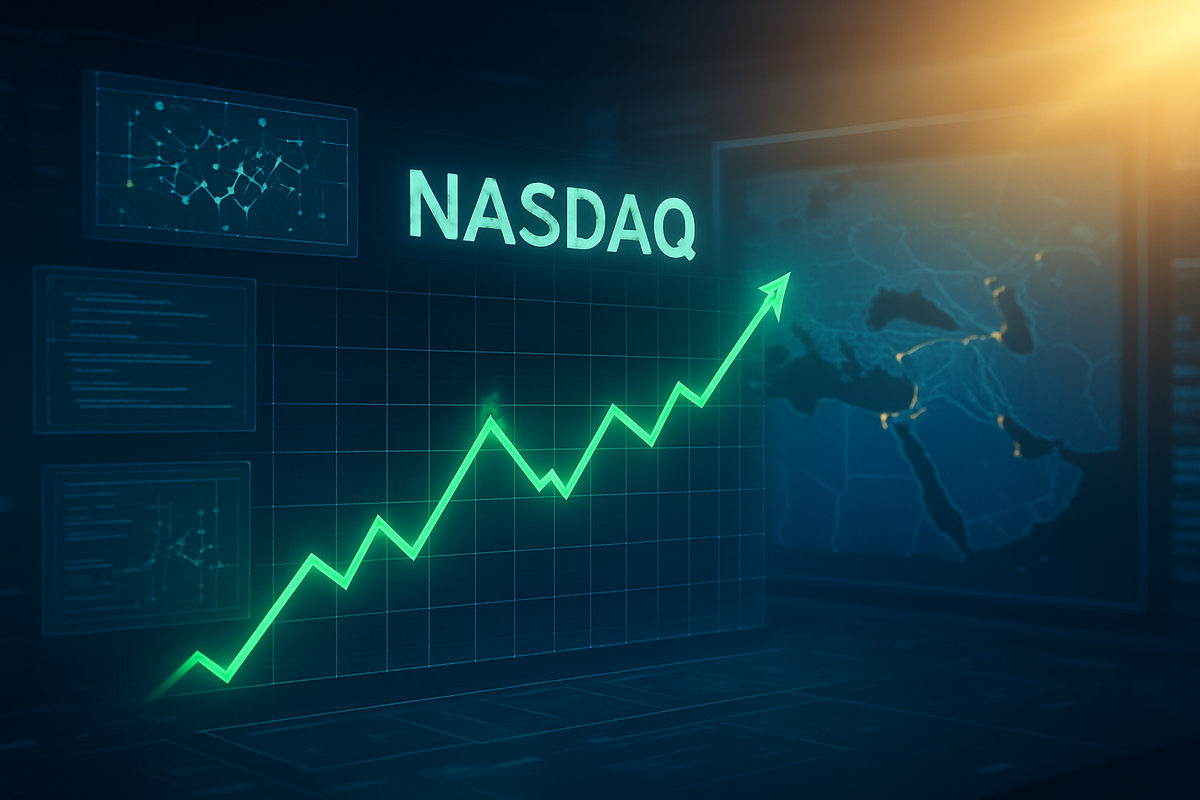
Market sentiment took a decisive turn toward optimism on Tuesday, April 14, 2026, as the Nasdaq Composite climbed 1.2% to settle at 23,183.74. This "relief rally" comes after a period of intense volatility sparked by escalating geopolitical tensions in the Middle East, which had previously sent shockwaves through global energy and equity markets. Investors are increasingly betting that a fragile ceasefire and new diplomatic initiatives in Islamabad will prevent a wider regional conflict from spiraling into a global recession.
The gains were particularly pronounced in the software sector, where enterprise giants and AI-focused firms saw a resurgence in buying activity. The index successfully reclaimed its 200-day moving average, a technical milestone that many analysts believe could signal a floor for the recent correction. While consumer sentiment remains at historical lows due to persistent inflation and high energy costs, the institutional "risk-on" appetite appears to be returning, fueled by the hope that the geopolitical "war premium" is finally beginning to fade.
Diplomatic Breakthroughs and the "Operation Epic Fury" Aftermath
The current market environment is the direct result of a cooling period following "Operation Epic Fury," a significant military engagement involving U.S. and Israeli forces targeting regional infrastructure earlier this year. The conflict led to the temporary closure of the Strait of Hormuz, causing Brent crude to spike near $120 per barrel in late March. However, as of April 14, 2026, a two-week ceasefire—mediated by Pakistan and Turkey—has held firm, allowing WTI Crude to settle back toward the $98 mark.
This stabilization has provided the necessary breathing room for tech valuations, which are historically sensitive to the inflationary pressures of high energy costs. Over the last 48 hours, reports of "meaningful progress" in diplomatic channels have circulated, with U.S. officials indicating a potential path toward a long-term resolution. While the U.S. naval presence in the region remains high as leverage, the shift from active combat to structured negotiation has allowed the Nasdaq-100 to recoup a significant portion of the losses sustained since the outbreak of hostilities in late February.
The rally is being described by many on Wall Street as a "reflexive bounce." After weeks of defensive positioning, funds are rotating back into high-growth software names that had been unfairly punished during the flight to safety. Despite the geopolitical progress, the market remains on edge, with every headline from the Islamabad summit capable of swaying the afternoon’s trading volume.
Software Titans Rebound: Palantir and ServiceNow Lead the Charge
Leading the sector's recovery are two pillars of the modern software ecosystem: Palantir Technologies (NYSE: PLTR) and ServiceNow (NYSE: NOW). Both companies have become bellwethers for the "AI-application" layer of the market, though they reached today's gains through very different paths. Palantir saw its shares climb approximately 3% to reach $136.81, buoyed by its recent designation as a "program of record" for the Department of Defense’s Maven system. While the fading "war premium" has limited Palantir’s upside compared to previous weeks, its essential role in modern defense logistics continues to provide a sturdy valuation floor.
ServiceNow (NYSE: NOW) delivered an even more impressive performance, surging 7.3% during Tuesday’s session. This move represents a significant comeback following a difficult start to 2026, a period some analysts dubbed the "SaaS-pocalypse." Fears that smaller, AI-native startups would disrupt traditional software-as-a-service models had pressured the stock, but today’s rally suggests investors are once again focusing on the company’s "NowAssist" platform. With management recently revising operating margins upward to 32%, the market is rewarding ServiceNow’s ability to monetize AI at an enterprise scale.
Other notable movers included Oracle (NYSE: ORCL), which jumped 12.7% on news of increased AI infrastructure demand, while Salesforce (NYSE: CRM) lagged behind, dropping 4% as the company announced further workforce reductions to accommodate its shift toward autonomous AI agents. The divergence within the sector highlights a maturing market where investors are becoming increasingly selective, favoring companies with clear, defensible AI integration strategies over those still in the "pivot" phase.
The Shift from Hardware to the AI Application Layer
The April 14 rally underscores a broader shift in the technology industry’s narrative. For much of 2024 and 2025, the market was dominated by the "hardware phase" of AI, where semiconductor manufacturers were the primary beneficiaries. By early 2026, however, the focus has shifted to the application layer. Events like the recent Middle East volatility have served as a stress test for these software firms, proving that enterprise demand for efficiency and defense-grade analytics remains robust even in a high-interest-rate environment.
This trend is also influenced by the growing "SaaS immunity" to supply chain disruptions. While hardware companies must contend with the logistical nightmares of closed shipping lanes and rare-earth metal shortages, software companies like ServiceNow (NYSE: NOW) can continue to deploy updates and sign contracts regardless of the physical status of the Strait of Hormuz. This structural advantage is becoming a key component of the "Software Relief" thesis that dominated today's trading session.
Furthermore, the geopolitical crisis has accelerated the adoption of sovereign AI clouds. Countries in the Middle East and Europe are increasingly looking to companies like Palantir (NYSE: PLTR) to build localized data environments that are independent of centralized global hubs. This movement toward "data sovereignty" is creating a new, highly profitable niche for established US software firms, providing a long-term growth tailwind that transcends current diplomatic tensions.
Outlook: Earnings Season and the "Islamabad Accord"
Looking ahead to the rest of April 2026, the market’s trajectory will likely be determined by two factors: the outcome of the diplomatic talks in Islamabad and the start of the Q1 earnings season. Should a formal "Islamabad Accord" be reached, analysts expect a further 5-8% upside for the Nasdaq as the last of the geopolitical risk is priced out. Conversely, any breakdown in negotiations could see a rapid return to the "risk-off" defensive posture that dominated March.
In the short term, investors will be watching for the next round of earnings reports from the enterprise software sector. These will provide the first concrete evidence of whether the AI-driven margin improvements touted by ServiceNow and Palantir are manifesting in the bottom line. Strategic pivots are also expected; as AI agents become more autonomous, the "per-seat" pricing model that has governed the software industry for decades is expected to face a major overhaul, potentially leading to more volatility later in the year.
The "diplomatic off-ramp" has provided a much-needed catalyst for a tech sector that was beginning to look oversold. However, with consumer sentiment still in the doldrums and interest rates remaining at 20-year highs, the sustainability of this rally is far from guaranteed. The coming weeks will determine if this is the start of a new bull leg or simply a temporary pause in a more protracted downturn.
Summary and Investor Takeaways
The tech relief rally of April 14, 2026, represents a moment of cautious triumph for the Nasdaq. By edging up 1.2% and reclaiming key technical levels, the index has demonstrated resilience in the face of significant geopolitical headwinds. The primary takeaways for investors are the stabilizing influence of diplomatic progress and the continued leadership of mission-critical software giants like Palantir (NYSE: PLTR) and ServiceNow (NYSE: NOW).
Moving forward, the market will remain hyper-sensitive to energy prices and the nuances of international diplomacy. While the "war premium" is currently deflating, the underlying shift toward AI-driven software efficiency remains the dominant long-term theme. Investors should maintain a balanced perspective, recognizing that while the immediate risk of a regional war may be receding, the structural challenges of high inflation and a shifting SaaS landscape remain.
In the coming months, watch for the "AI monetization" gap to widen between leaders and laggards. The firms that can prove they are saving their customers money through automation will likely continue to lead the charge, while those reliant on legacy models may find the 2026 environment increasingly unforgiving.
This content is intended for informational purposes only and is not financial advice.