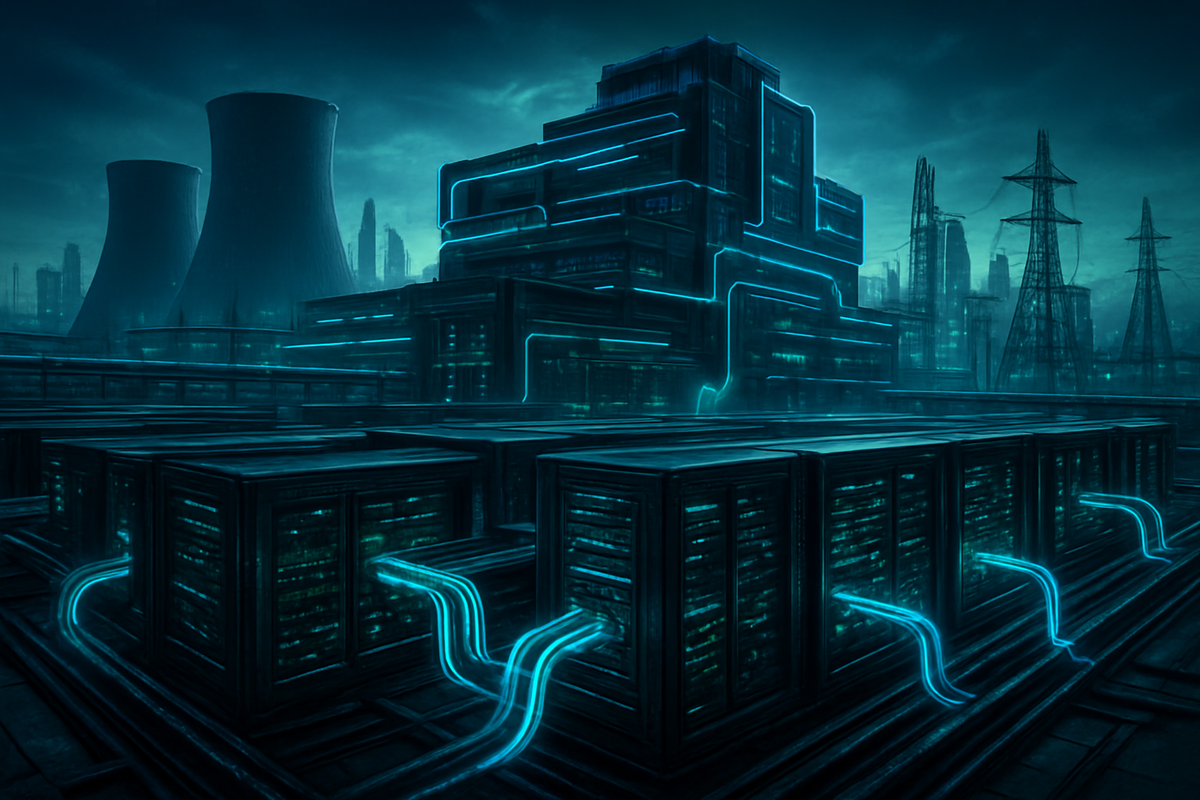
As of March 18, 2026, the global technology sector has officially transitioned from a battle of algorithms to a war of physical attrition. The "model-centric" era of artificial intelligence—where the primary focus was on the elegance of large language models—has been eclipsed by a brutal, high-stakes "infrastructure land grab." Driven by the insatiable compute requirements of agentic AI and early-stage superintelligence, tech titans are now committing hundreds of billions of dollars to secure the power, cooling, and silicon necessary to survive the coming decade.
The immediate implications are staggering: the "Big Five" hyperscalers are on track to spend a combined $720 billion in capital expenditures (CapEx) this year alone. This massive outflow of capital is no longer just going toward chip orders; it is fueling a wave of vertical integration and unprecedented mergers and acquisitions (M&A) that are blurring the lines between semiconductor designers, energy utilities, and cloud providers. The market is witnessing a fundamental restructuring of the global industrial base to serve the needs of a single technology.
The Infrastructure Pact and the Rise of "Project Stargate"
The defining moment of early 2026 has been the formalization of the $130 billion "Double-Play" between Nvidia (Nasdaq: NVDA) and OpenAI. Building on a series of handshake deals from late 2025, the two entities have entered a strategic partnership to deploy 10 gigawatts (GW) of dedicated AI data center capacity—enough power to fuel roughly seven million homes. This partnership reached a fever pitch in February 2026, when reports surfaced that Nvidia is negotiating a $30 billion direct equity stake in OpenAI. This potential deal would transition Nvidia from a mere "picks-and-shovels" vendor to a primary stakeholder in the world's most advanced AI research lab, effectively vertically integrating the supply chain from the GPU wafer to the final inference output.
Simultaneously, the industry is reeling from the launch of "Project Stargate," a $500 billion private investment consortium led by SoftBank Group (OTC: SFTBY), OpenAI, and Oracle (NYSE: ORCL). Announced in January 2026, Stargate aims to build the largest AI superclusters on U.S. soil, bypassing traditional cloud bottlenecks by constructing purpose-built "AI cities." This follows a timeline of escalating deals, including the massive $40 billion acquisition of Aligned Data Centers by a BlackRock (NYSE: BLK) led consortium in early 2026. These moves highlight a shift toward securing physical assets—land, power permits, and water rights—over software IP.
The reaction from the semiconductor sector has been one of volatile euphoria. While Nvidia continues to dominate, the "infrastructure tax" is being felt by every player. The demand for networking and high-speed interconnects has led to a flurry of activity, most notably Nvidia’s $2 billion investment into Coherent Corp (NYSE: COHR) earlier this month. This deal aims to secure specialized optics and silicon photonics capacity, which have become the primary bottleneck in scaling "AI factories" beyond the 100,000-GPU threshold.
The High-Density Winners and the Thermal Wall Losers
In this new era, the winners are those who control the physical constraints of the data center. Eaton (NYSE: ETN) has emerged as a surprise heavyweight in the AI sector following its $9.5 billion acquisition of Boyd Thermal in early March 2026. As AI racks now routinely exceed 100kW in power density, traditional air cooling has hit what engineers call a "thermal wall." Eaton’s ability to provide "grid-to-chip" liquid cooling solutions has made it an indispensable partner for Microsoft (Nasdaq: MSFT) and Meta Platforms (Nasdaq: META), both of whom are retrofitting entire server farms to handle the heat of the latest Blackwell and Vera Rubin architectures.
Conversely, the "losers" in this landscape are the mid-tier cloud providers and smaller AI labs that lack the balance sheets to compete in the infrastructure race. These companies are increasingly finding themselves squeezed out of the market by "Neoclouds"—specialized, heavily funded GPU-as-a-service providers. A prime example is the recent $27 billion multi-year capacity deal signed between Meta and the GPU-specialist Nebius, which underscores that even the largest tech companies are now outsourcing portions of their infrastructure to secure guaranteed compute. Companies that failed to invest early in power generation and liquid cooling are now facing "compute poverty," unable to train models that can compete with the subsidized hardware of the giants.
A Fundamental Shift in Industrial Policy and Energy
This surge in M&A represents more than just corporate expansion; it is a sign that AI has become a matter of national industrial policy. The shift toward direct ownership of energy assets is the most radical development of 2026. Alphabet (Nasdaq: GOOGL) took the lead in December 2025 by acquiring renewable energy developer Intersect Power for $4.75 billion, marking the first time a hyperscaler has directly owned a major utility-scale power generator. This was followed by a BlackRock-led consortium’s $33.4 billion acquisition of AES Corp (NYSE: AES), specifically to manage the surging electricity demands of AI data centers in the Mid-Atlantic region.
The regulatory implications of this consolidation are immense. Antitrust regulators in the U.S. and EU are already signaling "extreme scrutiny" over the Nvidia-OpenAI equity stake, fearing a "compute monopoly" that could stifle any competition not blessed by the Nvidia ecosystem. This mirrors the historical precedents of the early 20th-century oil and rail monopolies, where control over the infrastructure of commerce granted unprecedented political and economic power. The difference today is that the "commodity" being monopolized is intelligence itself, driven by the silicon and electricity that power it.
The Next Frontier: From Terrestrial Grids to Orbital Clusters
Looking ahead to the remainder of 2026 and 2027, the focus is shifting toward "radical" infrastructure solutions to bypass terrestrial constraints. The most talked-about scenario in Silicon Valley is the proposed $1.25 trillion merger of SpaceX and xAI. The strategic pivot here is to move massive training workloads to orbital, solar-powered data centers, effectively bypassing the congested and aging U.S. power grid. While still in the conceptual stage, the mere discussion of such a deal shows the level of strategic adaptation required as land-based power permits become a multi-year bottleneck.
In the short term, investors should expect a "secondary wave" of M&A focused on sovereign AI. Countries like Saudi Arabia, the UAE, and Japan are moving to build their own independent infrastructure, leading to massive joint ventures with Nvidia and Oracle. The market opportunity for "Sovereign Cloud" infrastructure is expected to reach $200 billion by 2027, providing a potential hedge for hardware vendors if U.S. hyperscaler spending ever begins to plateau—though as of March 2026, there is no sign of a slowdown.
Assessing the New AI Economic Order
The key takeaway for 2026 is that the barrier to entry for top-tier AI has moved from the boardroom to the power plant. The surge in infrastructure M&A is a clear signal that the world’s most powerful companies believe compute is the ultimate currency of the future. The $2 trillion global spend on AI infrastructure projected for 2026 is not just a capital investment; it is a restructuring of the global economy around the needs of synthetic intelligence.
Moving forward, the market will be defined by "volatility in the middle." While the giants like Nvidia, Microsoft, and Alphabet solidify their lead through vertical integration, and the industrial "picks" like Eaton and AES thrive, the software-only AI sector faces a grueling period of consolidation. Investors should keep a close eye on the "power-to-compute" ratio of new data center projects and the progress of the Nvidia-OpenAI deal. In this environment, the most valuable assets are no longer just the code, but the transformers, the cooling pipes, and the gigawatts.
This content is intended for informational purposes only and is not financial advice.