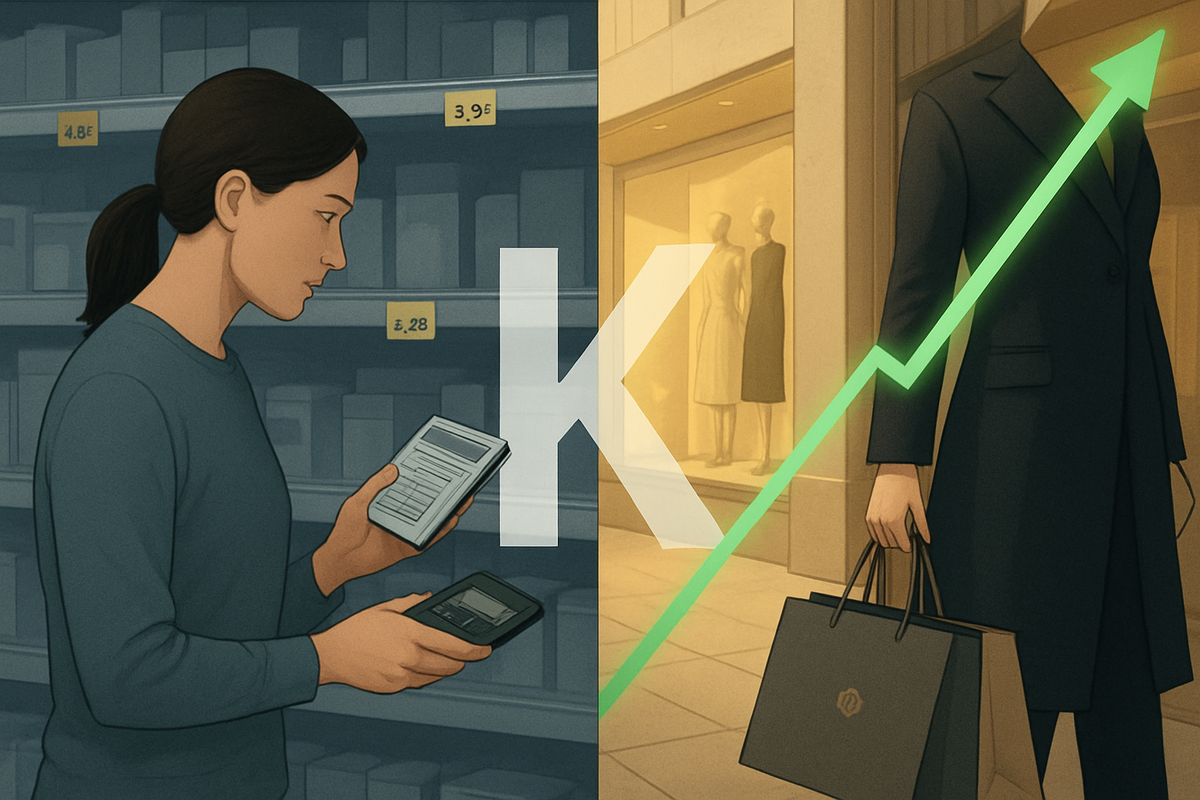
As of February 6, 2026, the American consumer landscape has fractured into two distinct realities, creating a "K-shaped" economic environment that is redefining the retail and service sectors. While a record-breaking stock market and robust asset growth have propelled affluent households to new heights of discretionary spending, lower-income Americans are retreating under the combined weight of persistent inflation, record household debt, and the lingering economic scars of the 43-day federal government shutdown that paralyzed the nation in late 2025.
This divergence is increasingly visible in the quarterly earnings of major corporations. High-income households, particularly the top 20%, saw their spending grow at an estimated 2.7% year-over-year in the final quarter of 2025. In stark contrast, lower-income households—those earning under $75,000—managed a meager 0.7% growth, focusing almost exclusively on essentials. The "wealth effect," a phenomenon where rising asset prices boost consumer confidence and spending among the wealthy, has become the primary engine of the U.S. economy, even as the broader population grapples with a "spending hangover" from the holiday season and the pervasive use of Buy Now, Pay Later (BNPL) services.
The Tale of Two Consumers: From Shutdown to Spending Gaps
The current state of consumer behavior is heavily influenced by the chaos of late 2025. The federal government shutdown, which lasted from October 1 to November 12, 2025, disrupted everything from federal paychecks to the release of critical economic data. While the "wealthy 20%" remained largely insulated from the immediate fallout of the shutdown, the middle and lower classes faced significant uncertainty, leading to a pull-back in discretionary categories like mid-tier apparel and home furnishings.
Timeline-wise, the surge in the equity markets through 2025—largely driven by the "AI Supercycle" and tech earnings—created a massive cushion for affluent consumers. This demographic has shifted its focus toward "experiential luxury" and high-end services. According to reports from major financial institutions, households earning over $150,000 have increased their discretionary spending by double digits compared to pre-2020 levels. This spending is not just in goods but in bespoke travel, private healthcare, and exclusive memberships, shielding high-end service providers from the volatility seen elsewhere in the market.
Market reactions have been swift. Investors have begun to favor a "barbell" investment strategy, piling into either extreme luxury or deep-discount retail. The middle-market—once the backbone of the American economy—is increasingly being referred to by analysts as the "dead zone," where brands struggle to offer enough value to the price-conscious or enough prestige to the asset-rich.
Corporate Winners and the Mid-Tier Reckoning
The divergence in spending has created a clear set of winners and losers among public companies. At the top of the "barbell," luxury icons and tech giants are thriving. Hermès (OTC: HESAY) and Richemont (OTC: CFRUY) have reported resilient demand, with Hermès seeing sales rise 11% in late 2025 as the ultra-wealthy continue to view high-end leather goods as "investment-grade" assets. Meanwhile, Apple (NASDAQ: AAPL) has defied expectations, reporting record demand for the iPhone 17 and a surge in Services revenue, which reached $109 billion in early 2026, proving that high-income tech users remain loyal even in a bifurcated economy.
At the other end of the spectrum, Walmart (NYSE: WMT) has emerged as a dominant force by capturing "trade-down" traffic. Walmart reported a record net income of $19.4 billion for the 2025 fiscal year, fueled by high-earners seeking value in groceries and an aggressive expansion of its advertising arm, Walmart Connect. Amazon (NASDAQ: AMZN) similarly continues to win by leveraging its "Amazon Access" program for SNAP benefit recipients while simultaneously serving the affluent through its high-margin AWS and Prime services.
Conversely, the losers are found in the squeezed middle. Target (NYSE: TGT) has struggled with its discretionary-heavy product mix, facing a multi-year decline in home goods and apparel sales as its core middle-class customer base pulls back. Kohl's (NYSE: KSS) and other mall-based retailers continue to face store closures and declining foot traffic. Perhaps most notably, the luxury sector isn't immune to poor management; the recently formed Saks Global (following the Saks/Neiman Marcus merger) is reportedly facing a "reckoning" period due to high debt levels and a slowdown in aspirational, rather than ultra-high-net-worth, luxury spending.
Asset Inflation and the Wealth Effect Precedent
The wider significance of this trend lies in the "wealth effect" created by the stock market's performance over the last two years. The S&P 500's significant gains since 2024 have created trillions of dollars in paper wealth for those with exposure to equities. Historically, this mirrors the post-2008 recovery, where asset price inflation significantly outpaced wage growth for the bottom 50% of earners. However, the 2026 version of this trend is exacerbated by the "AI-driven" concentration of wealth in the technology sector.
This event fits into a broader industry trend toward "fractionalization." We are seeing the marketplace divide into specialized niches that cater to very specific economic tiers. Regulatory and policy implications are also looming; with Core PCE inflation remaining "sticky" at 2.8%–2.9% in late 2025, the Federal Reserve remains in a difficult position. Raising rates to cool the spending of the wealthy risks further crushing the lower-income consumer who is already struggling with high credit card interest rates, which have hovered near record highs into 2026.
Looking Ahead: A Spending Hangover or a New Normal?
In the short term, the market is bracing for the "spending hangover" as holiday bills from Buy Now, Pay Later services come due in February and March 2026. This could lead to a further dip in retail sales for non-essential goods. However, for companies catering to the top tier, the outlook remains bullish. If the stock market continues its current trajectory, the luxury and high-end service sectors are projected to grow by 5%–6% through the remainder of 2026.
Strategic pivots are already underway. Many mid-tier retailers are attempting to "premiumize" their offerings to attract more affluent shoppers or "discount" their way into the hearts of the budget-conscious. The challenge for 2026 will be the "data lag" caused by the 2025 government shutdown. Investors will be flying partially blind until mid-February, when a backlog of delayed jobs reports, CPI, and PCE data is finally released. This lack of transparency may lead to increased market volatility in the coming weeks.
Summary and Investor Outlook
The start of 2026 has confirmed that the U.S. consumer is no longer a monolith. The "K-shaped" economy is in full effect: the wealthy are spending their stock market gains on experiences and luxury, while the rest of the population is making hard choices between brands and essentials. The resilience of the American economy is currently being sustained by the top 20%, but this creates a fragile foundation if the equity markets were to experience a significant correction.
For investors, the coming months will be critical. Watch for the delayed economic reports—specifically the Jobs Report on February 11 and CPI on February 13—to see if the labor market is cooling enough to allow the Fed to provide relief to the lower-income tier. Until then, the "barbell" strategy remains the most viable path, favoring giants like Walmart (NYSE: WMT) for stability and Apple (NASDAQ: AAPL) or Hermès (EPA: RMS) for growth within the affluent segment. The lasting impact of this period may be a permanent shift in how retailers approach the American market, moving away from a broad "middle-class" focus to a more bifurcated, tier-based strategy.
This content is intended for informational purposes only and is not financial advice.