In a definitive signal that the world’s largest retailer has completed its metamorphosis into a technology powerhouse, Walmart Inc. (NYSE: WMT) has issued a bold outlook for Fiscal Year 2027, targeting operating income growth of 6% to 8%. This guidance, delivered during the company’s Q4 FY26 earnings presentation on February 19, 2026, highlights a "structural leverage" strategy where profits are projected to grow at nearly double the rate of sales. The aggressive target is anchored by a massive multi-year investment in supply chain automation and proprietary generative AI, marking a historic shift in how the retail giant extracts value from its global operations.
The immediate implications for the market are clear: Walmart is no longer just competing on price; it is competing on margin efficiency. By guiding for 3.5% to 4.5% net sales growth while significantly outpacing that with operating income, Walmart is signaling to investors that the heavy capital expenditure of the previous three years is finally hitting the bottom line. As of February 27, 2026, the company’s stock has responded with a surge in valuation, reflecting investor confidence in a retail model that increasingly resembles a high-margin software ecosystem rather than a traditional brick-and-mortar chain.
The Engines of Efficiency: Robotics and AI
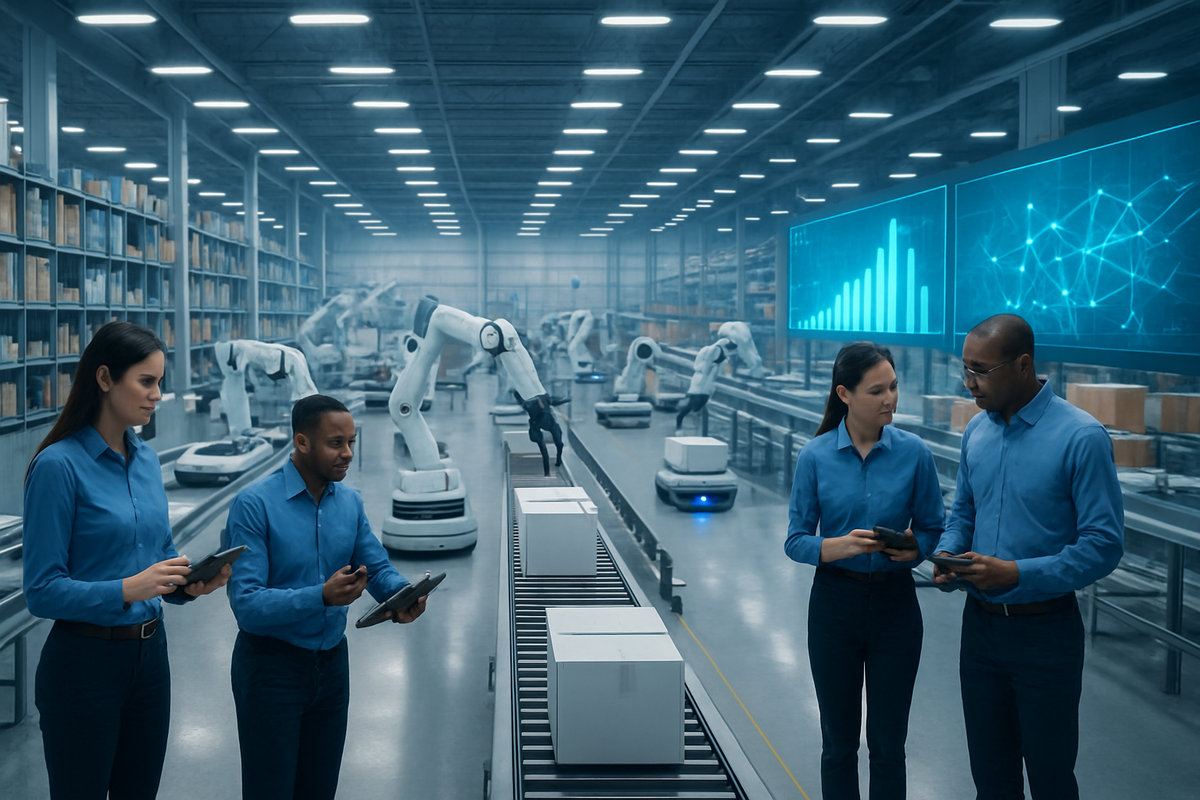
The specifics of the FY27 outlook center on a "return phase" of Walmart’s massive investment cycle. During the mid-February earnings call, CEO Doug McMillon and CFO John David Rainey detailed a roadmap that relies on a 20% reduction in average unit costs, driven primarily by the company's deepening integration with Symbotic Inc. (Nasdaq: SYM). This partnership has reached a critical tipping point: as of early 2026, approximately 60% of Walmart’s U.S. stores are now serviced by automated regional distribution centers (RDCs), up from just a fraction two years ago.
The timeline leading to this moment has been a calculated sprint. Since 2024, Walmart has been retrofitting 23 of its 42 regional centers with Symbotic’s AI-enabled robotics. Simultaneously, the company has rolled out its proprietary "Wallaby" Large Language Models (LLMs), which are trained on decades of internal transaction data. These models now govern everything from dynamic pricing to real-time inventory replenishment, allowing the company to grow its inventory at just 2.6%—roughly half the rate of its sales growth. This efficiency has freed up billions in working capital, which the board has promptly funneled into a record-breaking $30 billion share repurchase authorization.
Industry reaction has been overwhelmingly positive, with analysts noting that Walmart's move to the Nasdaq in late 2025 was a precursor to this "tech-first" guidance. The integration of the "Four Super Agents"—AI personas designed to assist customers, associates, suppliers, and developers—has already shown tangible results. The "Customer Agent," known internally as Sparky, has reportedly increased average order values by 35% by providing project-based shopping assistance rather than simple keyword searches.
Winners, Losers, and the Shifting Competitive Landscape
The primary winner in this shift is undoubtedly Walmart Inc. (NYSE: WMT) itself. By successfully decoupling profit growth from sales volume, the company is insulating itself against the traditional retail pressures of wage inflation and fluctuating consumer demand. However, the ripple effects extend to its technology partners. Symbotic Inc. (Nasdaq: SYM) stands as a major beneficiary, as its hardware and software now serve as the central nervous system for Walmart’s logistics. Following the 2025 acquisition of Walmart’s internal robotics unit by Symbotic, the two are now co-developing 400 Accelerated Pickup and Delivery (APD) centers, cementing a symbiotic relationship that makes SYM a staple in the "Retail 4.0" era.
Conversely, traditional competitors such as Target Corporation (NYSE: TGT) and Costco Wholesale Corporation (Nasdaq: COST) find themselves under renewed pressure. While Target has made strides in its "stores-as-hubs" model, it lacks the sheer scale of Walmart’s automated distribution infrastructure. To maintain competitive pricing without eroding margins, these retailers may be forced to accelerate their own capital-intensive automation programs, potentially leading to short-term earnings volatility. Amazon.com Inc. (Nasdaq: AMZN) remains the chief rival, but Walmart’s ability to leverage its 4,700 physical locations as automated fulfillment centers gives it a "last-mile" cost advantage that even the e-commerce giant is struggling to match in rural and suburban markets.
The workforce remains a more complex stakeholder. While Walmart’s "Associate Agent" AI is designed to automate mundane tasks like scheduling and inventory tracking, the long-term role of the traditional warehouse worker is being fundamentally redefined. While the company claims these tools empower employees, labor advocates are closely monitoring how the 20% unit-cost reduction target might impact total headcount over the next several fiscal cycles.
Agentic Commerce and the Nasdaq Gambit
Walmart’s FY27 strategy is a landmark event in the broader trend of "Agentic Commerce." The industry is moving away from the "search bar" era toward an "assistant" era, where AI proactively manages consumer needs. By launching the Wallaby LLMs, Walmart has bypassed general-purpose models like those from OpenAI in favor of specialized, retail-specific intelligence. This trend suggests that proprietary data is becoming the most valuable asset in the retail sector—more so than even store locations or brand loyalty.
Historically, retail has been a low-margin, volume-driven business. Walmart’s current trajectory draws comparisons to the "just-in-time" revolution of the 1980s, but with a digital layer. The move to the Nasdaq and the focus on "structural leverage" reflect a broader "tech-ification" of the S&P 500. Regulatory bodies are likely to take notice, particularly regarding the use of dynamic pricing and the collection of deep-funnel consumer data through AI agents. As Walmart uses AI to set prices in real-time based on local inventory and competitor moves, questions regarding algorithmic collusion or consumer transparency may arise.
Furthermore, the "Nasdaq Gambit"—the company's shift in listing—is a psychological milestone. It signals that the market now values Walmart based on its technological moat rather than just its same-store sales. This could trigger a re-rating of other legacy companies that are successfully integrating AI at scale, shifting the investment landscape toward "legacy tech" hybrid models.
Optimization and the Path to 2027
Looking ahead to the remainder of 2026 and into 2027, the focus will shift from "installation" to "optimization." The short-term challenge for Walmart will be the seamless execution of the 400 APD centers. Any technical hiccups in these store-level automated hubs could disrupt the "Instant Delivery" promise that currently covers 95% of U.S. households. However, if successful, the long-term possibility includes a licensing model where Walmart could potentially sell its "Wallaby" AI capabilities or automated logistics "as-a-service" to smaller retailers, creating a new high-margin revenue stream.
Strategic pivots may also be required in the international market. While the U.S. infrastructure is rapidly automating, scaling these systems in markets like Mexico or India through the Flipkart ecosystem presents unique logistical and regulatory hurdles. Investors should also watch for potential M&A activity in the AI space. As Walmart looks to refine its "Super Agents," it may seek to acquire boutique AI firms specializing in computer vision or natural language processing to maintain its lead over Amazon.
A New Blueprint for Retail
Walmart’s FY27 outlook is a definitive statement of intent. By targeting 6% to 8% operating income growth through the aggressive adoption of AI and automation, the company is rewriting the playbook for global retail. The key takeaways for the market are the 20% improvement in unit costs and the successful deployment of the Wallaby LLMs, which together create a formidable barrier to entry for competitors.
As we move forward into 2026, the market will be watching for the consistency of these margin gains. If Walmart can maintain this "structural leverage," it will likely see a permanent upward shift in its valuation multiples. For investors, the message is clear: the "New Walmart" is a technology company that happens to sell groceries and general merchandise. The coming months will be a litmus test for whether AI can truly transform the bottom line of a $600 billion-plus revenue giant, or if the "Automation Premium" is already priced into the stock.
This content is intended for informational purposes only and is not financial advice.