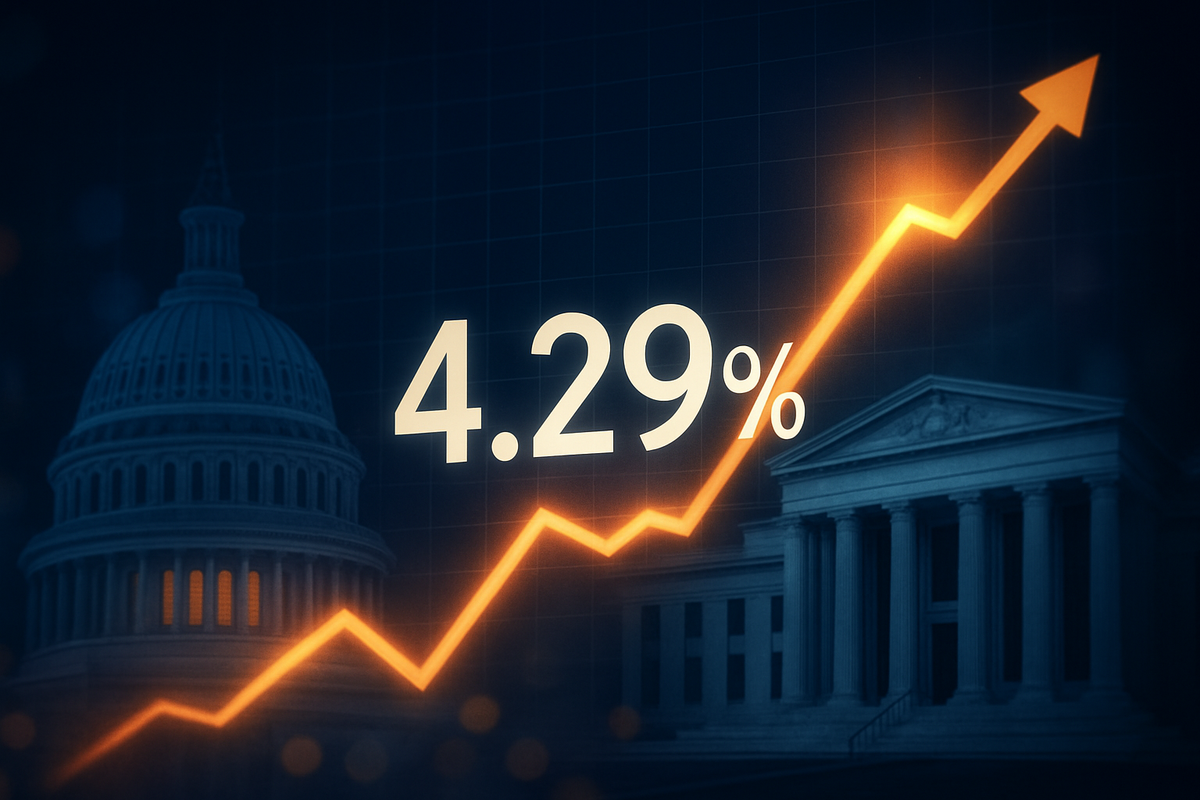
The sovereign bond market sent a clear signal to Washington and Wall Street this month as the benchmark 10-year Treasury yield surged to a multi-month high of 4.29% on January 20, 2026. This sharp move upward reflects a growing consensus among investors that the Federal Reserve may be physically unable to deliver the rate cuts it signaled late last year. Driven by a volatile mix of aggressive fiscal expansion and stubborn inflationary pressures from 2025’s trade policies, the "higher for longer" narrative has returned with a vengeance, casting a shadow over the start of the 2026 trading year.
As of January 26, 2026, the yield has settled slightly to 4.22%, but the underlying anxiety remains palpable. Market participants are increasingly skeptical of the central bank's independence and its ability to tame inflation while the federal government injects trillions into the economy through the "One Big Beautiful Bill Act" (OBBBA). The current environment has created a fundamental disconnect between a white-hot fiscal policy and a central bank that is theoretically trying to cool the engine, leaving the 10-year yield as the ultimate barometer of this economic tug-of-war.
The Fiscal Catalyst: Deficits and the "OBBBA" Impact
The primary driver behind the recent yield spike is the transition of the One Big Beautiful Bill Act (OBBBA) from legislative theory to economic reality. Signed into law in July 2025, the act made the 2017 tax cuts permanent and significantly increased child tax credits and standard deductions. As taxpayers begin filing their returns this January, the Internal Revenue Service is projecting a staggering 44% increase in aggregate tax refunds. This massive liquidity injection, estimated to add $4.1 trillion to the national debt over the next decade, has forced the Treasury Department to ramp up bond issuance, flooding the market with supply and pushing prices down and yields up.
The timeline leading to the 4.29% peak began in late 2025, when a series of aggressive tariffs on European and Canadian goods reignited fears of a second wave of inflation. By early January 2026, the bond market began pricing in a "term premium" for the risk of holding long-term debt in an era of 7% deficit-to-GDP ratios. Institutional investors, led by major sovereign wealth funds and domestic pension managers, shifted their portfolios toward shorter-duration assets, exacerbating the sell-off in the 10-year note.
Initial market reactions have been a "risk-off" move for equities, particularly in sectors sensitive to borrowing costs. The Federal Open Market Committee (FOMC) is now entering its first meeting of 2026 with a newly hawkish voting rotation. Three of the four incoming regional bank presidents have publicly expressed concerns that cutting rates now would be "pouring gasoline on a fiscal fire," directly contradicting the hopes of an administration that has been vocally demanding lower borrowing costs to support its industrial agenda.
Winners and Losers in a High-Yield Environment
The sudden jump to 4.29% has created a stark divide in the equity markets. Traditional "value" sectors and those with heavy capital expenditure needs are navigating a complex landscape. For example, industrial giants like Caterpillar (NYSE: CAT) and Deere & Co. (NYSE: DE) may actually find a silver lining; the OBBBA’s restoration of business interest deductibility to 30% of EBITDA—up from 30% of EBIT—lowers the effective cost of capital for these debt-heavy firms, potentially offsetting the headline increase in Treasury rates.
Conversely, the housing market and high-growth technology sectors are feeling the heat. Homebuilders like D.R. Horton (NYSE: DHI) and Lennar Corp. (NYSE: LEN) saw their share prices retreat as the 30-year fixed mortgage rate tracked the 10-year yield higher, threatening to freeze an already tight housing market. In the tech space, the "Magnificent Seven" stocks, including Nvidia (NASDAQ: NVDA) and Microsoft (NASDAQ: MSFT), faced valuation compression. When the "risk-free" rate on a 10-year Treasury approaches 4.3%, the present value of future earnings for high-growth companies becomes less attractive, prompting a rotation into more defensive postures.
The banking sector presents a mixed bag. While JPMorgan Chase (NYSE: JPM) and Bank of America (NYSE: BAC) traditionally benefit from higher net interest margins when yields rise, the speed of the move is a concern. A rapid spike in yields can lead to unrealized losses on existing bond portfolios, a ghost that has haunted the sector since the regional banking crisis of 2023. Investors are closely watching how these institutions manage their duration risk as the 10-year yield threatens to break above 4.5%.
A Broader Trend of Fiscal Dominance
This event fits into a broader global trend of "fiscal dominance," where government spending levels become so significant that they dictate the direction of monetary policy, rather than the other way around. The U.S. is not alone in this; several G7 nations are grappling with aging populations and high debt loads, but the scale of the American stimulus via the OBBBA has made the 10-year Treasury a global outlier. The yield jump suggests that the "bond vigilantes"—investors who sell bonds to protest inflationary fiscal policy—have returned after a decade of dormancy.
Historically, this period mirrors the late 1970s, where fiscal expansion and supply shocks created a feedback loop that the Fed struggled to break. The current situation is further complicated by political drama surrounding Fed Chair Jerome Powell, who is currently navigating a DOJ investigation that many in the market perceive as political pressure to align the Fed with the current administration’s "pro-growth" (and pro-inflation) stance. This erosion of central bank independence is a significant ripple effect that could fundamentally change how global markets price U.S. sovereign risk for years to come.
Furthermore, the "Higher for Longer" reality is creating a divergence between the U.S. and its partners. As the 10-year yield stays elevated, the U.S. Dollar (DXY) remains disproportionately strong, making American exports more expensive and putting immense pressure on emerging markets that hold dollar-denominated debt. This global ripple effect could eventually lead to international calls for coordinated currency intervention, similar to the Plaza Accord of the 1980s.
The Road Ahead: Potential Strategic Pivots
In the short term, all eyes are on the upcoming FOMC statement. If the Fed remains silent on the yield spike, markets may interpret it as a "green light" for the 10-year yield to test the 4.5% or even 5.0% level. Financial institutions will likely pivot toward more aggressive hedging strategies, using interest rate swaps and options to protect against further volatility. For the average investor, the "60/40" portfolio is being tested once again, as bonds fail to provide the traditional cushion against equity volatility when yields and stocks fall in tandem.
Long-term, the Treasury Department may be forced to change its issuance strategy. If long-term yields remain prohibitively high, the government might "bill-heavy" its financing—issuing more short-term debt to wait out the high rates. However, this strategy carries the risk of a "maturity wall" that could lead to even greater instability if rates don't eventually fall. Market opportunities may emerge in "inflation-protected" securities (TIPS) and commodities, as investors look for hedges against a fiscal policy that seems untethered from traditional debt constraints.
Market Outlook and Final Thoughts
The surge in the 10-year yield to 4.29% is more than just a technical breakout; it is a fundamental reassessment of the American economic trajectory. The collision of a $4.1 trillion fiscal stimulus package with a central bank trying to maintain its inflation-fighting credibility has created a high-stakes environment for all asset classes. The key takeaway for investors is that the era of "easy money" and predictable rate cuts is firmly in the rearview mirror, replaced by a complex landscape of fiscal dominance and geopolitical friction.
Moving forward, the market will likely remain in a state of "heightened vigilance." Investors should watch for three specific signals: the Fed's rhetoric regarding "neutral rates," the actual inflation data as the OBBBA stimulus hits consumer bank accounts in February, and any developments regarding the succession or independence of the Federal Reserve Chair. As we navigate the early months of 2026, the 10-year Treasury yield will remain the most critical number in finance, serving as a constant reminder that even the world's largest economy cannot outrun the laws of fiscal gravity forever.
This content is intended for informational purposes only and is not financial advice.