As the world prepares for the holiday break, the financial markets have delivered a historic gift—or a stark warning—to investors. On this Wednesday, December 24, 2025, gold and silver have surged to unprecedented all-time highs, defying traditional market logic by rallying alongside a record-breaking stock market. The dual surge represents a seismic shift in global finance, as the "debasement trade" takes center stage against a backdrop of geopolitical volatility and a structural pivot in central bank reserves.
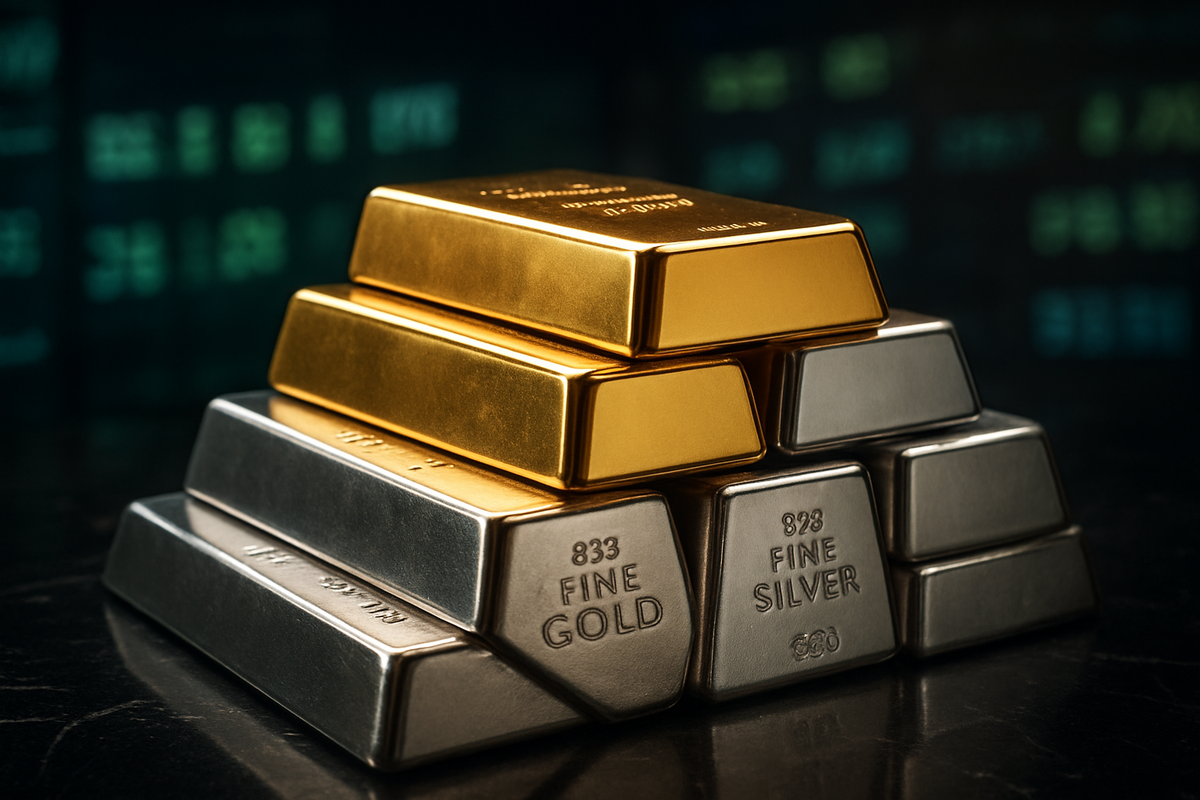
Gold prices officially breached the psychological $4,500 per ounce barrier early this morning, touching an intraday peak of $4,530. Not to be outdone, silver has staged a vertical ascent, smashing through $70 to reach a record $72.70 per ounce. While the S&P 500 continues to ride the wave of the artificial intelligence revolution, the parabolic move in precious metals suggests that institutional capital is simultaneously hedging against a long-term erosion of fiat currency value and a precarious geopolitical landscape.
A Perfect Storm: The Path to $4,500 Gold
The road to today’s record-breaking prices was paved by a series of high-impact events throughout 2025. The rally began in earnest during the second half of the year when the Federal Reserve executed three consecutive interest rate cuts. These moves, intended to engineer a soft landing, inadvertently signaled to the markets that the era of "higher for longer" was over, drastically reducing the opportunity cost of holding non-yielding assets. Consequently, the U.S. Dollar Index (DXY) experienced its most significant annual decline since 2017, providing a powerful tailwind for dollar-denominated commodities.
However, the primary driver of the Q4 surge has been the "war premium." In early December 2025, a naval blockade involving Venezuelan oil tankers escalated into a direct military standoff in the Caribbean, sparking fears of a broader regional conflict. This geopolitical flashpoint, combined with the lack of resolution in the Middle East and Eastern Europe, forced hedge funds and sovereign wealth funds to scramble for "safe-haven" liquidity. The timeline of this rally shows a distinct acceleration following the U.S. government’s decision to include silver on the Critical Minerals List in November, recognizing its indispensable role in the green energy transition and defense technologies.
Central banks have also played a decisive role as the "silent architects" of this price floor. Throughout 2025, a coalition of nations led by Poland, China, and India aggressively diversified their reserves away from the U.S. dollar. Poland, in particular, made headlines by raising its gold reserve target to 30% of total assets, purchasing hundreds of metric tons. This movement toward "monetary sovereignty" has created a persistent demand sink that absorbed any minor sell-offs, effectively floor-pricing gold at levels previously thought unreachable.
Mining Titans and Industrial Victims: The Market Impact
The primary beneficiaries of this price explosion are the major mining corporations, which are currently reporting record-breaking free cash flows. Newmont Corporation (NYSE: NEM), the world’s largest gold producer, has seen its stock price skyrocket by over 170% year-to-date, trading near $102.00. By maintaining stable all-in sustaining costs (AISC) through 2025, Newmont has been able to convert almost the entirety of the price surge into pure profit, leading to a massive expansion of its dividend program.
Similarly, Barrick Gold (NYSE: GOLD) has leveraged its "dual-metal" strategy to outperform. With copper prices also hovering near $12,000 per ton, Barrick’s significant copper portfolio has complemented its gold gains, making it a darling for diversified commodity investors. In the silver space, Pan American Silver (NYSE: PAAS) has emerged as a top performer, capitalizing on the physical silver squeeze. Streaming companies like Wheaton Precious Metals (NYSE: WPM) have also thrived; because they provide upfront capital in exchange for future production at fixed costs, they have captured the full upside of the $72 silver price without being exposed to the inflationary pressures of diesel and labor that affect traditional miners.
Conversely, the "losers" in this scenario are the industrial manufacturers that rely heavily on silver as a raw material. Solar panel manufacturers like First Solar (NASDAQ: FSLR) and electronics giants are facing a severe margin squeeze. Silver is a critical component in photovoltaic cells and high-end circuit boards; with prices up 150% year-to-date, the cost of production for renewable energy technology has spiked, potentially slowing the pace of the global energy transition unless these costs can be passed on to consumers.
The Broader Significance: A Shift in the Global Order
The current rally in gold and silver is not merely a speculative bubble; it is a symptom of a broader shift in the global financial architecture. For decades, gold and stocks maintained an inverse relationship. The fact that both are hitting records simultaneously in late 2025 suggests that the market is bifurcating. While investors remain optimistic about the growth potential of technology and AI, there is a growing consensus that the underlying currencies—specifically the U.S. dollar—are being debased by unsustainable sovereign debt levels.
This "debasement trade" reflects a historical precedent similar to the late 1970s, where high inflation and geopolitical instability drove a massive flight to hard assets. However, the 2025 version is unique due to the "de-dollarization" trend. Central banks are no longer just buying gold for safety; they are buying it as a replacement for Treasury bonds. This structural change in how nations view their reserves suggests that the current highs may become the new baseline for the next decade.
Furthermore, the inclusion of silver on the Critical Minerals List has redefined the metal's role. It is no longer just "poor man's gold" or a speculative play; it is now viewed as a strategic national asset. This regulatory shift has invited institutional players who previously avoided the volatile silver market, providing a level of liquidity and price support that was absent in previous cycles.
What Lies Ahead: The 2026 Outlook
As we move into 2026, the market must grapple with whether these prices are sustainable. In the short term, a period of consolidation is likely as traders take profits following the 2025 holiday rally. However, the long-term fundamentals remain overwhelmingly bullish. If the Federal Reserve continues its easing cycle to manage the interest burden on U.S. debt, the tailwinds for gold and silver will only intensify. Strategic pivots are already occurring, with many institutional portfolios shifting from a traditional 60/40 (stocks/bonds) model to a 50/30/20 model that includes a 20% allocation to alternative "hard" assets.
The potential for a "silver squeeze" remains a high-probability scenario for 2026. With industrial demand from the EV and solar sectors projected to outpace mining supply for the fifth consecutive year, the physical market is reaching a breaking point. Investors should watch for any signs of supply chain nationalization, where countries might restrict the export of silver to protect their own domestic green energy industries—a move that could send prices well above the current $72 record.
Final Reflections for the Investor
The record-breaking performance of gold and silver on this Christmas Eve marks the culmination of a year defined by the search for stability in an unstable world. The key takeaway for investors is that the "everything rally" of 2025 is built on two different foundations: the promise of technological growth and the fear of currency devaluation. Moving forward, the market will likely remain sensitive to geopolitical developments in the Caribbean and any shifts in the Federal Reserve's inflation-targeting rhetoric.
As we enter 2026, the primary metric to watch will be central bank accumulation. If the trend of diversification continues at its current pace, the $4,500 gold and $70 silver prices we see today may eventually be viewed as a bargain. For now, the "Hard Asset Super-Cycle" appears to be in full swing, and the traditional rules of the market have been rewritten for a new era of global finance.
This content is intended for informational purposes only and is not financial advice.