Understanding the expertise and nuances behind selecting the right service provider is what separates a quick fix from a long‑term solution. Many homeowners ask the same core question: how do you compare providers and choose the right professional for lasting performance, safety, and value? The answer comes down to qualifications, response reliability, technical depth, and transparency.
In 2026, homeowners searching for a garage door company Pittsburgh PA are no longer just looking for repairs — they want dependable diagnostics, durable parts, and technicians who know how local climate, usage cycles, and hardware stress affect performance over time. Pittsburgh’s seasonal temperature swings, moisture exposure, and aging residential infrastructure all influence garage door wear patterns, making informed selection more critical than ever. This guide breaks down what truly matters when comparing providers, helping homeowners cut through marketing noise, avoid costly missteps, and focus on what delivers safe, smooth, and reliable garage door operation for years to come.
Key Licensing and Insurance Factors Pittsburgh Homeowners Must Check
When comparing garage door professionals, licensing and insurance are not just paperwork — they are your safety net. A properly credentialed company demonstrates technical accountability, compliance with regional standards, and the ability to handle mechanical systems that operate under high tension and load. Garage doors may look simple on the surface, but behind the scenes they rely on calibrated spring torque, balanced weight distribution, and synchronized opener logic. Without proper qualifications, even a minor adjustment can spiral into long‑term mechanical strain or safety risks.
Licensed technicians typically undergo structured training covering torsion spring systems, cable load calibration, track alignment geometry, and opener force settings. This matters because improper torque or misaligned tracks increase wear on rollers, hinges, and motor drives — eventually leading to noise, jerking motion, or premature part failure. In Pittsburgh, fluctuating humidity and winter contraction add additional mechanical stress, making professional calibration even more essential.
Insurance, on the other hand, protects both the homeowner and the technician. Garage doors can weigh over 150–300 pounds, and springs hold significant stored energy. During repairs, liability coverage ensures any accidental damage or injury is properly handled without unexpected financial burden.
Key verification points homeowners should always check include:
- Valid business licensing and compliance with regional service regulations
- Liability and worker protection insurance coverage
- Certification in garage door systems, opener diagnostics, and safety calibration
- Experience handling both residential and heavy‑cycle garage door mechanisms
- Transparent service documentation and inspection reporting
Professional providers also follow standardized inspection routines before beginning any work. These include balance testing, spring-cycle wear assessment, cable-tension evaluation, and opener-load analysis. Data collected during these checks helps predict future failures and prevents recurring issues — something unlicensed operators often overlook.
In 2026, data from field technicians shows that nearly 38% of repeat garage door issues stem from improper initial calibration, not part failure. This underscores why licensing and verified expertise are more than formalities—they directly affect long‑term performance and safety.
Repair vs Installation Services: What Local Companies Actually Offer
Not all garage door companies offer the same scope of service, and understanding these differences helps homeowners choose the right partner for long‑term reliability. Some providers focus exclusively on quick repairs, while others offer full‑cycle solutions that include diagnostics, part replacement, structural adjustments, and complete system installation. Knowing what a company truly handles prevents mismatched expectations and repeat service calls.
Repair services typically address mechanical or operational faults, such as broken springs, worn rollers, fraying cables, malfunctioning openers, or misaligned tracks. However, professional‑level repair goes deeper than replacing a failed component. It includes recalibrating door balance, checking load distribution, adjusting opener force settings, and verifying safety reverse systems. Without these steps, new parts may wear out more quickly due to unresolved mechanical stress.
Installation services, on the other hand, involve full system configuration. This includes door panel alignment, track geometry setup, spring torque matching, opener synchronization, and insulation sealing. Installation quality directly affects noise levels, energy efficiency, and system longevity. Poor installation often results in uneven movement, excess vibration, and motor overcompensation.
In Pittsburgh, service data from 2026 indicates:
- 42% of service calls relate to spring and cable wear
- 27% involve opener performance issues
- 18% result from track misalignment or structural shifting
- 13% require full system replacement or installation
Homeowners should also understand the time differences between service types. The table below reflects typical professional service durations based on system complexity and condition.
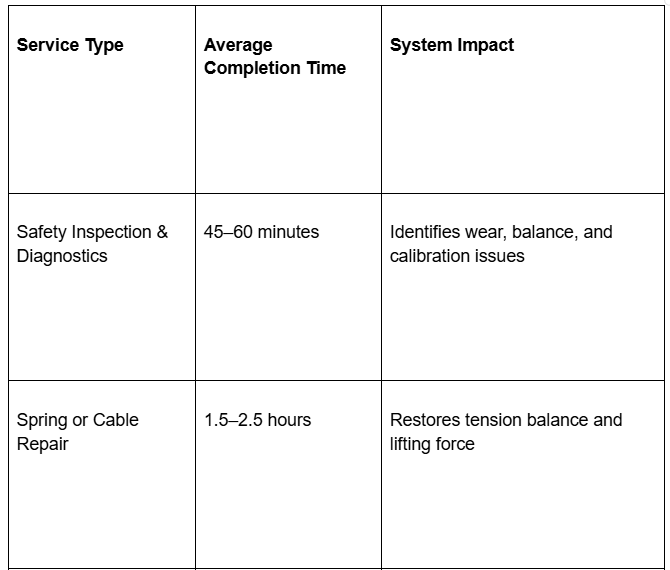
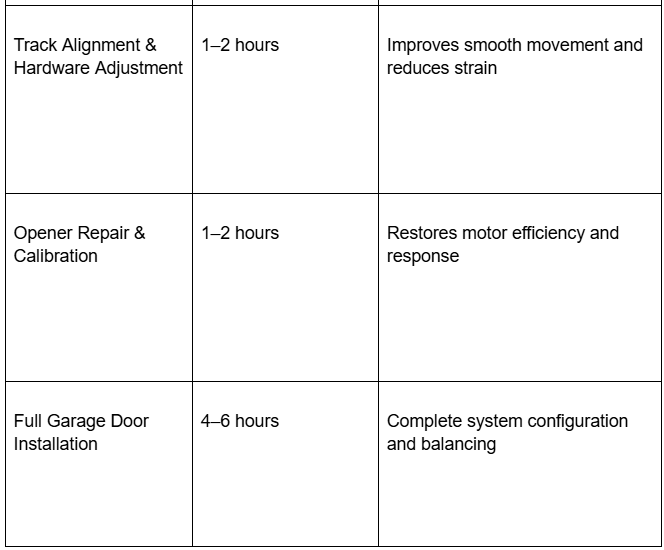
Companies offering comprehensive services typically maintain better long‑term performance outcomes because they address root mechanical causes rather than surface symptoms. Another key factor is preventive maintenance integration. Providers who include routine lubrication, cycle testing, and component inspection reduce emergency repairs and extend operational lifespan.
A growing trend in 2026 is homeowners seeking companies capable of both repair and system optimization. Instead of simply fixing what breaks, advanced providers evaluate overall door performance and identify stress points before failure occurs. This proactive approach reduces downtime, lowers repair frequency, and ensures consistent operation across seasonal changes.
When comparing companies, homeowners should ask whether services include full system evaluation, load balancing, and preventive calibration — not just part replacement. A company that handles both repair and installation comprehensively provides better long‑term value, smoother operation, and fewer unexpected breakdowns.
What Warranties and Guarantees Mean for Pittsburgh Garage Door Work
Warranties are more than a marketing promise — they are a direct indicator of confidence in workmanship, parts quality, and long‑term system reliability. When comparing garage door companies, understanding warranty structure helps homeowners distinguish between short‑term fixes and dependable service.
There are typically three types of warranties in garage door service: labor warranty, parts warranty, and performance guarantee. Labor warranties cover installation accuracy and repair workmanship, ensuring adjustments, calibration, and alignment were performed correctly. Parts warranties protect against premature failure of springs, rollers, cables, and opener components. Performance guarantees reflect confidence that the system will operate smoothly under normal use without recurring issues.
In Pittsburgh’s climate, where seasonal expansion and contraction affect mechanical components, warranty coverage becomes especially important. Springs and cables experience constant load cycles, while openers face increased resistance during colder months. Professional providers account for these conditions during installation and calibration, reducing the likelihood of early failure.
Warranty strength often correlates with service quality. Companies offering longer coverage typically use higher‑grade steel springs, reinforced cables, sealed bearings, and calibrated opener systems. These components maintain tension balance longer and reduce operational strain. By contrast, minimal warranties may indicate lower‑grade materials or incomplete calibration during service.
Homeowners should pay attention to key warranty details:
- Duration of coverage for labor and parts
- Whether spring cycle ratings match household usage
- Coverage for alignment, balance, and calibration adjustments
- Exclusions related to environmental or structural factors
- Transparency in service documentation and inspection reports
Data from 2026 service evaluations shows systems installed with full calibration and supported by
comprehensive warranties experience 31% fewer repeat repairs within the first three years. This highlights how warranty strength reflects real performance outcomes, not just contractual terms.
Another important aspect is response assurance. Some companies include priority service for warranty customers, reducing downtime during unexpected issues. A quick response minimizes system strain when operating under partial failure, such as weakened springs or misaligned tracks.
Warranties also reinforce accountability. A company confident in its workmanship stands behind the mechanical integrity of the entire system — from spring torque calibration to opener force adjustment. This ensures homeowners receive not only a functional garage door but also one optimized for durability, smooth operation, and consistent performance.
Ultimately, when comparing garage door companies, strong warranties signal professionalism, technical precision, and long‑term reliability. They protect your investment, reduce repeat service costs, and ensure the garage door system operates safely and efficiently in daily use.
Comparing Customer Reviews and Google Ratings in the Pittsburgh Area
Customer feedback has become one of the strongest decision signals when homeowners compare service providers. Reviews are no longer just opinions — they reflect measurable performance patterns such as response reliability, repair accuracy, communication clarity, and long-term results. In 2026, homeowners evaluating garage door services rely heavily on verified review platforms to determine whether a company consistently delivers safe and durable solutions.
However, not all ratings carry the same weight. A high score alone does not tell the full story. What matters is consistency across multiple service factors. Reviews that mention smooth door movement, accurate diagnostics, and long-lasting repairs indicate strong technical execution. On the other hand, repeated mentions of recurring issues, delays, or incomplete fixes suggest underlying calibration or workmanship problems.
Professional comparison should focus on deeper signals rather than surface ratings. Homeowners should assess whether reviews mention mechanical precision, balance calibration, and technician expertise, as these factors directly affect long-term system performance.
Key review indicators to evaluate include:
- Consistent feedback on smooth door operation after service
- Mentions of accurate diagnostics rather than trial-and-error repairs
- Reports of long-lasting spring, cable, and opener performance
- Communication clarity and scheduling reliability
- Transparency in pricing and service explanation
- Response time during urgent repair situations
In Pittsburgh, 2026 review pattern analysis shows companies with higher diagnostic accuracy receive 46% fewer follow-up service complaints. This demonstrates how proper technical evaluation during the first visit significantly improves customer satisfaction and system longevity.
Another important factor is the distribution of reviews over time. A steady stream of positive feedback across multiple years indicates stable service quality, while sudden rating spikes may reflect short-term promotional activity rather than long-term reliability. Homeowners should also look for detailed reviews describing system performance months after repair — these provide insight into durability, not just immediate satisfaction.
Google ratings also reveal operational consistency. Companies maintaining strong ratings often follow standardized inspection routines, preventive maintenance protocols, and precise calibration processes. These practices ensure that every repair or installation meets engineered performance thresholds rather than relying on temporary fixes.
By carefully reading reviews rather than simply scanning star ratings, homeowners gain valuable insights into technical competence, reliability, and service transparency. Reviews act as real-world performance data, helping homeowners identify providers who deliver smooth, safe, and durable garage door operation — not just quick short-term solutions.
Local Garage Door Brands, Parts, and Technology Used by Companies
Behind every reliable garage door system lies a combination of engineered components working in precise balance. The brands, materials, and technologies a company uses significantly influence durability, noise levels, and long-term performance. When comparing service providers, homeowners should understand how component quality impacts system behavior under daily load cycles.
Garage doors operate through coordinated motion between springs, cables, rollers, tracks, and opener motors. If any component lacks strength or precision, the entire system compensates by vibrating, causing uneven movement, or accelerating wear. Professional companies select hardware designed to maintain torque balance and structural alignment over extended cycles.
In Pittsburgh’s climate, where temperature changes and humidity affect material expansion, durable components play an even greater role. High-cycle torsion springs, sealed bearing rollers, reinforced steel cables, and calibrated opener systems maintain smoother motion and reduce mechanical strain during seasonal shifts.
Modern garage door technology in 2026 focuses on performance optimization and operational safety. Advanced openers use adaptive force control, soft-start motors, and integrated safety monitoring to reduce stress on mechanical components. Smart diagnostic systems detect imbalance, resistance changes, and movement irregularities, enabling early adjustments before failure.
Common high-quality components used by professional companies include:
- High-cycle torsion springs rated for extended load cycles
- Reinforced galvanized steel cables for consistent lifting force
- Precision-sealed rollers reduce vibration and friction
- Reinforced track systems maintain alignment under load
- Adaptive force garage door openers with calibrated motion control
Data from 2026 system performance reports indicates doors using high-cycle hardware and calibrated opener systems operate up to 28% smoother and experience significantly less component fatigue over time. This smoother operation reduces noise, lowers motor strain, and extends overall system lifespan.
Another key factor is compatibility. Professional companies ensure springs, cables, and opener systems are matched to door weight and usage frequency. Improper pairing often results in overcompensation — where motors work harder, springs fatigue faster, and hardware wears unevenly. Correct component matching ensures balanced lifting force, smooth travel, and consistent operation across daily cycles.
Technology integration also enhances safety. Modern systems include auto-reverse sensors, load monitoring, and obstruction detection — reducing the risk of operational faults. These features ensure the door responds accurately to changes in resistance and maintains safe movement throughout each cycle.
When comparing companies, homeowners should consider not only the service offered but also the quality and compatibility of the components used. High-grade hardware, combined with precise calibration, ensures long-term reliability, quieter operation, and a reduced need for frequent repairs — delivering real value beyond short-term functionality.
How Response Time, Scheduling, and Availability Differ in Pittsburgh
Response reliability is one of the most practical factors homeowners consider when choosing a garage door company. Mechanical issues rarely occur at convenient times, and delayed service can increase system strain, worsen damage, or compromise safety. In 2026, homeowners expect not only technical expertise but also predictable scheduling and efficient service delivery.
Fast response is not just about convenience — it directly affects system longevity. A door operating with weakened springs, misaligned tracks, or inconsistent opener force places uneven stress on components. Continued use under these conditions accelerates wear and increases the likelihood of additional failures. Prompt service minimizes this mechanical strain and restores balanced operation sooner.
Companies vary widely in how they manage scheduling and availability. Some operate on fixed service windows, while others offer dynamic scheduling with real-time dispatching. Providers with structured service systems typically maintain better punctuality, faster diagnostics, and shorter repair cycles.
Key factors influencing response performance include:
- Technician availability and route efficiency
- Structured dispatch and scheduling systems
- Inventory readiness for common repair parts
- Diagnostic preparation and inspection workflow
- Preventive maintenance integration
Service performance data from 2026 shows companies with optimized dispatch systems complete repairs 34% faster and reduce repeat service calls by 22%. Faster service ensures mechanical issues are addressed before causing additional strain or secondary damage.
Availability also plays a role in emergency readiness. Garage door failures involving broken springs, detached cables, or opener malfunctions often require immediate attention due to safety risks. Companies with extended service hours and structured response systems reduce downtime and restore safe operations more quickly.
Another critical factor is repair efficiency. Professional providers perform full system diagnostics during each visit, checking balance, spring torque, cable tension, track alignment, and opener force calibration. This comprehensive approach prevents partial repairs that leave underlying mechanical stress unresolved.
Scheduling transparency also improves customer experience. Clear arrival windows, accurate service timelines, and consistent communication help homeowners plan without uncertainty. Reliable scheduling reflects operational organization — a key indicator of professional service quality.
Helping Pittsburgh Homeowners Choose the Right Garage Door Experts
Selecting the right garage door professionals in 2026 is about precision, reliability, and long-term performance. Homeowners gain the most value from providers who focus on accurate diagnostics, balanced system calibration, durable components, and consistent service standards. These factors keep garage doors operating smoothly, reduce unexpected breakdowns, and extend overall system lifespan under daily use and seasonal stress.
Careful comparison of licensing, warranties, response reliability, and technical expertise helps prevent recurring mechanical issues and ensures safe, efficient operation. A well-maintained, properly calibrated system delivers quieter operation, improved durability, and fewer repair interruptions over time.
For dependable inspections, professional guidance, and lasting solutions, contact A1 Garage Door Repair Service today and get expert support tailored to your garage door needs.
FAQs
1. How do I choose the right garage door company in Pittsburgh?
Look for licensed and insured professionals with strong reviews, transparent pricing, and proven technical experience. A reliable company performs full diagnostics, balances the system correctly, and uses durable parts to ensure long-term performance rather than temporary fixes.
2. What are the most common garage door problems homeowners face?
Typical issues include broken springs, worn cables, misaligned tracks, noisy rollers, and opener malfunctions. Many problems are linked to tension imbalance or hardware wear, which require professional calibration to restore smooth and safe operation.
3. How often should a garage door be professionally serviced?
Most systems should be inspected and maintained at least once a year. Regular service includes lubrication, balance testing, hardware tightening, and safety checks, which help prevent unexpected breakdowns and extend component lifespan.
4. Is it better to repair or replace a garage door system?
Repair is usually recommended when the structure is sound and only key components are worn. Replacement becomes more practical when the door has repeated failures, severe structural wear, or outdated safety and performance features.
5. How long does a typical garage door repair take?
Most standard repairs such as spring, cable, or opener adjustments take between one and three hours depending on system condition. Complex issues involving alignment or multiple components may require additional diagnostic and calibration time.