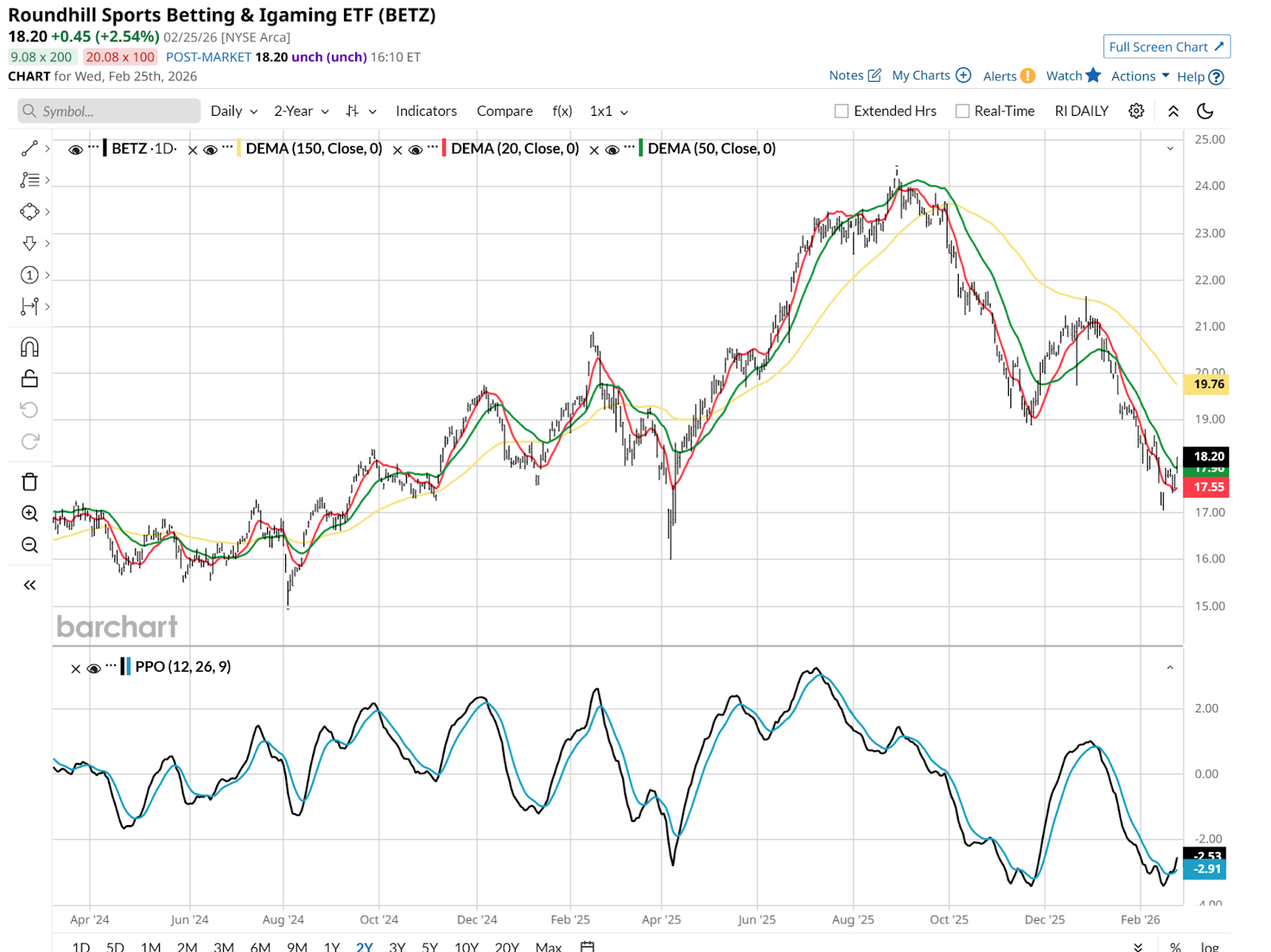
OK, what odds do you give me that The Roundhill Sports Betting and iGaming ETF (BETZ) gains 15% from its Wednesday close of $18.20 before it loses 15%? In surface terms, that’s what my ROAR score aims to do — balance return potential and risk of major loss.
And for this basket of international casino stocks, online betting companies and others devoted to taking our money — I mean, wagering — on games, the chart seems to offer an intriguing proposition. First, let’s review what BETZ is, then handicap its future path. After all, the NCAA March Madness college basketball tournament, a betting bonanza, is just a few weeks away.
BETZ has been around since June 2020, which means it debuted just in time to catch the historic wave of consumer interest in online betting. We were all stuck at home, and along with day trading, sports betting entered its golden era.
BETZ has had a checkered history, performance-wise. Its chart looks like a typical evening at a casino table. On a good night! Up, down, sideways, but ultimately, the profits made just vanished. And you can’t remember why.
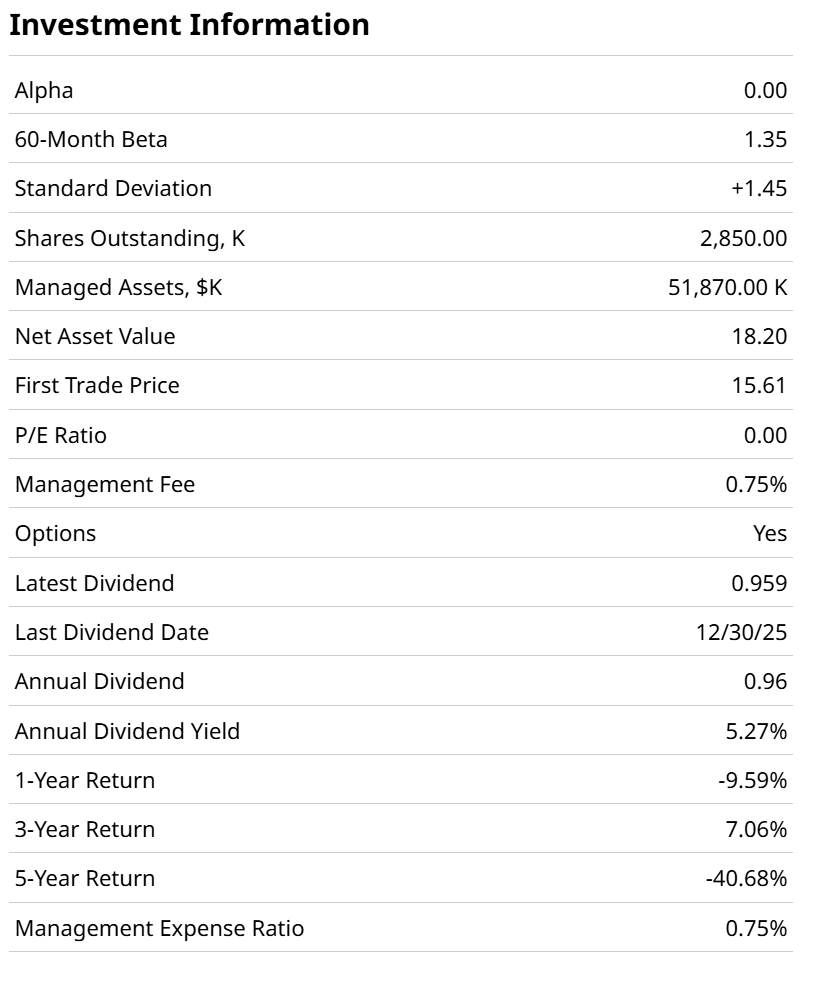
This exchange-traded fund (ETF) is dealing with a complex narrative. Strong industry growth is clashing with intense market competition, including from prediction markets, and shifting regulatory landscapes. At just over $50 million in assets, BETZ reflects the smallish nature of its component stocks, which include some large-caps, but no mega-cap standards.
An Industry With an Exciting Set of Crosswinds
What I have found interesting about this ETF over the years is that it provides a pure-play look at an industry that is rapidly moving from physical brick-and-mortar locations to mobile platforms. As I see it, BETZ is more a case of playing an evolving theme with a single ticker.
The ETF owns about 30 stocks, and for a fund of that size in terms of holdings, it is well spread out. This shows all holdings of at least 3% weighting. That make up exactly half of the 32 names in the ETF. In today’s top-heavy market, that's a good balance.
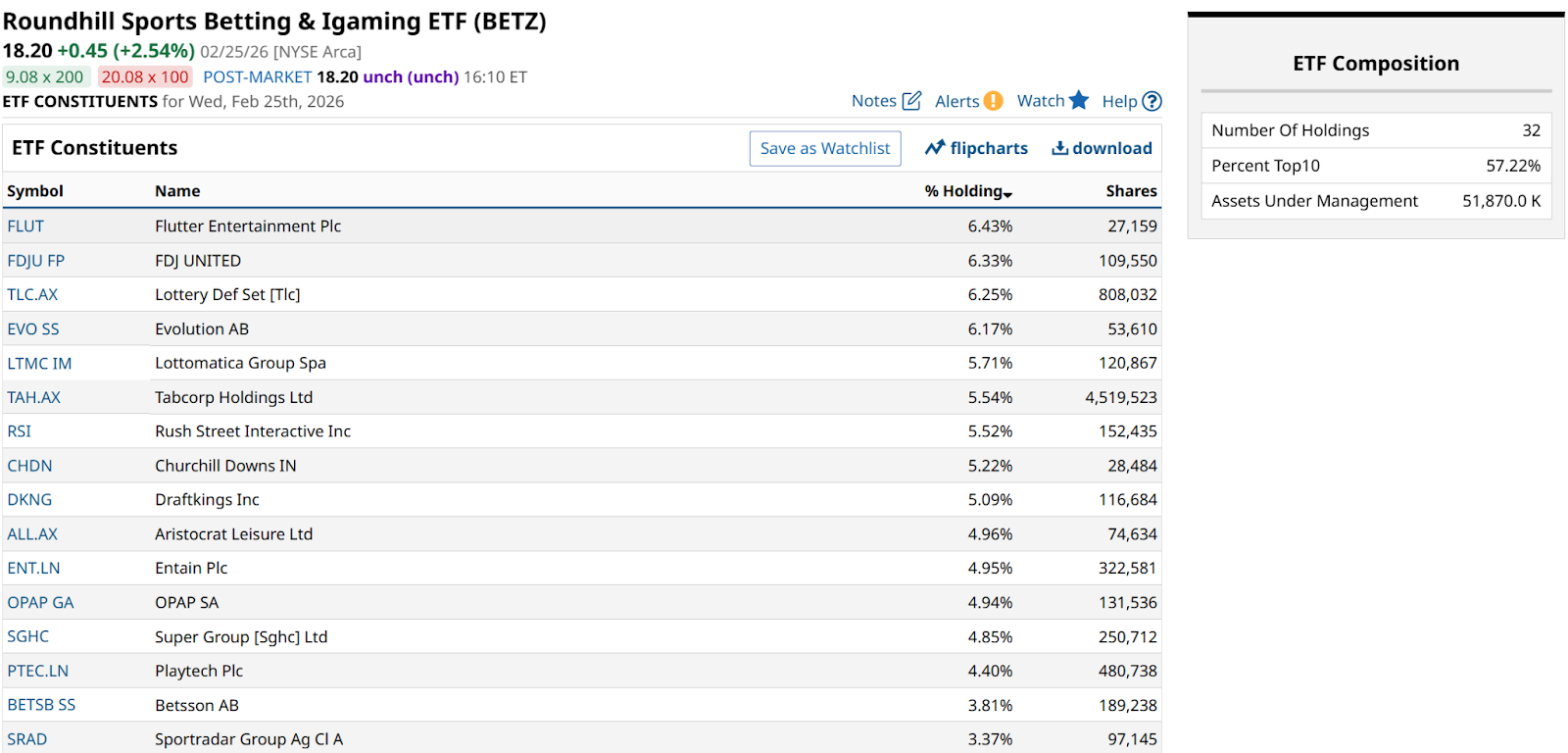
The composition of the fund reflects the global nature of the gambling market, with more than 80% of its holdings based in developed markets. These companies are increasingly leveraging technology to drive engagement, particularly through high-speed 5G connectivity that allows for real-time odds updates and micro-betting features during live events. The fundamental secular growth story remains intact, with Americans expected to spend billions on legal betting and global iGaming revenue projected to grow steadily through 2030.
Regulatory developments remain the primary catalyst for the future of BETZ. Many U.S. states have legalized mobile betting. However, several large markets like Minnesota remain in a legislative impasse, potentially leaving billions in revenue on the table. And the aforementioned emergence of prediction markets, which operate under federal rather than state oversight, add to the competitive threat. On the flip side of that, the industry is expanding into emerging markets like Brazil, which recently opened its doors to regulated digital betting.
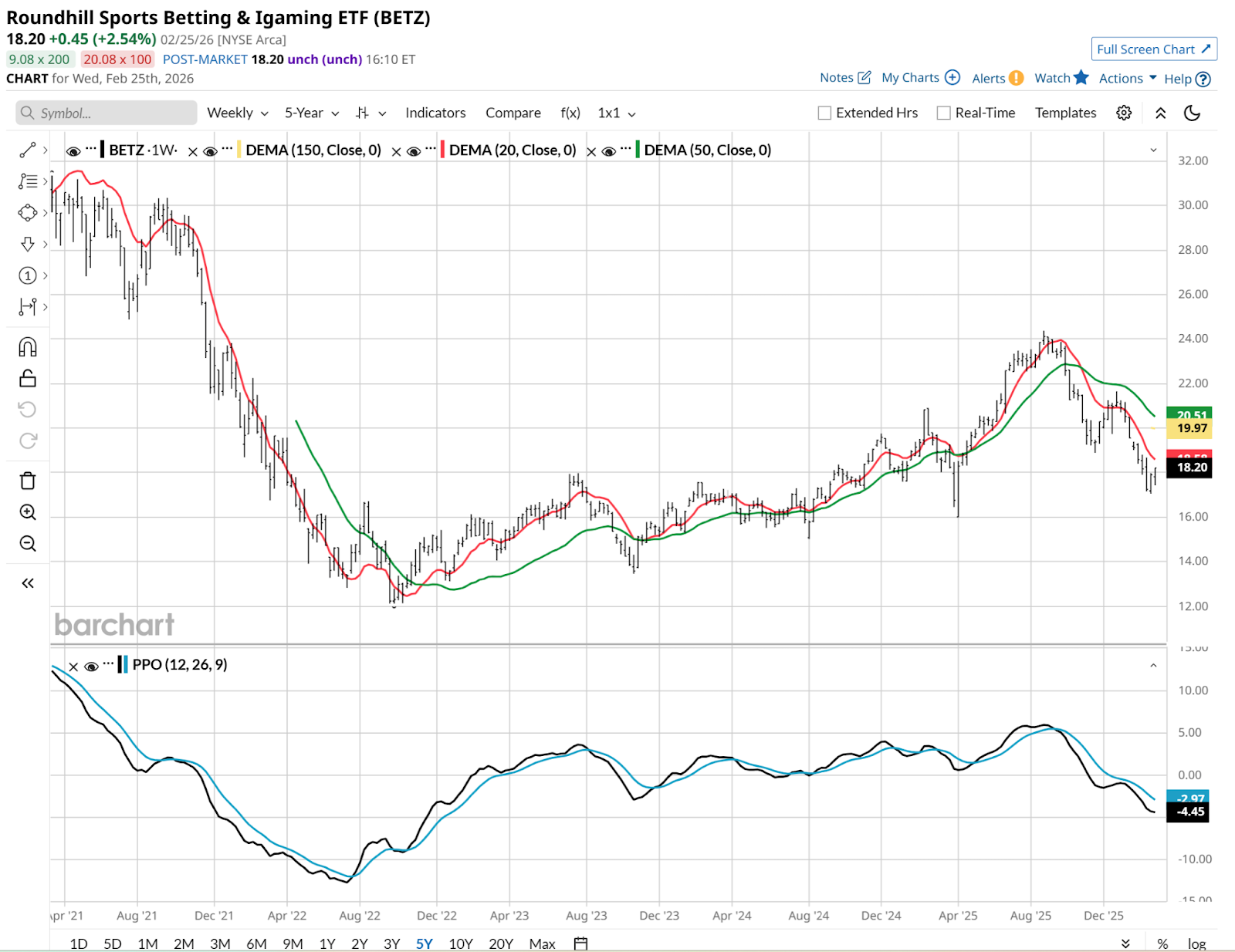
I’m adding this weekly chart to the daily one I started this article with. Because the daily indicates to me that the $17 to $18 area is a very familiar bounce location for BETZ. And it is essentially there again.
But the weekly does not confirm that optimism — at least not yet. The 20-week moving average is in a strong downtrend. Translation: bounce much more likely than long-term, low-risk profit opportunity.
Finally, I guess it is only fitting that this article on a digital gambling ETF closes with a picture filled with the colors red and black. This is the recent path of the ROAR score for BETZ.
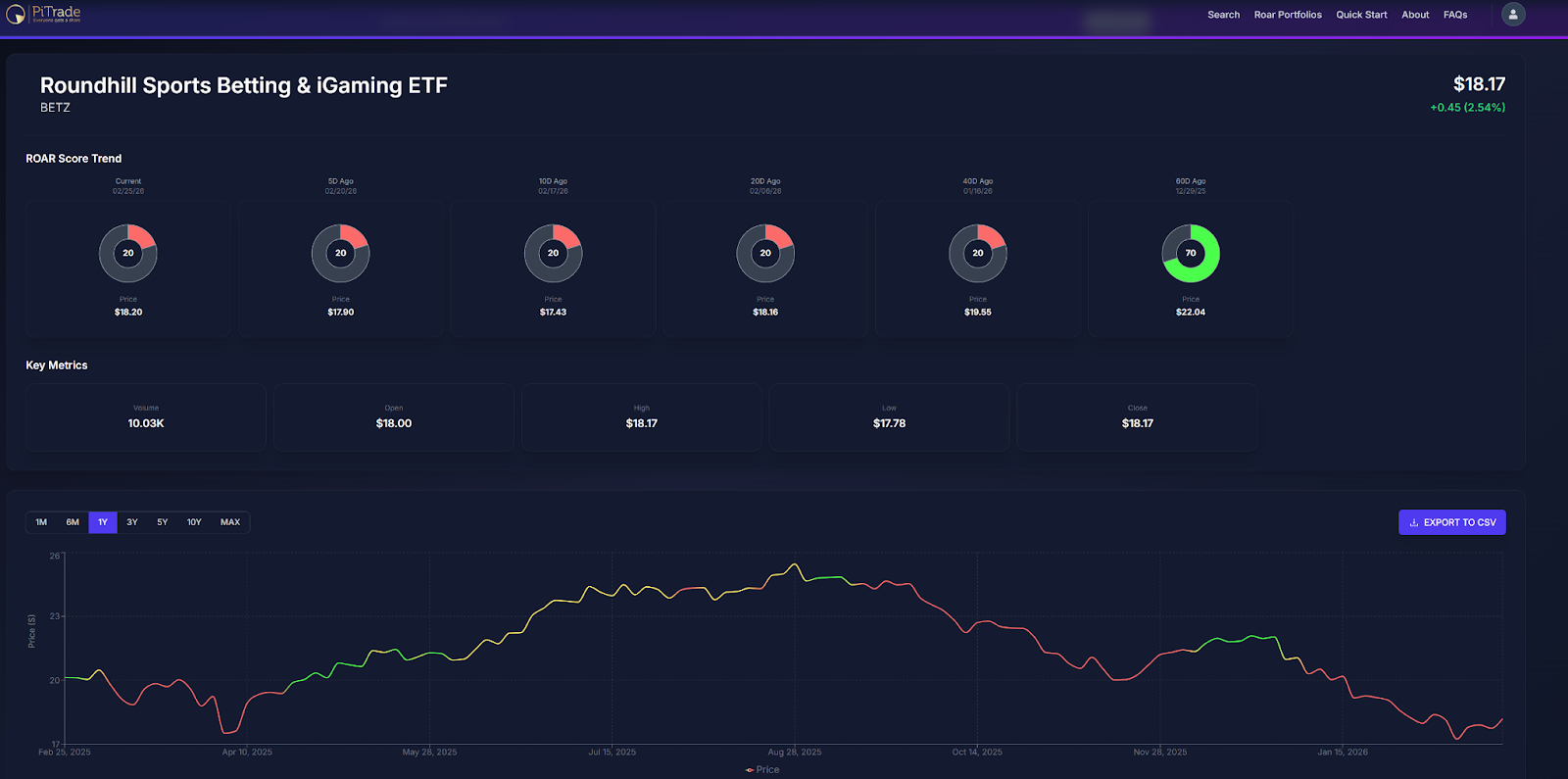
It turned red in mid-September around $25 a share, which proved useful, given the ETF’s 35% decline through Feb. 13 of this year. Still, it flirted with green (lower risk) during that time. This reminds us that stocks and baskets of them, i.e., ETFs, are not as binary as “buy” or “sell.” Any time the red zone is in play for a while, any immediate jump in ROAR score (to a lower risk zone) should be met with at least modest skepticism.
Currently the score of 20 makes sense to me. Because it indicates exactly what I see in the daily chart I showed at the top. This ETF still has a lot of recovering to do. But that is also where the greatest upside starts from. I see it all the time. That’s why a low ROAR score doesn’t mean “sell” or “buy” or even “hold.” It simply means that while there could be big profits around the corner, it is a more aggressive move than average to take that on in size.
Rob Isbitts created the ROAR Score, based on his 40+ years of technical analysis experience. ROAR helps DIY investors manage risk and create their own portfolios. For Rob's written research, check out ETFYourself.com.
On the date of publication, Rob Isbitts did not have (either directly or indirectly) positions in any of the securities mentioned in this article. All information and data in this article is solely for informational purposes. For more information please view the Barchart Disclosure Policy here.
More news from Barchart