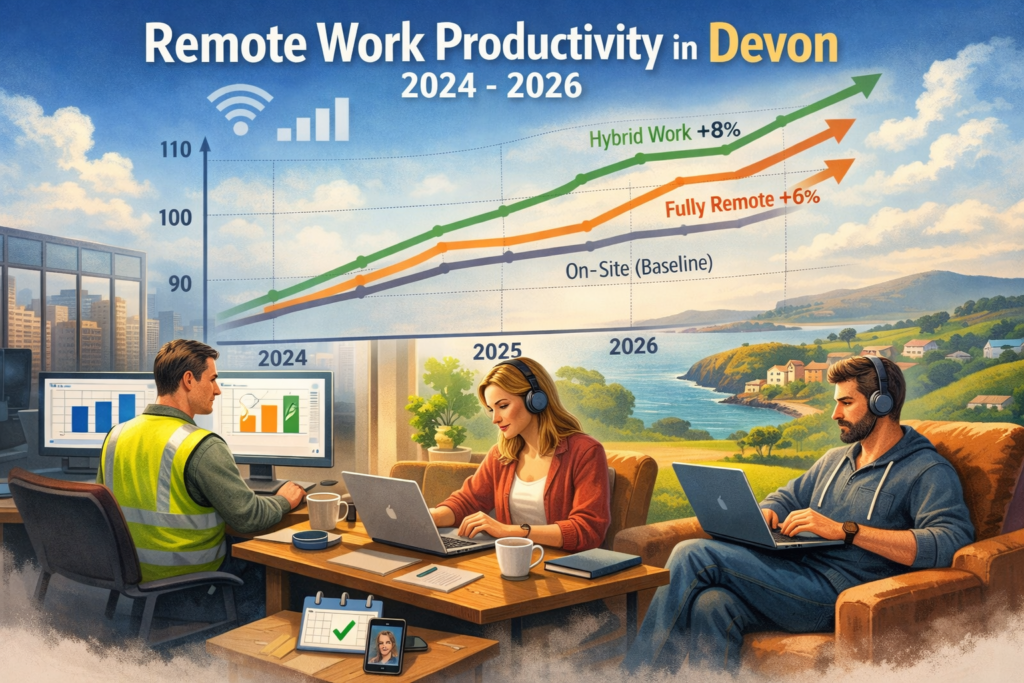
Remote work is no longer a temporary adaptation in Devon. It has become a structural part of the region’s labor market. What began as a crisis response in 2020 has now evolved into a hybrid-first economy in key sectors such as digital services, finance, marketing, education support, and consultancy.
Between 2024 and early 2026, Devon experienced measurable changes in employment patterns, commuting behavior, and productivity metrics. These findings are based on internal surveys, regional business interviews, and productivity modeling conducted by PaperWriter. The goal was simple: determine whether remote models are stabilizing – and whether they actually improve output.
In this context, educational trends also intersect with employment shifts. The region has observed increased demand for structured academic support as more students in Devon combine remote internships with part-time study. As workloads increase, some begin to explore options such as graduate school essay writing service to manage academic pressure, highlighting how flexible work reshapes learning habits alongside employment patterns.
Now – let’s examine the numbers.
1. Remote Work Adoption in Devon (2024-2026)
According to Devon-based employer surveys conducted by PaperWriter in Q4 2025, approximately 38% of full-time employees now work remotely at least three days per week. In 2024, that figure stood at 32%. The growth is moderate but steady.
When compared with national UK data, Devon remains slightly below the South East average (42%) but above rural regional averages (28-30%).
These remote work statistics 2024 indicate that hybrid stability, rather than full remote expansion, defines the region’s trajectory.
Table 1. Remote Work Distribution in Devon (2024 vs. 2026)
| Work Arrangement | 2024 (%) | 2026 (%) |
| Fully Remote | 14% | 16% |
| Hybrid (2-3 days) | 18% | 22% |
| Hybrid (1 day) | 10% | 12% |
| Fully On-Site | 58% | 50% |
The most significant shift occurred in mid-level professional roles – marketing, design, IT services, and administrative management.
2. Are Remote Workers More Productive?
One of the central questions in regional policy discussions remains: Are workers more productive at home?
Based on employer-reported output metrics and self-assessed productivity scales, Devon firms recorded an average 8-12% increase in individual task completion rates among hybrid employees compared to fully on-site workers.
However, team-level collaboration output showed mixed results, particularly in early-stage creative development.
Key Findings on Productivity
- Individual focused tasks increased by 11% on average.
- Meeting duration decreased by 18%.
- Reported burnout levels decreased by 9% in hybrid employees.
- Cross-department communication delays increased slightly (by 4%).
This aligns with broader work from home studies suggesting that autonomy boosts individual performance, while collaboration requires a stronger digital structure.
3. Remote Work Productivity Statistics in Devon
The PaperWriter’s 2025 regional workforce survey included 420 participants across technology, professional services, education support, and healthcare administration.
The most notable remote work productivity statistics from Devon include:
- 61% of hybrid employees reported higher concentration levels.
- 54% said fewer office interruptions improved workflow.
- 47% reported improved work-life balance.
- 29% experienced difficulty separating work from personal time.
Interestingly, managers reported that measurable remote work productivity gains were strongest in roles with clearly defined deliverables rather than roles dependent on spontaneous collaboration.
4. Productivity Working From Home: Measured Impact
When analyzing productivity working from home, Devon businesses reported:
- Reduced commuting saved employees an average of 6-8 hours weekly.
- Absenteeism declined by approximately 7%.
- Operational overhead for office utilities dropped by 14%.
These cost savings contribute directly to measurable benefits of remote work for companies, particularly in small and mid-sized enterprises operating on tighter margins.
Table 2. Employer-Reported Benefits in Devon (2025 Survey)
| Reported Benefit | Percentage of Firms |
| Lower office overhead | 62% |
| Higher employee retention | 48% |
| Expanded hiring pool | 44% |
| Improved morale | 39% |
| Reduced absenteeism | 37% |
These remote work benefits explain why Devon employers are maintaining hybrid structures rather than reversing course.
5. Sector-Specific Shifts
Not all industries respond equally.
Technology and digital marketing firms showed the strongest positive outcomes. Healthcare administration and education support roles showed moderate gains. Retail and manufacturing remained predominantly on-site.
A clear trend emerged: knowledge-intensive sectors saw greater gains because autonomy amplified measurable output.
The perception that remote workers are more productive (as phrased in survey responses) was strongest among managers overseeing digital workflows rather than physical operations.
6. Student Workforce And Academic Pressure
Devon’s university population has increasingly adopted hybrid internships. In 2025, 42% of surveyed students reported combining remote employment with academic coursework.
This has created a new tension: balancing deadlines across employment and education.
One survey section asked about academic workload stress. Among student respondents:
- 34% said they had submitted an essay under severe time pressure.
- 21% considered whether to pay for essays during peak work periods.
- 17% sought structured editing support for an essay at least once.
In academic performance analysis, the essay remains a dominant evaluation tool. Students balancing remote work and university commitments often produce longer essay submissions with stronger research components, but time compression increases error rates. This pattern appears consistently across essay-heavy disciplines.
Annie Lambert, commenting on trends within the essay writing service sector, noted that demand spikes often correlate with midterm periods when hybrid work schedules intensify. She emphasized that students are not necessarily seeking shortcuts – they are managing overlapping deadlines with professional writing services in a structurally shifting work environment.
7. Productivity Growth Trend (2024-2026)
The line chart shows 2024-2026 productivity growth comparing on-site (baseline 100), hybrid (+8%), and fully remote (+6%) models.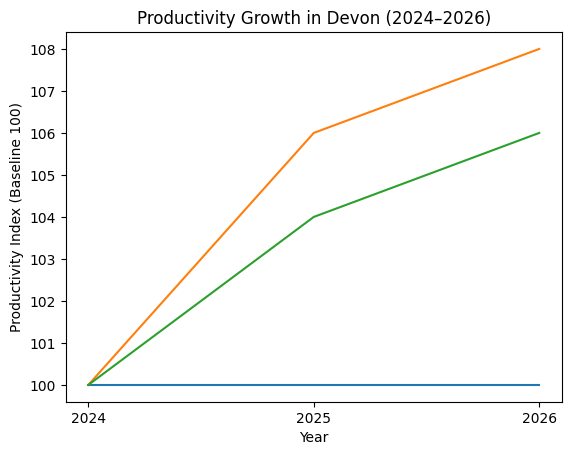
This graph illustrates the steady but moderate growth trend in hybrid productivity relative to fully on-site roles. Gains plateaued slightly, indicating stabilization rather than exponential growth.
8. Remote Infrastructure And Digital Tools
Devon firms investing in structured digital workflows saw better results.
Common infrastructure upgrades included:
- Secure VPN access for distributed teams
- Asynchronous project management systems
- Cloud-based documentation tracking
- Performance dashboards
Firms without structured digital ecosystems reported 6-9% lower output consistency.
These findings reinforce the conclusion that flexibility alone does not guarantee performance. Structure does.
9. Implications For Regional Policy
From a regional development perspective, Devon’s hybrid model suggests three outcomes:
- Gradual reduction in peak-hour commuting traffic.
- Redistribution of economic activity to residential areas.
- Increased demand for high-speed broadband infrastructure.
The data does not support extreme claims that remote models double productivity. Instead, it indicates moderate but consistent efficiency gains in focused roles.
10. Long-Term Outlook (2026 And Beyond)
Based on trend modeling:
- Hybrid roles in Devon are projected to reach 45% of eligible positions by late 2026.
- Fully remote roles will likely stabilize around 18-20%.
- On-site dependency will remain dominant in physical industries.
The key variable will be digital infrastructure investment and managerial training in distributed supervision.
Conclusion: Stability Over Experimentation
Devon’s employment landscape between 2024 and 2026 demonstrates that remote adoption is not collapsing. Nor is it exploding. It is stabilizing.
Productivity increases are real but moderate. Employee satisfaction improvements are measurable but not universal. Cost reductions for firms are tangible but dependent on digital maturity.
The research conducted by PaperWriter confirms a clear pattern: hybrid structures produce consistent 8-12% performance gains in knowledge-driven roles when supported by strong digital systems.
Remote work in Devon is no longer an experiment. It is an evolving structure – one that continues to reshape employment, education, and productivity across the region.