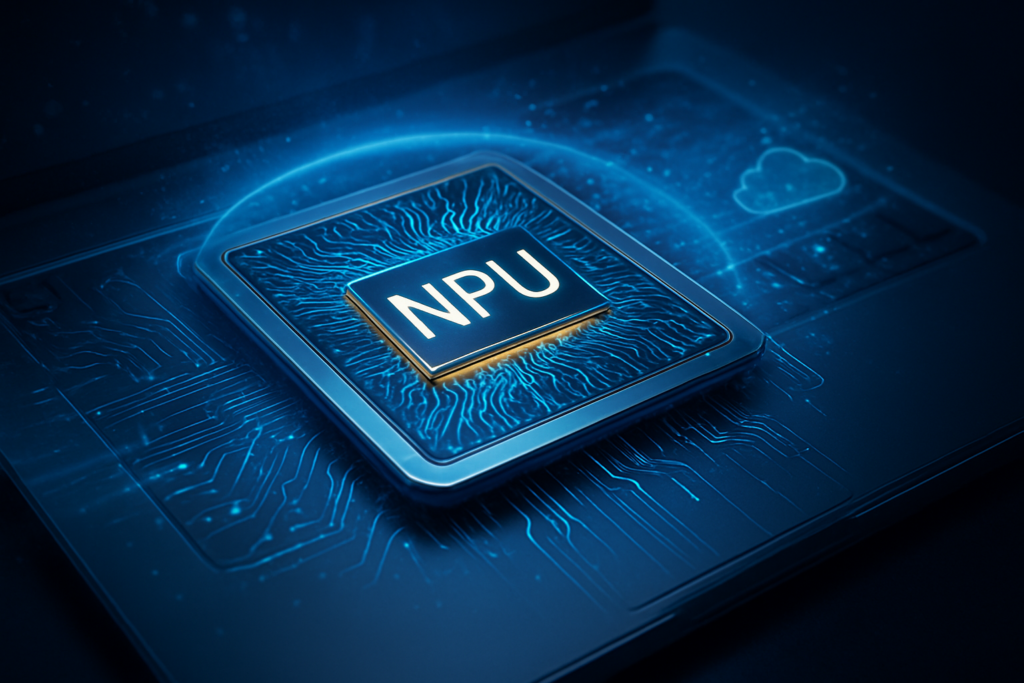
As we close out 2025, the personal computer is undergoing its most radical transformation since the introduction of the graphical user interface. What began as a buzzword in early 2024 has matured into a fundamental shift in computing architecture: the "AI PC" Revolution. By December 2025, AI-capable machines have moved from niche enthusiast hardware to a market standard, now accounting for over 40% of all global PC shipments. This shift represents a pivot away from the cloud-centric model that defined the last decade, bringing the power of massive neural networks directly onto the silicon sitting on our desks.
The mainstreaming of Copilot+ PCs has fundamentally altered the relationship between users and their data. By integrating dedicated Neural Processing Units (NPUs) directly into the processor die, manufacturers have enabled a "local-first" AI strategy. This evolution is not merely about faster chatbots; it is about a new era of "Edge AI" where privacy, latency, and cost-efficiency are no longer traded off for intelligence. As the industry moves into 2026, the AI PC is no longer a luxury—it is the baseline for the modern digital experience.
The Silicon Shift: Inside the 40 TOPS Standard
The technical backbone of the AI PC revolution is the Neural Processing Unit (NPU), a specialized accelerator designed specifically for the mathematical workloads of deep learning. As of late 2025, the industry has coalesced around a strict performance floor: to earn the "Copilot+ PC" badge from Microsoft (NASDAQ: MSFT), a device must deliver at least 40 Trillion Operations Per Second (TOPS) on the NPU alone. This requirement has sparked an unprecedented "TOPS war" among silicon giants. Intel (NASDAQ: INTC) has responded with its Panther Lake (Core Ultra Series 3) architecture, which boasts a 5th-generation NPU targeting 50 TOPS and a total system output of nearly 180 TOPS when combining CPU and GPU resources.
AMD (NASDAQ: AMD) has carved out a dominant position in the high-end workstation market with its Ryzen AI Max series, code-named "Strix Halo." These chips utilize a massive integrated memory architecture that allows them to run local models previously reserved for discrete, power-hungry GPUs. Meanwhile, Qualcomm (NASDAQ: QCOM) has disrupted the traditional x86 duopoly with its Snapdragon X2 Elite, which has pushed NPU performance to a staggering 80 TOPS. This leap in performance allows for the simultaneous execution of multiple Small Language Models (SLMs) like Microsoft’s Phi-3 or Google’s Gemini Nano, enabling the PC to interpret screen content, transcribe audio, and generate code in real-time without ever sending a packet of data to an external server.
Disrupting the Status Quo: The Business of Local Intelligence
The business implications of the AI PC shift are profound, particularly for the enterprise sector. For years, companies have been wary of the recurring "token costs" associated with cloud-based AI services. The transition to Edge AI allows organizations to shift from an OpEx (Operating Expense) model to a CapEx (Capital Expenditure) model. By investing in AI-capable hardware from vendors like Apple (NASDAQ: AAPL), whose M5 series chips have set new benchmarks for AI efficiency per watt, businesses can run high-volume inference tasks locally. This is estimated to reduce long-term AI deployment costs by as much as 60%, as the "per-query" billing of the cloud era is replaced by the one-time purchase of the device.
Furthermore, the competitive landscape of the semiconductor industry has been reordered. Qualcomm's aggressive entry into the Windows ecosystem has forced Intel and AMD to prioritize power efficiency alongside raw performance. This competition has benefited the consumer, leading to a new class of "all-day" laptops that do not sacrifice AI performance when unplugged. Microsoft’s role has also evolved; the company is no longer just a software provider but a platform architect, dictating hardware specifications that ensure Windows remains the primary interface for the "Agentic AI" era.
Data Sovereignty and the End of the Latency Tax
Beyond the technical specs, the AI PC revolution is driven by the growing demand for data sovereignty. In an era of heightened regulatory scrutiny, including the full implementation of the EU AI Act and updated GDPR guidelines, the ability to process sensitive information locally is a game-changer. Edge AI ensures that medical records, legal briefs, and proprietary corporate data never leave the local SSD. This "Privacy by Design" approach has cleared the path for AI adoption in sectors like healthcare and finance, which were previously hamstrung by the security risks of cloud-based LLMs.
Latency is the other silent killer that Edge AI has successfully neutralized. While cloud-based AI typically suffers from a 100-200ms "round-trip" delay, local NPU processing brings response times down to a near-instantaneous 5-20ms. This enables "Copilot Vision"—a feature where the AI can watch a user’s screen and provide contextual help in real-time—to feel like a natural extension of the operating system rather than a lagging add-on. This milestone in human-computer interaction is comparable to the shift from dial-up to broadband; once users experience zero-latency AI, there is no going back to the cloud-dependent past.
Beyond the Chatbot: The Rise of Autonomous PC Agents
Looking toward 2026, the focus is shifting from reactive AI to proactive, autonomous agents. The latest updates to the Windows Copilot Runtime have introduced "Agent Mode," where the AI PC can execute multi-step workflows across different applications. For example, a user can command their PC to "find the latest sales data, cross-reference it with the Q4 goals, and draft a summary email," and the NPU will orchestrate these tasks locally. Experts predict that the next generation of AI PCs will cross the 100 TOPS threshold, enabling devices to not only run models but also "fine-tune" them based on the user’s specific habits and data.
The challenges remaining are largely centered on software optimization and battery life under sustained AI loads. While hardware has leaped forward, developers are still catching up, porting their applications to take full advantage of the NPU rather than defaulting to the CPU. However, with the emergence of standardized cross-platform libraries, the "AI-native" app ecosystem is expected to explode in the coming year. We are moving toward a future where the OS is no longer a file manager, but a personal coordinator that understands the context of every action the user takes.
A New Era of Personal Computing
The AI PC revolution of 2025 marks a definitive end to the "thin client" era of AI. We have moved from a world where intelligence was a distant service to one where it is a local utility, as essential and ubiquitous as electricity. The combination of high-TOPS NPUs, local Small Language Models, and a renewed focus on privacy has redefined what we expect from our devices. The PC is no longer just a tool for creation; it has become a cognitive partner that learns and grows with the user.
As we look ahead, the significance of this development in AI history cannot be overstated. It represents the democratization of high-performance computing, putting the power of a 2023-era data center into a two-pound laptop. In the coming months, watch for the release of "Wave 3" AI PCs and the further integration of AI agents into the core of the operating system. The revolution is here, and it is running locally.
This content is intended for informational purposes only and represents analysis of current AI developments.
TokenRing AI delivers enterprise-grade solutions for multi-agent AI workflow orchestration, AI-powered development tools, and seamless remote collaboration platforms.
For more information, visit https://www.tokenring.ai/.