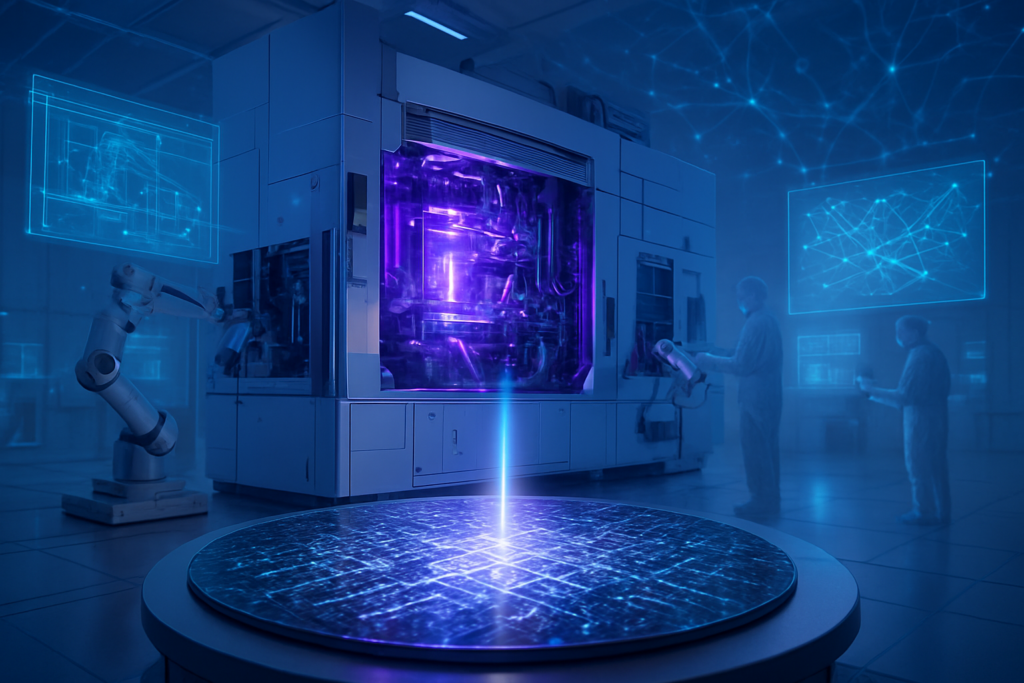
As of December 18, 2025, the semiconductor industry has reached a historic inflection point. Intel Corporation (NASDAQ: INTC) has officially confirmed the successful acceptance testing and validation of the ASML Holding N.V. (NASDAQ: ASML) Twinscan EXE:5200B, the world’s first high-volume production High-NA Extreme Ultraviolet (EUV) lithography system. This milestone signals the formal beginning of the "Angstrom Era" for commercial silicon, as Intel moves its 14A (1.4nm-class) process node into the final stages of pre-production readiness.
The partnership between Intel and ASML represents a multi-billion dollar gamble that is now beginning to pay dividends. By becoming the first mover in High-NA technology, Intel aims to reclaim its "process leadership" crown, which it lost to rivals over the last decade. The immediate significance of this development cannot be overstated: it provides the physical foundation for the next generation of AI accelerators and high-performance computing (HPC) chips that will power the increasingly complex Large Language Models (LLMs) of the late 2020s.
Technical Mastery: 0.55 NA and the End of Multi-Patterning
The transition from standard (Low-NA) EUV to High-NA EUV is the most significant leap in lithography in over twenty years. At the heart of this shift is the increase in the Numerical Aperture (NA) from 0.33 to 0.55. This change allows for a 1.7x increase in resolution, enabling the printing of features so small they are measured in Angstroms rather than nanometers. While standard EUV tools had begun to hit a physical limit, requiring "double-patterning" or even "quad-patterning" to achieve 2nm-class densities, the EXE:5200B allows Intel to print these critical layers in a single pass.
Technically, the EXE:5200B is a marvel of engineering, capable of a throughput of 175 to 200 wafers per hour. It features an overlay accuracy of 0.7nm, a precision level necessary to align the dozens of microscopic layers that comprise a modern 1.4nm transistor. This reduction in patterning complexity is not just a matter of elegance; it drastically reduces manufacturing cycle times and eliminates the "stochastic" defects that often plague multi-patterning processes. Initial data from Intel’s D1X facility in Oregon suggests that the 14A node is already showing superior yield curves compared to the previous 18A node at a similar point in its development cycle.
The industry’s reaction has been one of cautious awe. While skeptics initially pointed to the $400 million price tag per machine as a potential financial burden, the technical community has praised Intel’s "stitching" techniques. Because High-NA tools have a smaller exposure field—effectively half the size of standard EUV—Intel had to develop proprietary software and hardware solutions to "stitch" two halves of a chip design together seamlessly. By late 2025, these techniques have been proven stable, clearing the path for the mass production of massive AI "super-chips" that exceed traditional reticle limits.
Shifting the Competitive Chessboard
The commercialization of High-NA EUV has created a stark divergence in the strategies of the world’s leading foundries. While Intel has gone "all-in" on the new tools, Taiwan Semiconductor Manufacturing Company (NYSE: TSM), or TSMC, has taken a more conservative path. TSMC’s A14 node, scheduled for a similar timeframe, continues to rely on Low-NA EUV with advanced multi-patterning. TSMC’s leadership has argued that the cost-per-transistor remains lower with mature tools, but Intel’s early adoption of High-NA has effectively built a two-year "operational moat" in managing the complex optics and photoresist chemistries required for the 1.4nm era.
This strategic lead is already attracting "AI-first" fabless companies. With the release of the Intel 14A PDK 0.5 (Process Design Kit) in late 2025, several major cloud service providers and AI chip startups have reportedly begun exploring Intel Foundry as a secondary or even primary source for their 2027 silicon. The ability to achieve 15% better performance-per-watt and a 20% increase in transistor density over 18A-P makes the 14A node an attractive target for those building the hardware for "Agentic AI" and trillion-parameter models.
Samsung Electronics (KRX: 005930) finds itself in the middle ground, having recently received its first EXE:5200B modules to support its SF1.4 process. However, Intel’s head start in the Hillsboro R&D center means that Intel engineers have already spent two years "learning" the quirks of the High-NA light source and anamorphic lenses. This experience is critical; in the semiconductor world, knowing how to fix a tool when it goes down is as important as owning the tool itself. Intel’s deep integration with ASML has essentially turned the Oregon D1X fab into a co-development site for the future of lithography.
The Broader Significance for the AI Revolution
The move to High-NA EUV is not merely a corporate milestone; it is a vital necessity for the continued survival of Moore’s Law. As AI models grow in complexity, the demand for "compute density"—the amount of processing power packed into a square millimeter of silicon—has become the primary bottleneck for the industry. The 14A node represents the first time the industry has moved beyond the "nanometer" nomenclature into the "Angstrom" era, providing the physical density required to keep pace with the exponential growth of AI training requirements.
This development also has significant geopolitical implications. The successful commercialization of High-NA tools within the United States (at Intel’s Oregon and upcoming Ohio sites) strengthens the domestic semiconductor supply chain. As AI becomes a core component of national security and economic infrastructure, the ability to manufacture the world’s most advanced chips on home soil using the latest lithography techniques is a major strategic advantage for the Western tech ecosystem.
However, the transition is not without its concerns. The extreme cost of High-NA tools could lead to a further consolidation of the semiconductor industry, as only a handful of companies can afford the $400 million-per-machine entry fee. This "billionaire’s club" of chipmaking risks creating a monopoly on the most advanced AI hardware, potentially slowing down innovation in smaller labs that cannot afford the premium for 1.4nm wafers. Comparisons are already being drawn to the early days of EUV, where the high barrier to entry eventually forced several players out of the leading-edge race.
The Road to 10A and Beyond
Looking ahead, the roadmap for High-NA EUV is already extending into the next decade. Intel has already hinted at its "10A" node (1.0nm), which will likely utilize even more advanced versions of the High-NA platform. Experts predict that by 2028, the use of High-NA will expand beyond just the most critical metal layers to include a majority of the chip’s structure, further simplifying the manufacturing flow. We are also seeing the horizon for "Hyper-NA" lithography, which ASML is currently researching to push beyond the 0.75 NA mark in the 2030s.
In the near term, the challenge for Intel and ASML will be scaling this technology from a few machines in Oregon to dozens of machines across Intel’s global "Smart Capital" network, including Fabs 52 and 62 in Arizona. Maintaining high yields while operating these incredibly sensitive machines in a high-volume environment will be the ultimate test of the partnership. Furthermore, the industry must develop new "High-NA ready" photoresists and masks that can withstand the higher energy density of the focused EUV light without degrading.
A New Chapter in Computing History
The successful acceptance of the ASML Twinscan EXE:5200B by Intel marks the end of the experimental phase for High-NA EUV and the beginning of its commercial life. It is a moment that will likely be remembered as the point when Intel reclaimed its technical momentum and redefined the limits of what is possible in silicon. The 14A node is more than just a process update; it is a statement of intent that the Angstrom era is here, and it is powered by the closest collaboration between a toolmaker and a manufacturer in the history of the industry.
As we look toward 2026 and 2027, the focus will shift from tool installation to "wafer starts." The industry will be watching closely to see if Intel can translate its technical lead into market share gains against TSMC. For now, the message is clear: the path to the future of AI and high-performance computing runs through the High-NA lenses of ASML and the cleanrooms of Intel. The next eighteen months will be critical as the first 14A test chips begin to emerge, offering a glimpse into the hardware that will define the next decade of artificial intelligence.
This content is intended for informational purposes only and represents analysis of current AI developments.
TokenRing AI delivers enterprise-grade solutions for multi-agent AI workflow orchestration, AI-powered development tools, and seamless remote collaboration platforms.
For more information, visit https://www.tokenring.ai/.