Wrapping up Q2 earnings, we look at the numbers and key takeaways for the cybersecurity stocks, including SentinelOne (NYSE: S) and its peers.
Cybersecurity continues to be one of the fastest-growing segments within software for good reason. Almost every company is slowly finding itself becoming a technology company and facing rising cybersecurity risks. Businesses are accelerating adoption of cloud-based software, moving data and applications into the cloud to save costs while improving performance. This migration has opened them to a multitude of new threats, like employees accessing data via their smartphone while on an open network, or logging into a web-based interface from a laptop in a new location.
The 9 cybersecurity stocks we track reported a strong Q2. As a group, revenues beat analysts’ consensus estimates by 1.7% while next quarter’s revenue guidance was 0.9% above.
Luckily, cybersecurity stocks have performed well with share prices up 12.2% on average since the latest earnings results.
Weakest Q2: SentinelOne (NYSE: S)
Built on the principle of "fighting machine with machine," SentinelOne (NYSE: S) provides an AI-powered cybersecurity platform that autonomously prevents, detects, and responds to threats across endpoints, cloud workloads, and identity systems.
SentinelOne reported revenues of $292 million, up 20.6% year on year. This print exceeded analysts’ expectations by 0.6%. Despite the top-line beat, it was still a slower quarter for the company with full-year EPS guidance missing analysts’ expectations significantly and EPS guidance for next quarter missing analysts’ expectations significantly.
“Our Q2 performance demonstrates strong progress across every dimension of our business – a top-tier growth profile, accelerating platform adoption, and undisputed technology leadership for both AI for Security and Security for AI,” said Tomer Weingarten, CEO of SentinelOne. “AI is transforming the way software is built, businesses are operated, and cybersecurity is delivered. With AI-native runtime protection fundamental to the Singularity platform’s architecture, SentinelOne is uniquely positioned to lead the future of AI cybersecurity.”
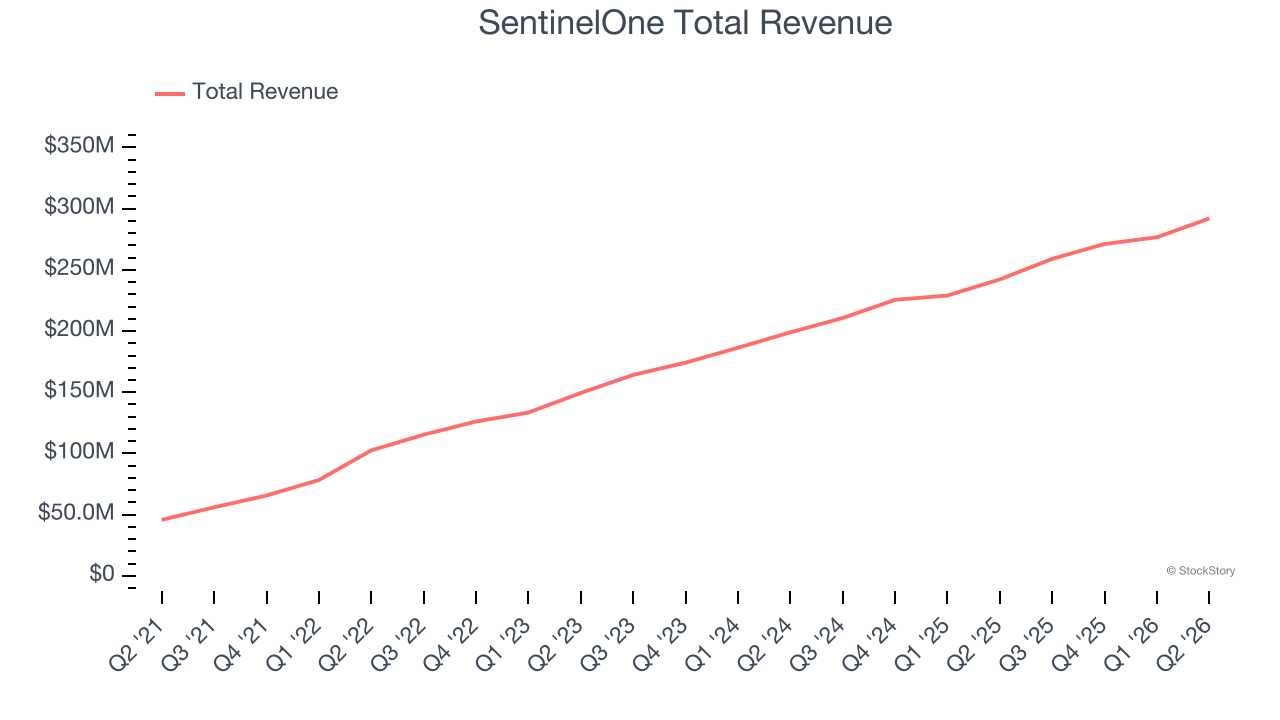
SentinelOne delivered the weakest performance against analyst estimates among its peers. The company added 13 enterprise customers paying more than $100,000 annually to reach a total of 1,715. The market seems disappointed with the results as the stock is down 1.5% since reporting and currently trades at $22.38.
Is now the time to buy SentinelOne? Access our full analysis of the earnings results here, it’s free.
Best Q2: Qualys (NASDAQ: QLYS)
Originally developed to address the growing complexity of IT security in the cloud era, Qualys (NASDAQ: QLYS) provides a cloud-based platform that helps organizations identify, manage, and protect their IT assets from cyber threats across on-premises, cloud, and mobile environments.
Qualys reported revenues of $182.2 million, up 11% year on year, outperforming analysts’ expectations by 2%. The business had an exceptional quarter with a solid beat of analysts’ billings estimates and an impressive beat of analysts’ adjusted operating income estimates.
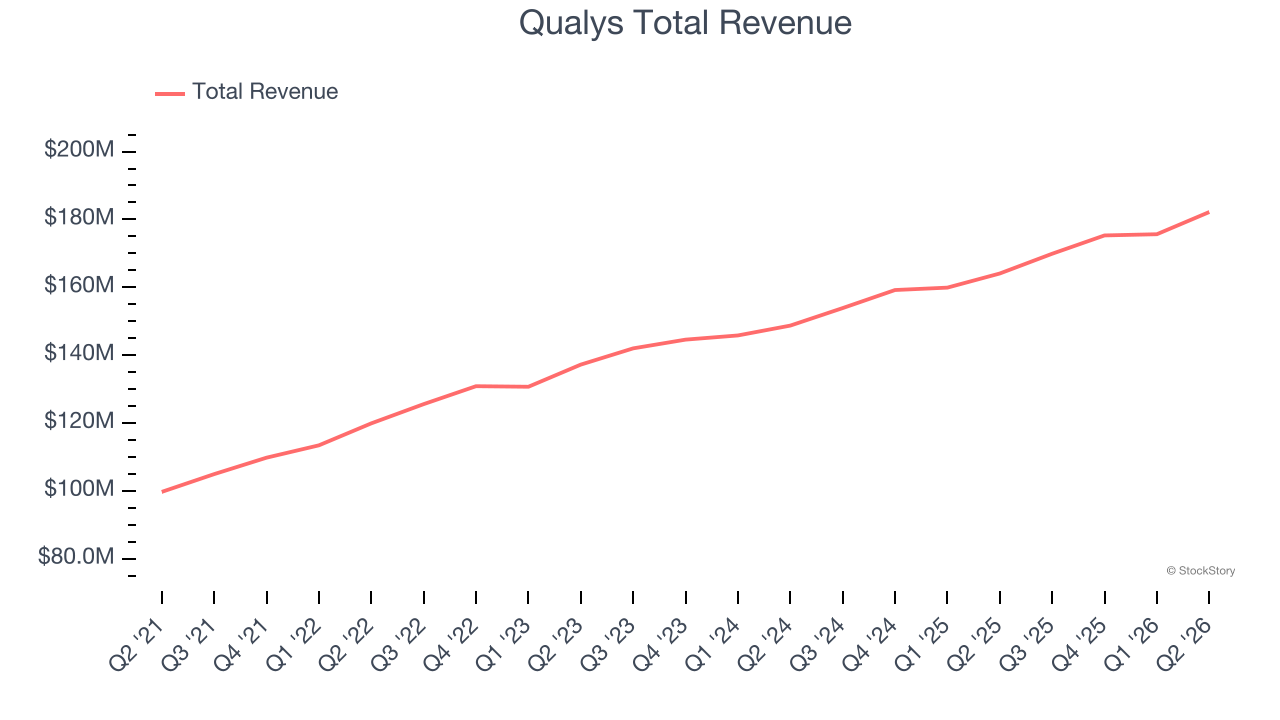
The market seems happy with the results as the stock is up 8.4% since reporting. It currently trades at $174.62.
Is now the time to buy Qualys? Access our full analysis of the earnings results here, it’s free.
Tenable (NASDAQ: TENB)
Starting with the widely-used Nessus vulnerability scanner first released in 1998, Tenable (NASDAQ: TENB) provides exposure management solutions that help organizations identify, assess, and prioritize cybersecurity vulnerabilities across their IT infrastructure and cloud environments.
Tenable reported revenues of $268.5 million, up 8.6% year on year, exceeding analysts’ expectations by 1.4%. Still, it was a mixed quarter as it posted a significant miss of analysts’ annual recurring revenue estimates.
Interestingly, the stock is up 5.2% since the results and currently trades at $33.12.
Read our full analysis of Tenable’s results here.
Varonis Systems (NASDAQ: VRNS)
Beginning with protecting Windows file shares in 2005 and evolving into a comprehensive security platform, Varonis Systems (NASDAQ: VRNS) provides data security software that helps organizations protect sensitive information, detect threats, and comply with privacy regulations.
Varonis Systems reported revenues of $180 million, up 18.3% year on year. This number beat analysts’ expectations by 1.8%. Overall, it was a strong quarter as it also logged EPS guidance for next quarter exceeding analysts’ expectations and an impressive beat of analysts’ adjusted operating income estimates.
The stock is up 4.7% since reporting and currently trades at $46.78.
Read our full, actionable report on Varonis Systems here, it’s free.
Palo Alto Networks (NASDAQ: PANW)
Founded in 2005 by security visionary Nir Zuk who sought to reimagine firewall technology, Palo Alto Networks (NASDAQ: PANW) provides AI-powered cybersecurity platforms that protect organizations' networks, clouds, and endpoints from sophisticated threats.
Palo Alto Networks reported revenues of $3.41 billion, up 34.4% year on year. This print topped analysts’ expectations by 1.7%. It was a strong quarter as it also put up EPS guidance for next quarter exceeding analysts’ expectations and full-year EPS guidance beating analysts’ expectations.
Palo Alto Networks achieved the highest guidance raise, fastest revenue growth, and highest full-year guidance raise of the whole group. The stock is up 3.5% since reporting and currently trades at $374.78.
Read our full, actionable report on Palo Alto Networks here, it’s free.
Market Update
Over the past year, investors have been forced to repeatedly answer the same question: what is the market’s biggest risk? The answer has changed several times, and each shift has reshaped market leadership.
Late in 2025 and early 2026, artificial intelligence became the market’s primary uncertainty. Investors questioned whether AI would erode software pricing power and weaken competitive moats as AI made it easier to replicate once-differentiated products.
By the spring, technology took a back seat to geopolitics. The U.S. conflict with Iran briefly became the market’s dominant narrative, raising concerns about oil prices, inflation, and global growth. But as energy markets remained orderly and fears of a prolonged supply disruption faded, investors quickly turned their focus back to fundamentals.
Want to invest in winners with rock-solid fundamentals? Check out our Top 5 Growth Stocks and add them to your watchlist. These companies are poised for growth regardless of the political or macroeconomic climate.