Packaged foods company Post (NYSE: POST) missed Wall Street’s revenue expectations in Q2 CY2026, with sales falling 1.8% year on year to $1.95 billion. Its non-GAAP profit of $1.78 per share was 4.3% above analysts’ consensus estimates.
Is now the time to buy Post? Find out by accessing our full research report, it’s free.
Post (POST) Q2 CY2026 Highlights:
- Revenue: $1.95 billion vs analyst estimates of $2.02 billion (1.8% year-on-year decline, 3.7% miss)
- Adjusted EPS: $1.78 vs analyst estimates of $1.71 (4.3% beat)
- Adjusted EBITDA: $377.3 million vs analyst estimates of $372.2 million (19.4% margin, 1.4% beat)
- EBITDA guidance for the full year is $1.57 billion at the midpoint, in line with analyst expectations
- Operating Margin: 9.7%, down from 11.8% in the same quarter last year
- Free Cash Flow Margin: 6.7%, up from 4.8% in the same quarter last year
- Market Capitalization: $4.04 billion
Company Overview
Founded in 1895, Post (NYSE: POST) is a packaged food company known for its namesake breakfast cereal and healthier-for-you snacks.
Revenue Growth
A company’s long-term sales performance can indicate its overall quality. Any business can put up a good quarter or two, but many enduring ones grow for years.
With $8.41 billion in revenue over the past 12 months, Post is one of the larger consumer staples companies and benefits from a well-known brand that influences purchasing decisions.
As you can see below, Post’s sales grew at a decent 8.3% compounded annual growth rate over the last three years. This shows its offerings generated slightly more demand than the average consumer staples company, a useful starting point for our analysis.
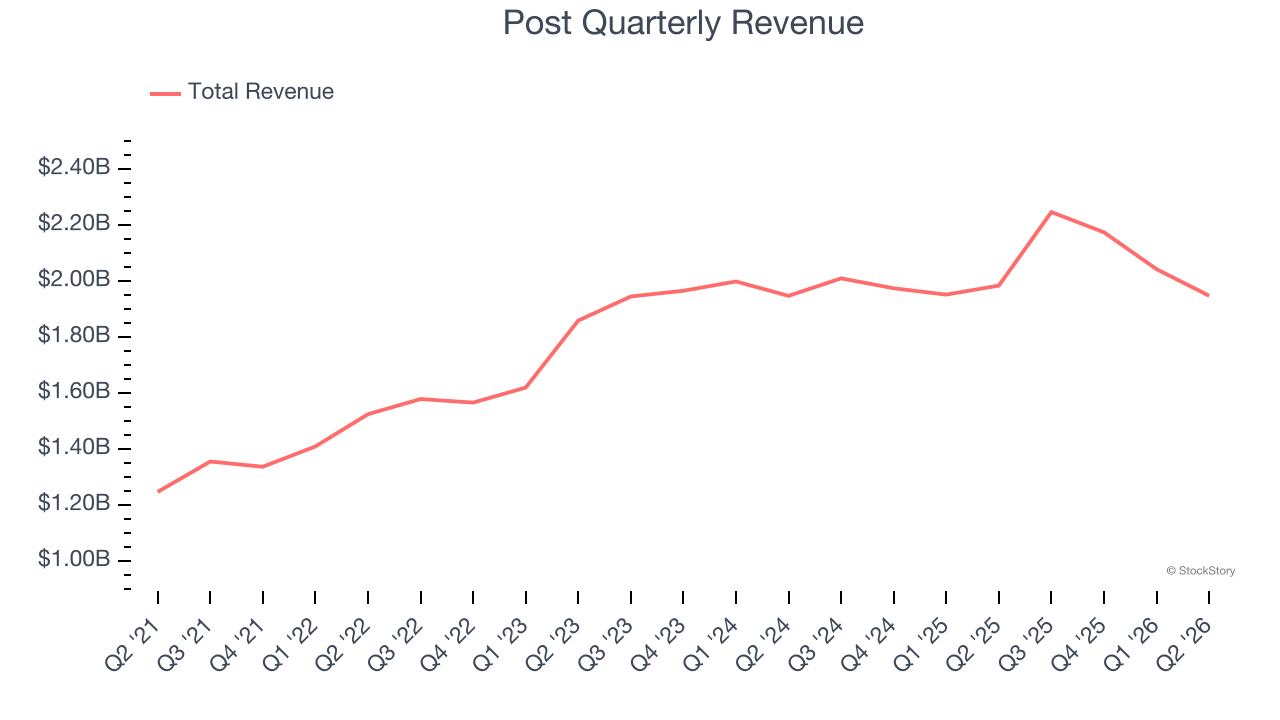
This quarter, Post missed Wall Street’s estimates and reported a rather uninspiring 1.8% year-on-year revenue decline, generating $1.95 billion of revenue.
Looking ahead, sell-side analysts expect revenue to decline by 2.8% over the next 12 months, a deceleration versus the last three years. This projection doesn’t excite us and indicates its products will see some demand headwinds.
ONE MORE THING: The $21 AI Application Stock Wall Street Forgot. While Wall Street obsesses over who’s building AI, one company is already using it to print money. And nobody’s paying attention.
AI chip stocks trade at ridiculous valuations. This company processes a trillion consumer signals monthly using AI and trades at a third of the price. The gap won’t last. The institutions will figure it out. You need to see this first. Read the FREE Report Before They Notice.
Cash Is King
If you’ve followed StockStory for a while, you know we emphasize free cash flow. Why, you ask? We believe that in the end, cash is king, and you can’t use accounting profits to pay the bills.
Post has shown decent cash profitability, giving it some flexibility to reinvest or return capital to investors. The company’s free cash flow margin averaged 6% over the last two years, slightly better than the broader consumer staples sector.
Taking a step back, we can see that Post’s margin expanded by 1.1 percentage points over the last year. This shows the company is heading in the right direction, and we can see it became a less capital-intensive business because its free cash flow profitability rose while its operating profitability was flat.
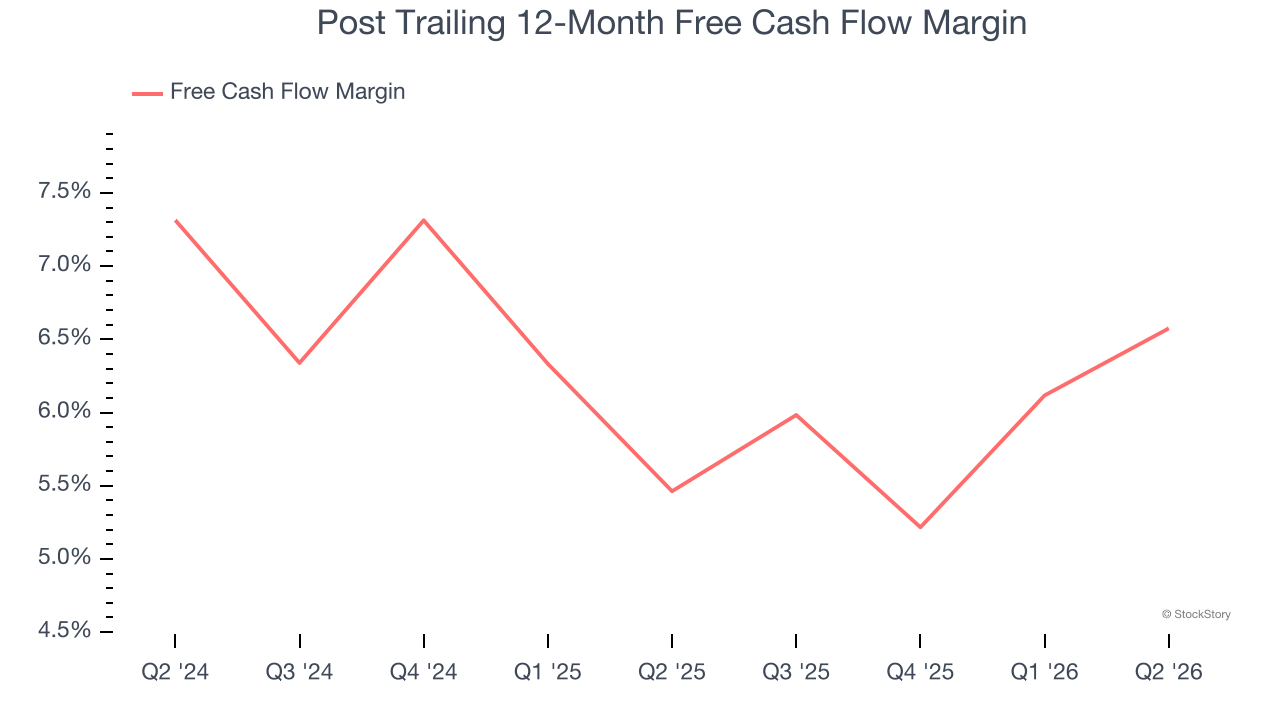
Post’s free cash flow clocked in at $131.2 million in Q2, equivalent to a 6.7% margin. This result was good as its margin was 2 percentage points higher than in the same quarter last year, building on its favorable historical trend.
Key Takeaways from Post’s Q2 Results
It was encouraging to see Post beat analysts’ gross margin expectations this quarter. We were also happy its EBITDA narrowly outperformed Wall Street’s estimates. On the other hand, its revenue missed. Overall, this was a softer quarter. The stock traded down 2.6% to $87.84 immediately following the results.
Post’s latest earnings report disappointed. One quarter doesn’t define a company’s quality, so let’s explore whether the stock is a buy at the current price. We think that the latest quarter is only one piece of the longer-term business quality puzzle. Quality, when combined with valuation, can help determine if the stock is a buy. We cover that in our actionable full research report which you can read here (it’s free).