
Insurance provider CNA Financial (NYSE: CNA) announced better-than-expected revenue in Q2 CY2026, with sales up 1.8% year on year to $3.83 billion. Its GAAP profit of $1.18 per share was 12.4% above analysts’ consensus estimates.
Is now the time to buy CNA Financial? Find out by accessing our full research report, it’s free.
CNA Financial (CNA) Q2 CY2026 Highlights:
- Net Premiums Earned: $2.76 billion (2.4% year-on-year growth)
- Revenue: $3.83 billion vs analyst estimates of $3.79 billion (1.8% year-on-year growth, 1.1% beat)
- Pre-tax Profit: $405 million (10.6% margin)
- EPS (GAAP): $1.18 vs analyst estimates of $1.05 (12.4% beat)
- Market Capitalization: $14.19 billion
Company Overview
With roots dating back to 1853 and majority ownership by Loews Corporation, CNA Financial (NYSE: CNA) is a commercial property and casualty insurance provider offering coverage for businesses, including professional liability, surety bonds, and specialized risk management services.
Revenue Growth
Insurers earn revenue three ways. The core insurance business itself, often called underwriting and represented in the income statement as premiums earned, is one way. Investment income from investing the “float” (premiums collected upfront not yet paid out as claims) in assets such as fixed-income assets and equities is the second way. Fees from various sources such as policy administration, annuities, or other value-added services are the third. Regrettably, CNA Financial’s revenue grew at a tepid 5.7% compounded annual growth rate over the last five years. This fell short of our benchmark for the insurance sector and is a rough starting point for our analysis.
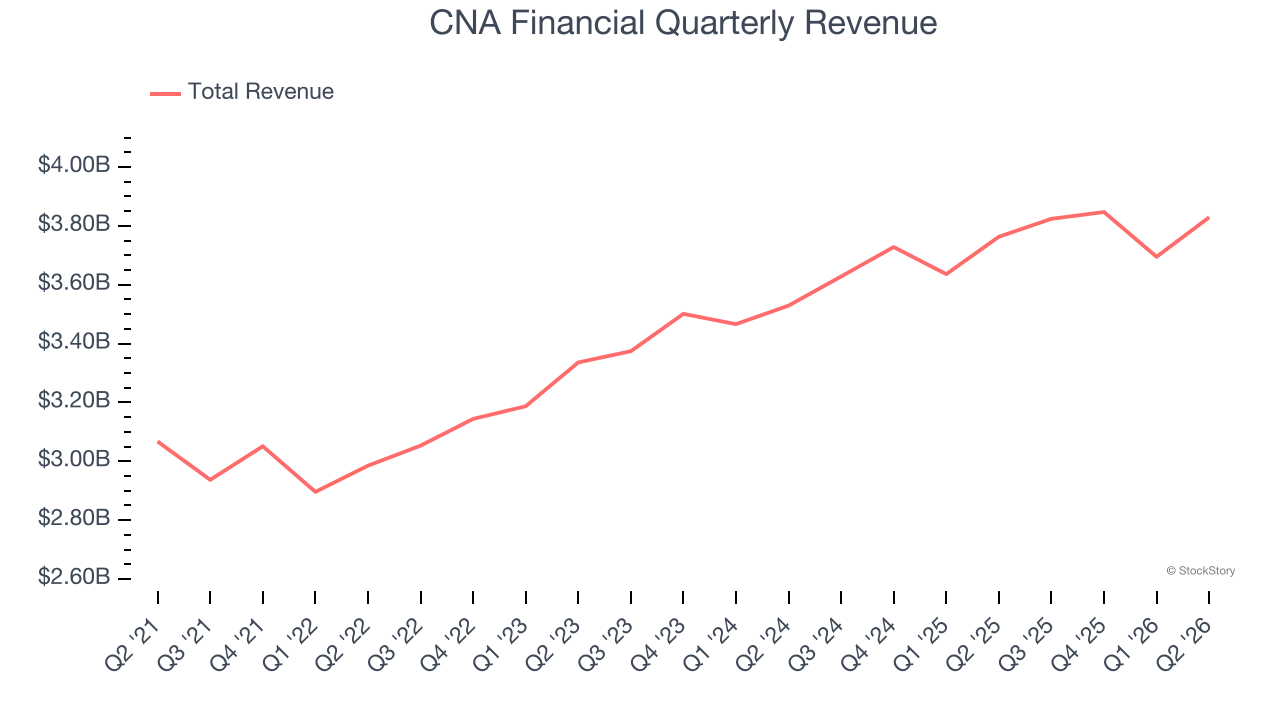
We at StockStory place the most emphasis on long-term growth, but within financials, a half-decade historical view may miss recent interest rate changes, market returns, and industry trends. CNA Financial’s recent performance shows its demand has slowed as its annualized revenue growth of 4.7% over the last two years was below its five-year trend. We’re wary when companies in the sector see decelerations in revenue growth, as it could signal changing consumer tastes aided by low switching costs. 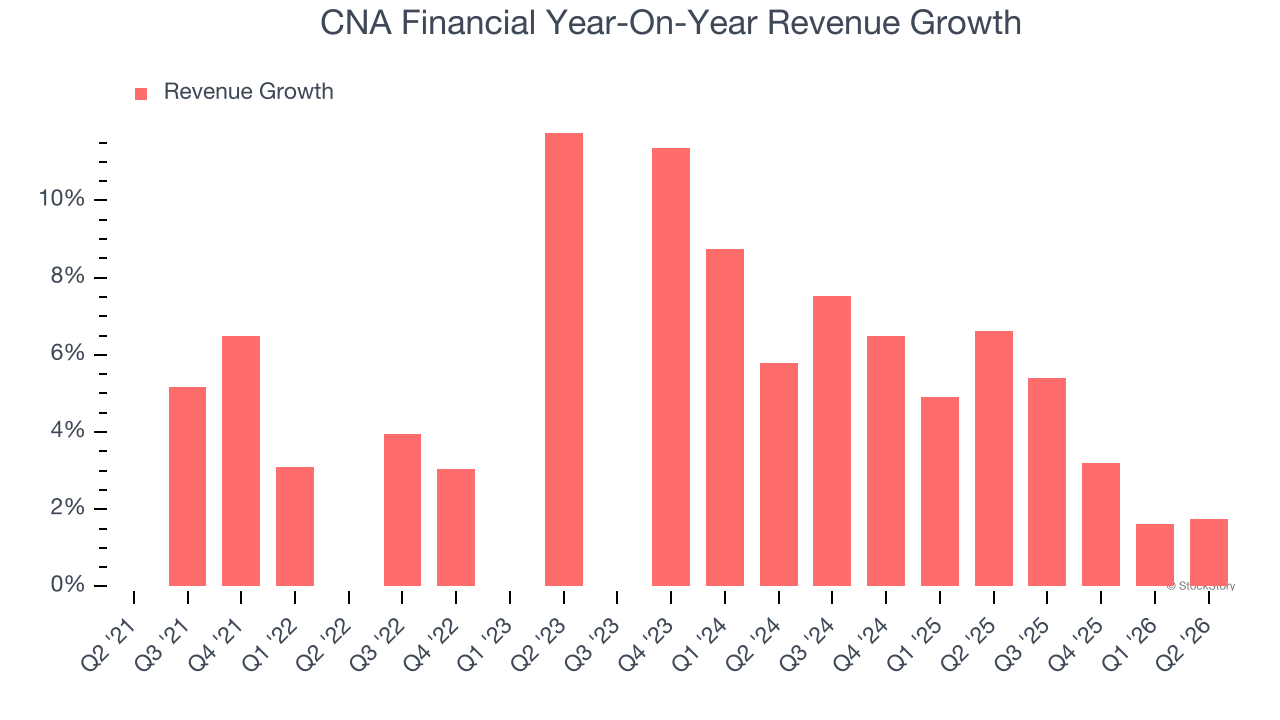 Note: Quarters not shown were determined to be outliers because they were impacted by outsized investment gains/losses that are not indicative of the recurring fundamentals of the business.
This quarter, CNA Financial reported modest year-on-year revenue growth of 1.8% but beat Wall Street’s estimates by 1.1%.
Net premiums earned made up 71.5% of the company’s total revenue during the last five years, meaning insurance operations are CNA Financial’s largest source of revenue.
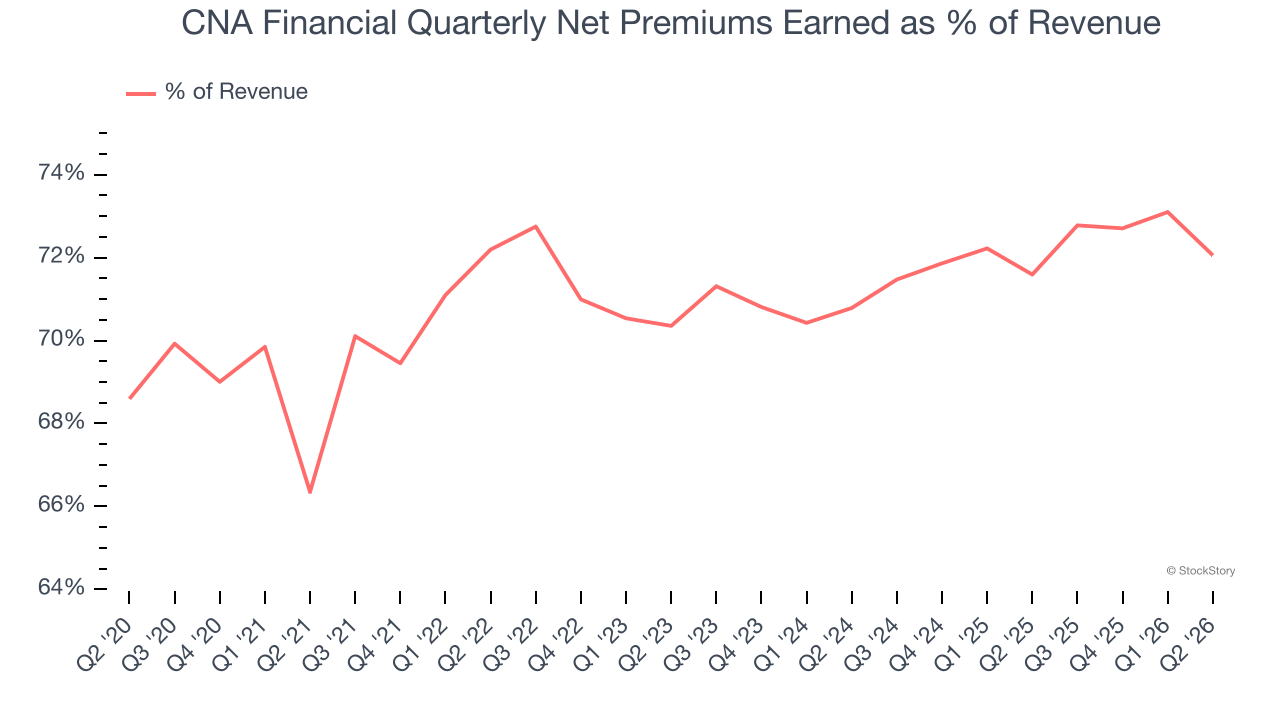
While insurers generate revenue from multiple sources, investors view net premiums earned as the cornerstone — their direct link to core operations stands in sharp contrast to the unpredictability of investment returns and fees.
ONE MORE THING: The $21 AI Application Stock Wall Street Forgot. While Wall Street obsesses over who’s building AI, one company is already using it to print money. And nobody’s paying attention.
AI chip stocks trade at ridiculous valuations. This company processes a trillion consumer signals monthly using AI and trades at a third of the price. The gap won’t last. The institutions will figure it out. You need to see this first. Read the FREE Report Before They Notice.
Net Premiums Earned
When insurers sell policies, they protect themselves from extremely large losses or an outsized accumulation of losses with reinsurance (insurance for insurance companies). Net premiums earned are therefore net of what’s ceded to reinsurers as a risk mitigation and transfer strategy.
CNA Financial’s net premiums earned has grown at a 6.8% annualized rate over the last five years, slightly worse than the broader insurance industry but faster than its total revenue.
When analyzing CNA Financial’s net premiums earned over the last two years, we can paint a similar picture as it recorded an annual growth rate of 6%. Since two-year net premiums earned grew faster than total revenue over this period, it’s implied that other line items such as investment income grew at a slower rate. These extra revenue streams are important to the bottom line, yet their performance can be inconsistent. Some firms have been more successful and consistent in managing their float, but sharp fluctuations in the fixed income and equity markets can dramatically affect short-term results.
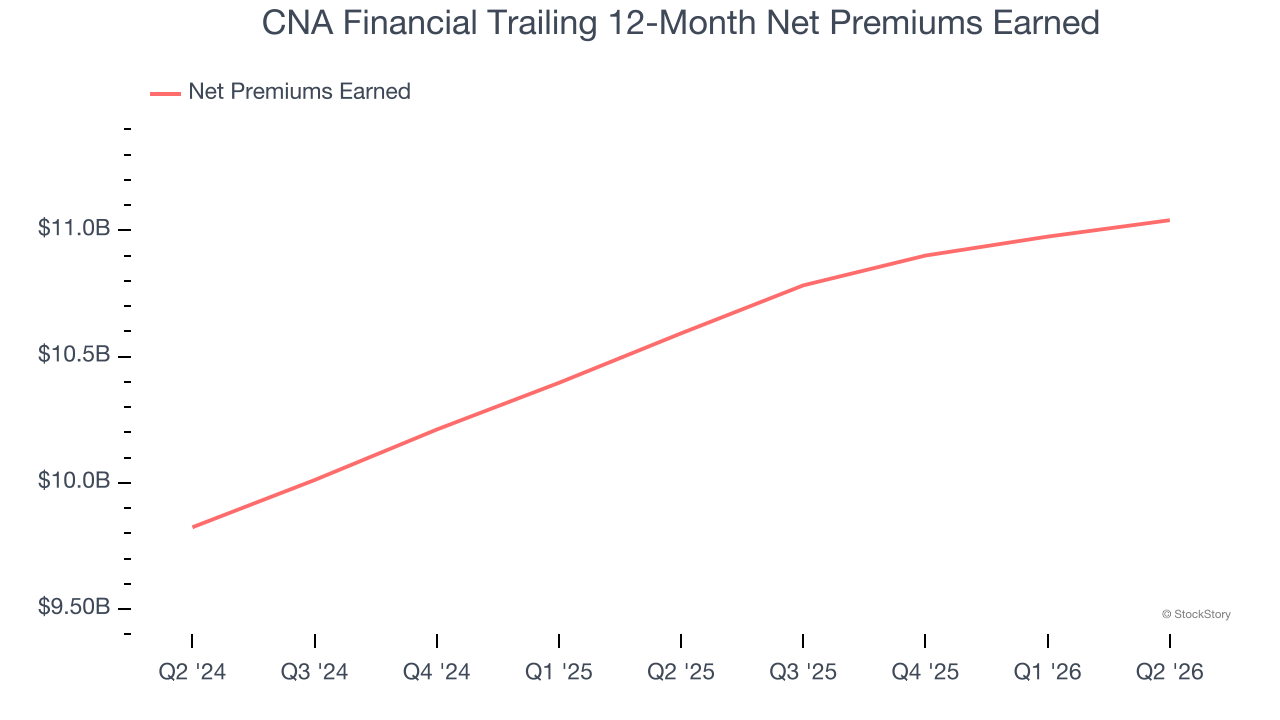
In Q2, CNA Financial produced $2.76 billion of net premiums earned, up 2.4% year on year.
Key Takeaways from CNA Financial’s Q2 Results
It was good to see CNA Financial beat analysts’ EPS expectations this quarter. We were also happy its revenue narrowly outperformed Wall Street’s estimates. Overall, we think this was a solid quarter with some key areas of upside. The stock remained flat at $52.47 immediately following the results.
Sure, CNA Financial had a solid quarter, but if we look at the bigger picture, is this stock a buy? The latest quarter does matter, but not nearly as much as longer-term fundamentals and valuation, when deciding if the stock is a buy. We cover that in our actionable full research report which you can read here (it’s free).