
Auto services provider Monro (NASDAQ: MNRO) met Wall Street’s revenue expectations in Q2 CY2026, but sales fell by 4.6% year on year to $287.1 million. Its non-GAAP loss of $0.09 per share was significantly below analysts’ consensus estimates.
Is now the time to buy Monro? Find out by accessing our full research report, it’s free.
Monro (MNRO) Q2 CY2026 Highlights:
- Revenue: $287.1 million vs analyst estimates of $286.3 million (4.6% year-on-year decline, in line)
- Adjusted EPS: -$0.09 vs analyst estimates of $0.02 (significant miss)
- Adjusted Operating Income: $2.2 million vs analyst estimates of $5.14 million (0.8% margin, 57.2% miss)
- Operating Margin: 1.3%, up from -2% in the same quarter last year
- Locations: 1,115 at quarter end, in line with the same quarter last year
- Same-Store Sales fell 1.7% year on year (5.7% in the same quarter last year)
- Market Capitalization: $537.4 million
“Our first quarter comparable store sales declined 1.7%, reflecting an operating environment, which continued to challenge the full-service auto aftermarket. This was driven by lower store traffic as well as consumers that continued to defer higher-ticket spending decisions in tires and brakes and traded-down to lower-cost alternatives in our tire category. However, and importantly, we were able to hold our tire unit volumes flat, and we believe this allowed us to take market share, both in our tier one tires as well as in our overall tire category in the quarter. We believe that this is a direct result of our promotional effectiveness and the timely expansion of our tier four tire offerings, which allowed us to meet the needs of our customers across the price spectrum. The effectiveness of our ConfiDrive courtesy inspection process helped us drive average repair order growth in the quarter. This was driven by meaningful improvements in certain of our higher-margin service categories, including batteries, alignments, and front/end shocks. This performance reinforces that we continue to deliver genuine value to our full-service customers, even in a difficult spending environment. Importantly, we maintained our marketing investment during the quarter, despite the sales headwinds we faced,” said Peter Fitzsimmons, President and Chief Executive Officer.
Company Overview
Started as a single location in Rochester, New York, Monro (NASDAQ: MNRO) provides common auto services such as brake repairs, tire replacements, and oil changes.
Revenue Growth
A company’s long-term performance is an indicator of its overall quality. Any business can put up a good quarter or two, but the best consistently grow over the long haul.
With $1.14 billion in revenue over the past 12 months, Monro is a small retailer, which sometimes brings disadvantages compared to larger competitors benefiting from economies of scale and negotiating leverage with suppliers.
As you can see below, Monro struggled to generate demand over the last three years. Its sales dropped by 4.3% annually as it closed stores.
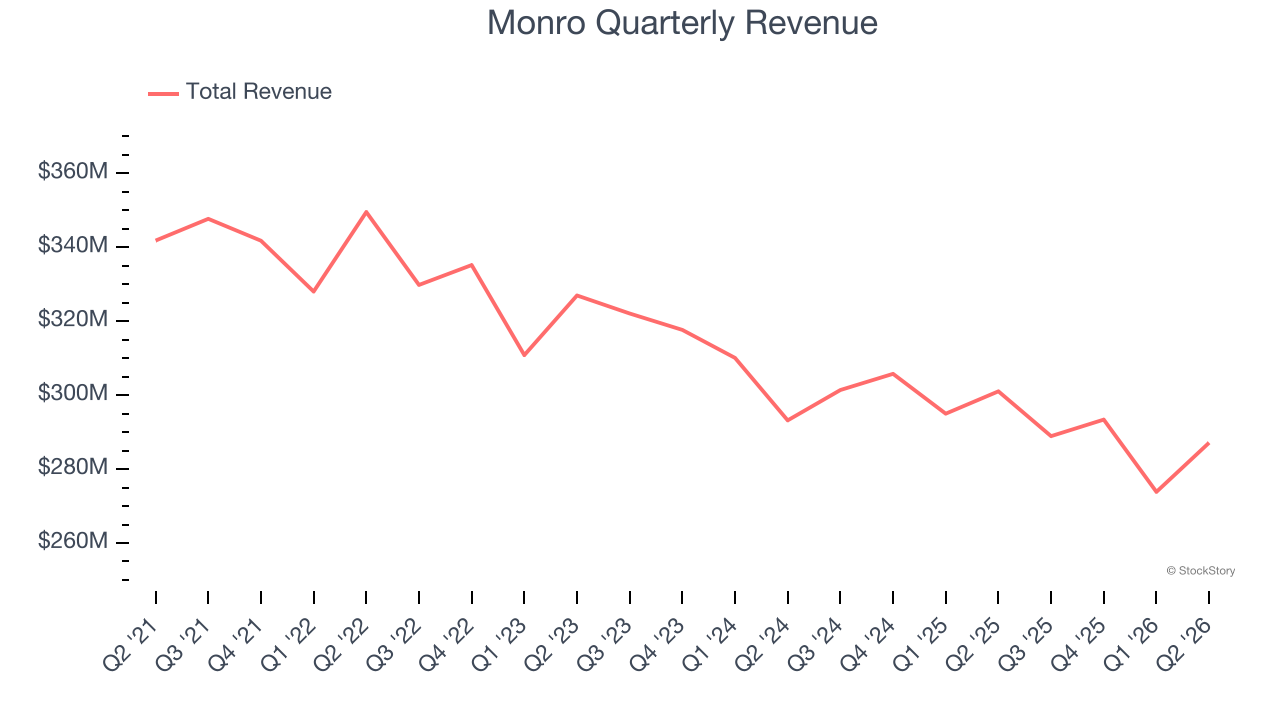
This quarter, Monro reported a rather uninspiring 4.6% year-on-year revenue decline to $287.1 million of revenue, in line with Wall Street’s estimates.
Looking ahead, sell-side analysts expect revenue to grow 2.3% over the next 12 months. Although this projection suggests its newer products will fuel better top-line performance, it is still below average for the sector.
ONE MORE THING: 3 Hidden Platforms Growing 3X Faster than Amazon, Google, and PayPal. Amazon, Google, and Meta all followed the same playbook: Dominate an ignored market. Build an unbeatable moat. Scale until you’re unstoppable.
These three platforms are running that exact playbook right now. The early investors in Amazon made fortunes. The early investors in these could do the same. Get All 3 Stocks Here for FREE.
Store Performance
Number of Stores
A retailer’s store count influences how much it can sell and how quickly revenue can grow.
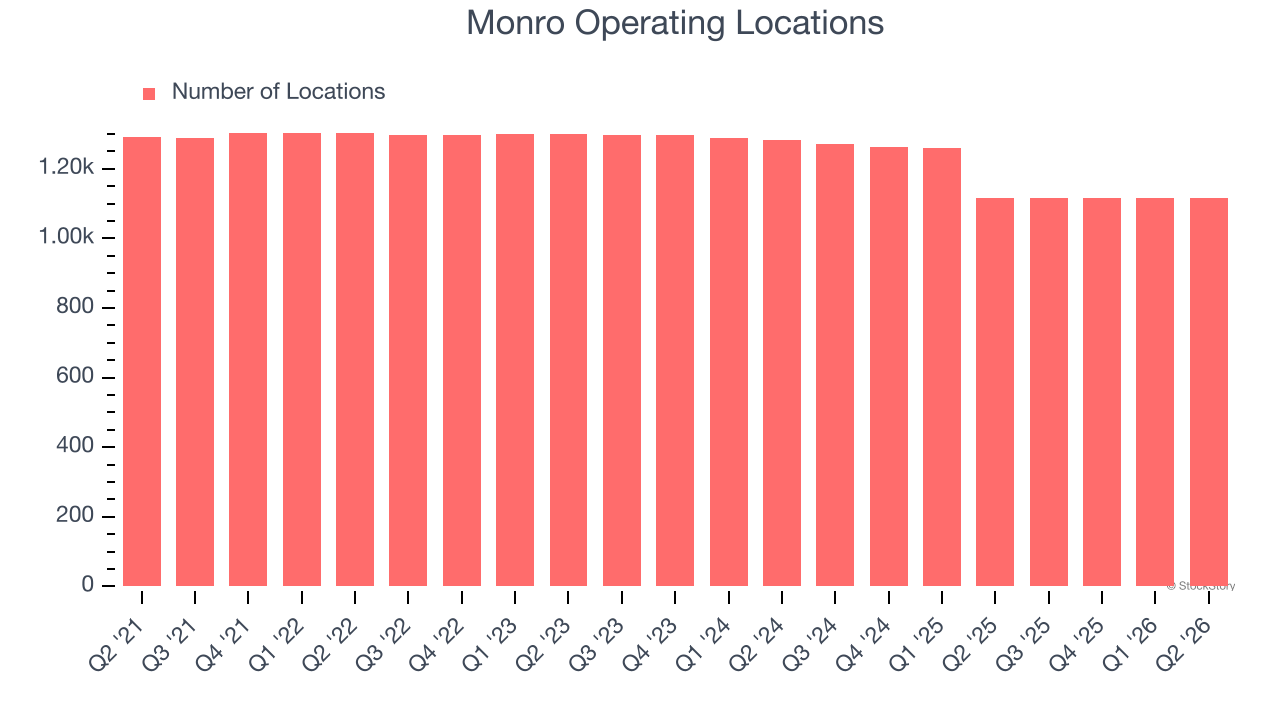
Monro operated 1,115 locations in the latest quarter. Over the last two years, the company has generally closed its stores, averaging 6.9% annual declines.
When a retailer shutters stores, it usually means that brick-and-mortar demand is less than supply, and it is responding by closing underperforming locations to improve profitability.
Same-Store Sales
The change in a company’s store base only tells one side of the story. The other is the performance of its existing locations and e-commerce sales, which informs management teams whether they should expand or downsize their physical footprints. Same-store sales gives us insight into this topic because it measures organic growth for a retailer’s e-commerce platform and brick-and-mortar shops that have existed for at least a year.
Monro’s demand within its existing locations has barely increased over the last two years as its same-store sales were flat. This performance isn’t ideal, and Monro is attempting to boost same-store sales by closing stores (fewer locations sometimes lead to higher same-store sales).
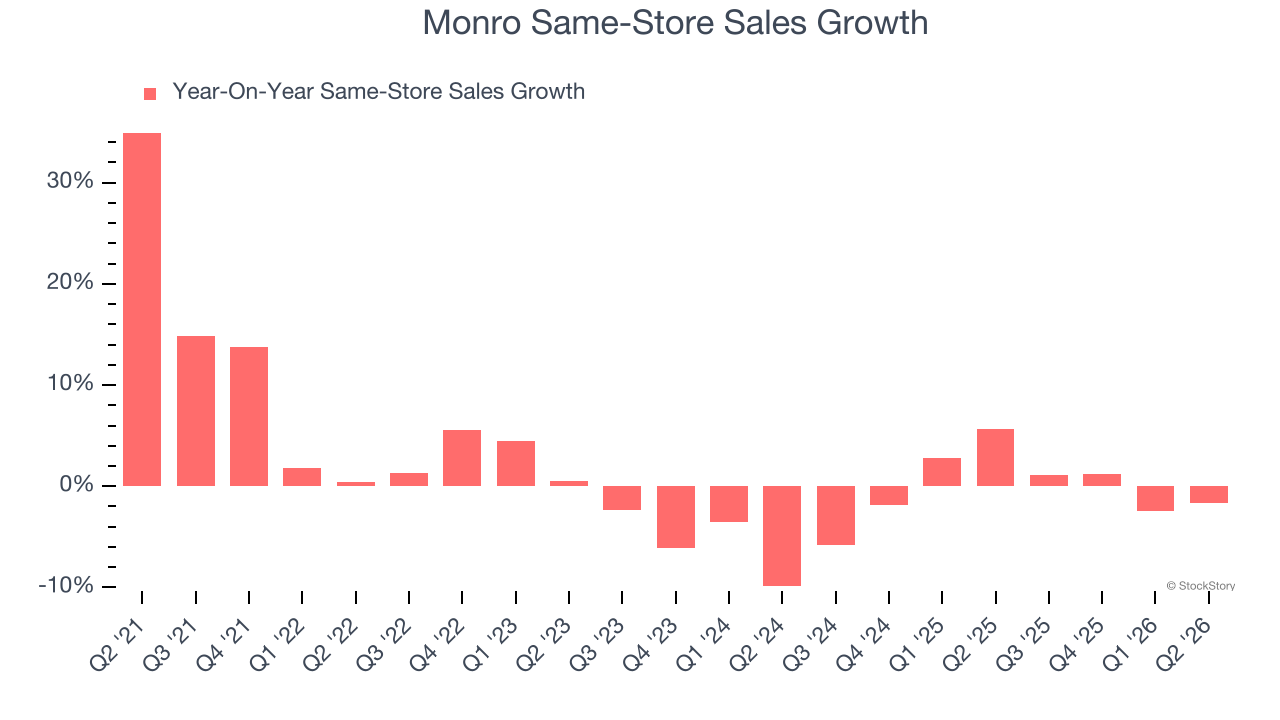
In the latest quarter, Monro’s same-store sales fell by 1.7% year on year. This decrease represents a further deceleration from its historical levels. We hope the business can get back on track.
Key Takeaways from Monro’s Q2 Results
We struggled to find many positives in these results. Its EPS missed and its gross margin fell slightly short of Wall Street’s estimates. Overall, this was a weaker quarter. The stock traded down 10.6% to $15.38 immediately following the results.
The latest quarter from Monro’s wasn’t that good. One earnings report doesn’t define a company’s quality, though, so let’s explore whether the stock is a buy at the current price. We think that the latest quarter is only one piece of the longer-term business quality puzzle. Quality, when combined with valuation, can help determine if the stock is a buy. We cover that in our actionable full research report which you can read here (it’s free).