
Global pharmaceutical company Eli Lilly (NYSE: LLY) reported Q1 CY2026 results topping the market’s revenue expectations, with sales up 55.5% year on year to $19.8 billion. The company’s full-year revenue guidance of $83.5 billion at the midpoint came in 2% above analysts’ estimates. Its non-GAAP profit of $8.55 per share was 25.9% above analysts’ consensus estimates.
Is now the time to buy Eli Lilly? Find out by accessing our full research report, it’s free.
Eli Lilly (LLY) Q1 CY2026 Highlights:
- Revenue: $19.8 billion vs analyst estimates of $17.41 billion (55.5% year-on-year growth, 13.7% beat)
- Adjusted EPS: $8.55 vs analyst estimates of $6.79 (25.9% beat)
- Adjusted Operating Income: $8.92 billion vs analyst estimates of $7.54 billion (45% margin, 18.3% beat)
- The company lifted its revenue guidance for the full year to $83.5 billion at the midpoint from $81.5 billion, a 2.5% increase
- Management raised its full-year Adjusted EPS guidance to $36.25 at the midpoint, a 5.8% increase
- Operating Margin: 45%, up from 29% in the same quarter last year
- Market Capitalization: $761.7 billion
"2026 is off to a strong start, we delivered 56% revenue growth in the first quarter and raised our full-year revenue guidance by $2 billion," said David A. Ricks, Lilly chair and CEO.
Company Overview
Founded in 1876 by a Civil War veteran and pharmacist frustrated with the poor quality of medicines, Eli Lilly (NYSE: LLY) discovers, develops, and manufactures pharmaceutical products for conditions including diabetes, obesity, cancer, immunological disorders, and neurological diseases.
Revenue Growth
A company’s long-term sales performance is one signal of its overall quality. Any business can put up a good quarter or two, but many enduring ones grow for years. Thankfully, Eli Lilly’s 23.2% annualized revenue growth over the last five years was excellent. Its growth surpassed the average healthcare company and shows its offerings resonate with customers, a great starting point for our analysis.
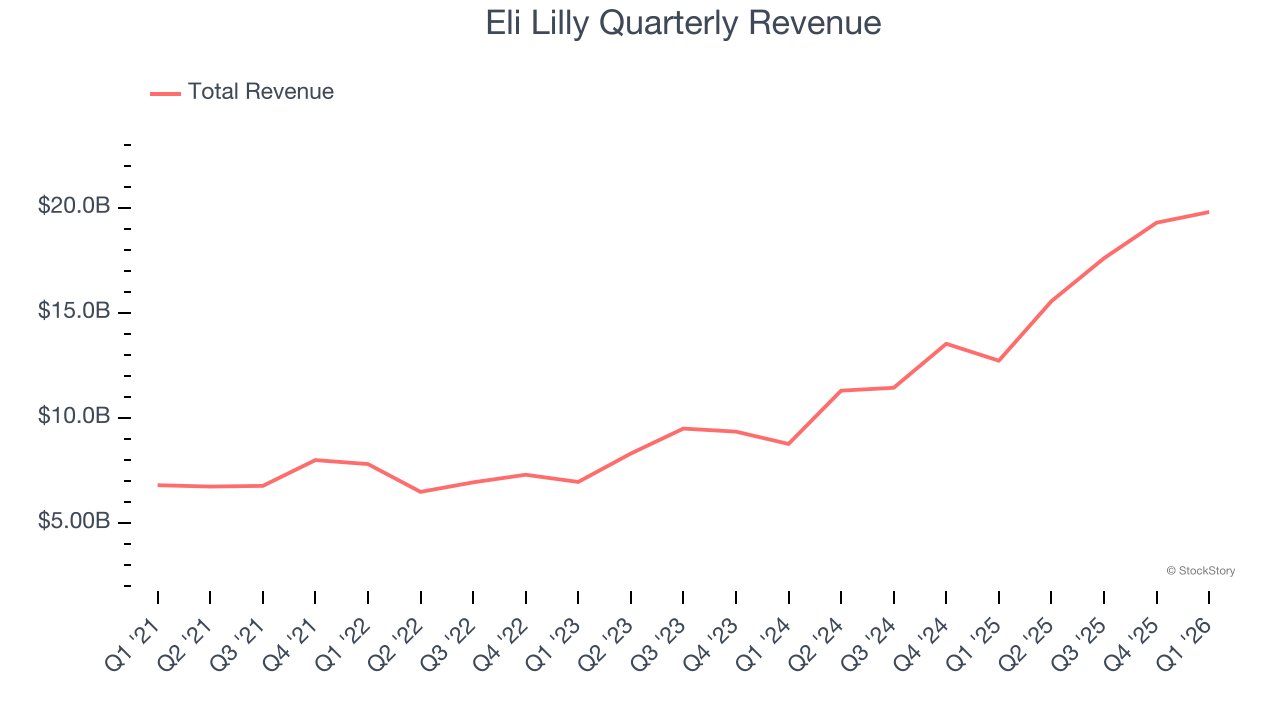
Long-term growth is the most important, but within healthcare, a half-decade historical view may miss new innovations or demand cycles. Eli Lilly’s annualized revenue growth of 41.8% over the last two years is above its five-year trend, suggesting its demand was strong and recently accelerated. 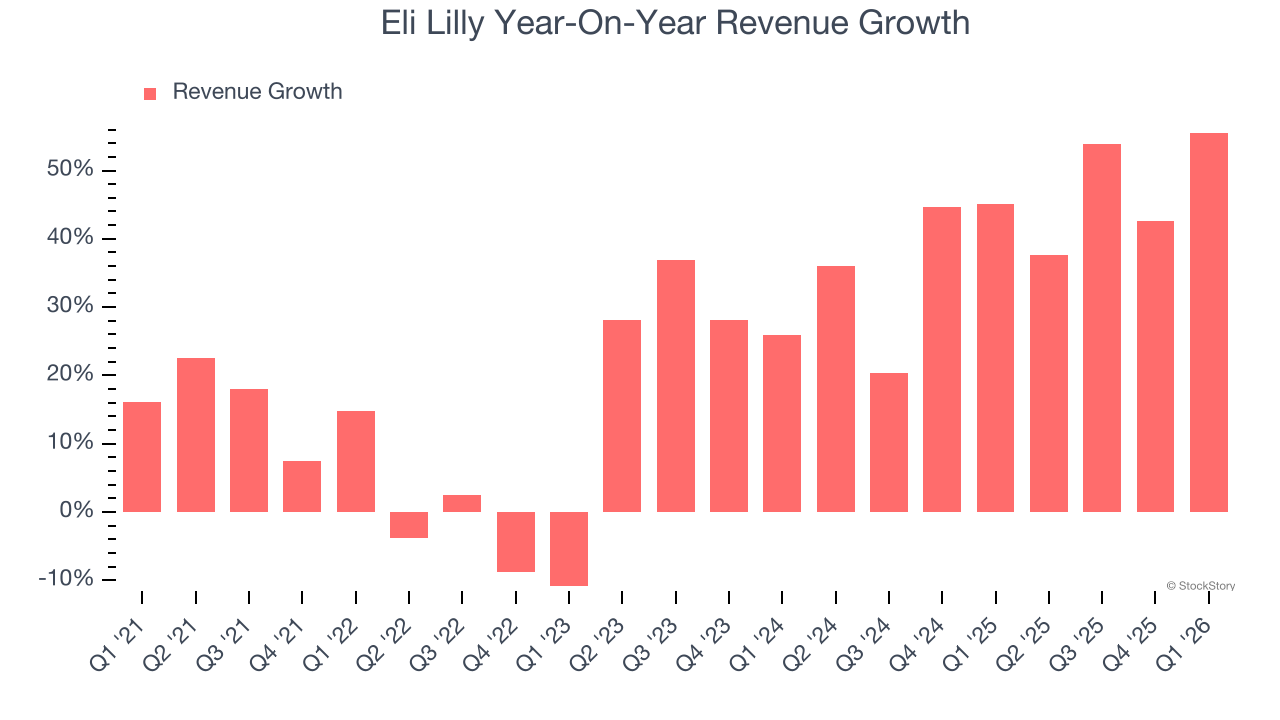
This quarter, Eli Lilly reported magnificent year-on-year revenue growth of 55.5%, and its $19.8 billion of revenue beat Wall Street’s estimates by 13.7%.
Looking ahead, sell-side analysts expect revenue to grow 19.4% over the next 12 months, a deceleration versus the last two years. Still, this projection is eye-popping given its scale and implies the market sees success for its products and services.
ONE MORE THING: The $21 AI Application Stock Wall Street Forgot. While Wall Street obsesses over who’s building AI, one company is already using it to print money. And nobody’s paying attention.
AI chip stocks trade at ridiculous valuations. This company processes a trillion consumer signals monthly using AI and trades at a third of the price. The gap won’t last. The institutions will figure it out. You need to see this first. Read the FREE Report Before They Notice.
Adjusted Operating Margin
Eli Lilly has been a well-oiled machine over the last five years. It demonstrated elite profitability for a healthcare business, boasting an average adjusted operating margin of 33.4%.
Looking at the trend in its profitability, Eli Lilly’s adjusted operating margin rose by 15.4 percentage points over the last five years, as its sales growth gave it immense operating leverage. This performance was mostly driven by its recent improvements as the company’s margin has increased by 22.3 percentage points on a two-year basis. These data points are very encouraging and show momentum is on its side.
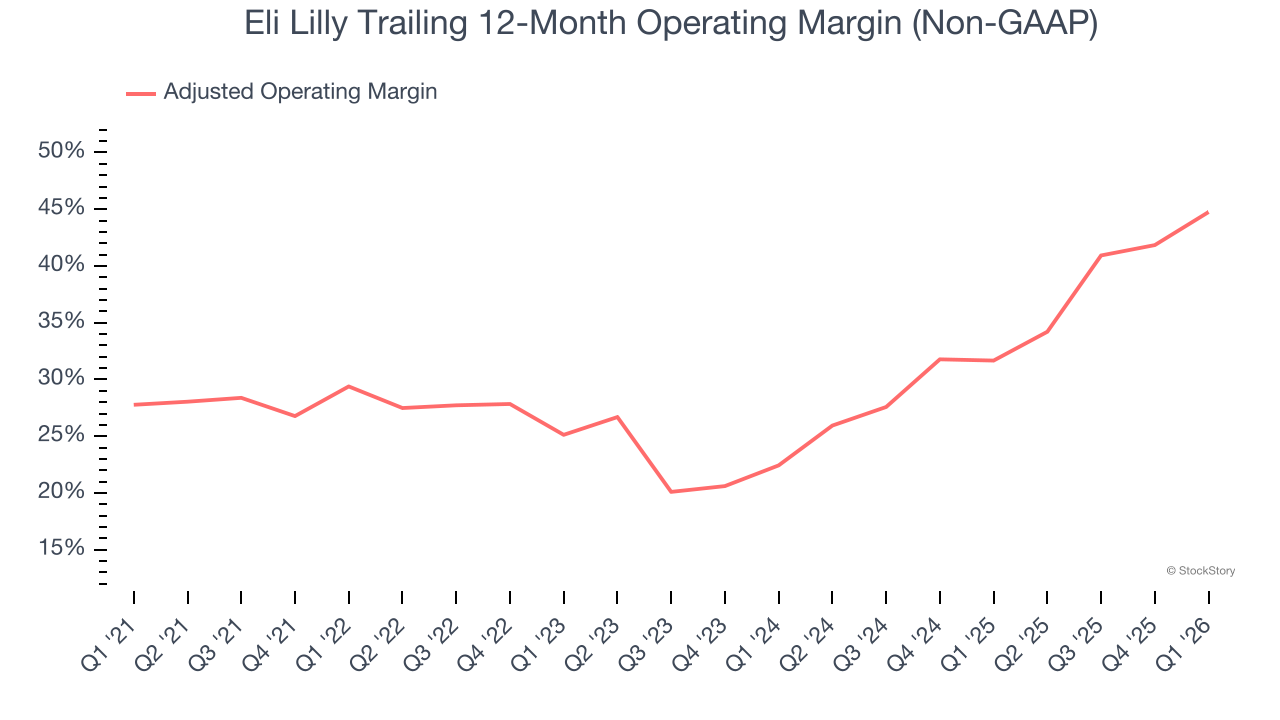
In Q1, Eli Lilly generated an adjusted operating margin profit margin of 45%, up 14.8 percentage points year on year. This increase was a welcome development and shows it was more efficient.
Earnings Per Share
Revenue trends explain a company’s historical growth, but the long-term change in earnings per share (EPS) points to the profitability of that growth – for example, a company could inflate its sales through excessive spending on advertising and promotions.
Eli Lilly’s EPS grew at 29.6% compounded annual growth rate over the last five years, higher than its 23.2% annualized revenue growth. This tells us the company became more profitable on a per-share basis as it expanded.
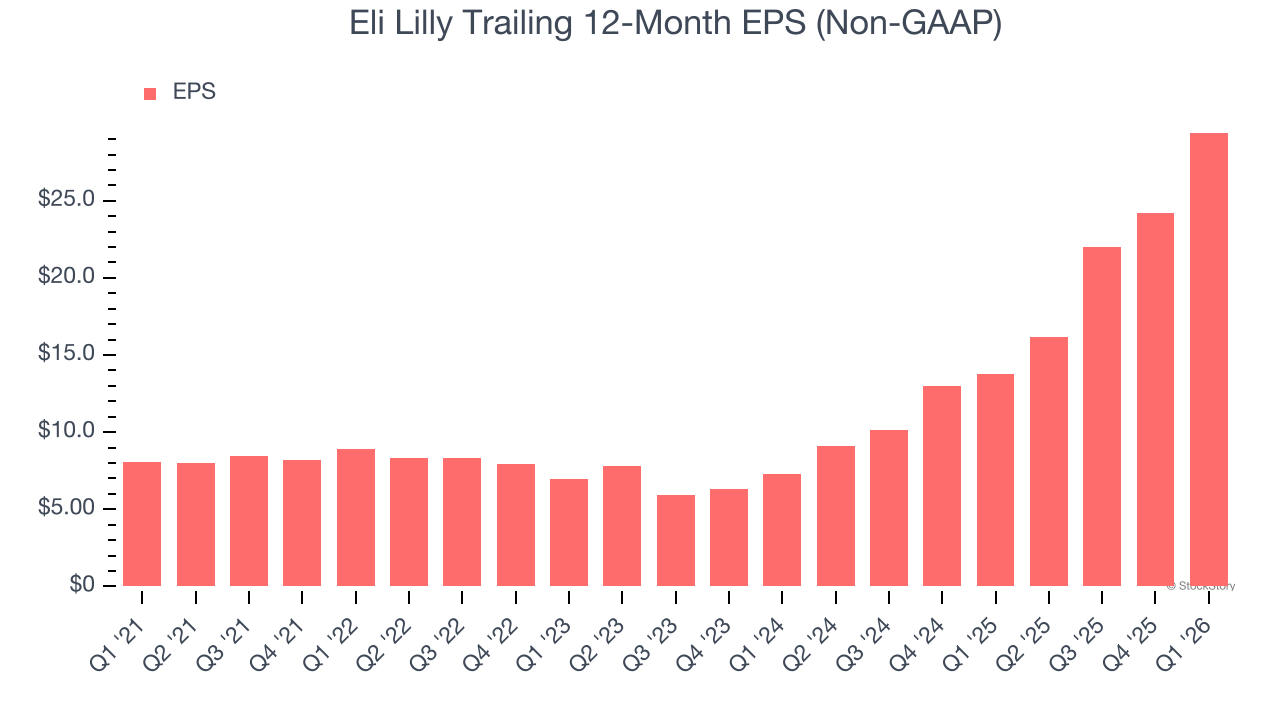
Diving into Eli Lilly’s quality of earnings can give us a better understanding of its performance. As we mentioned earlier, Eli Lilly’s adjusted operating margin expanded by 15.4 percentage points over the last five years. On top of that, its share count shrank by 1.8%. These are positive signs for shareholders because improving profitability and share buybacks turbocharge EPS growth relative to revenue growth. 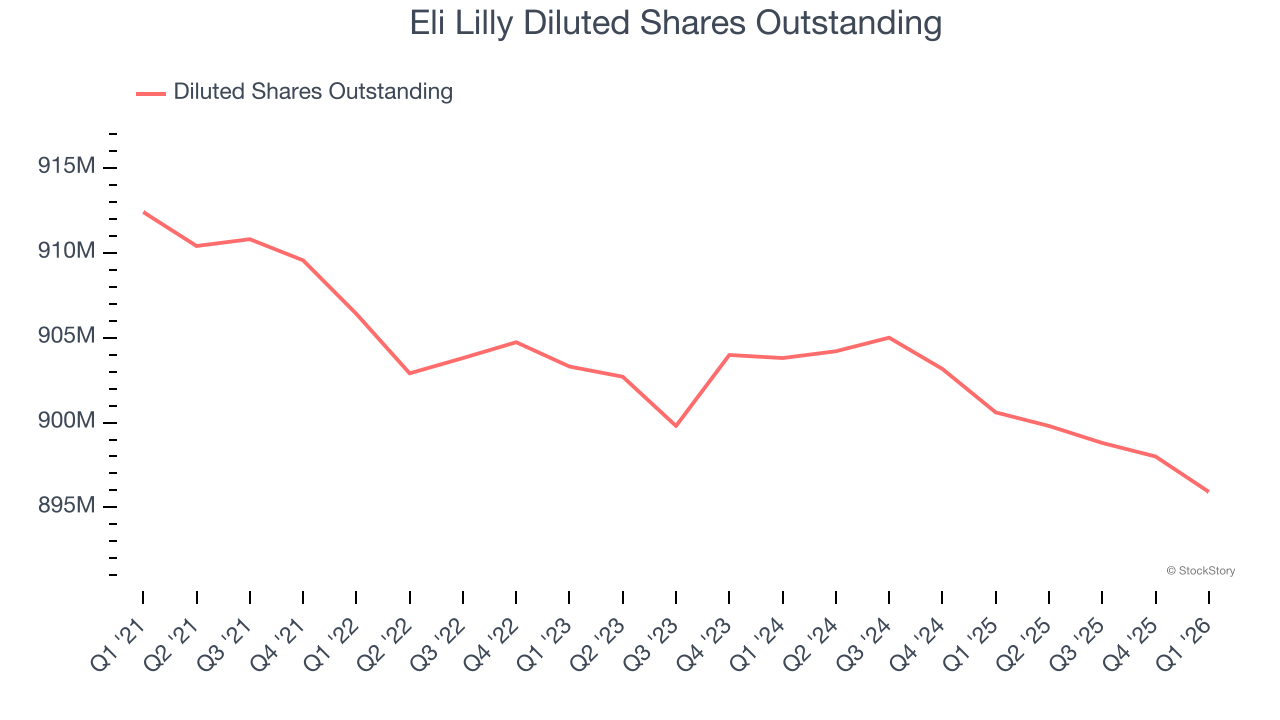
In Q1, Eli Lilly reported adjusted EPS of $8.55, up from $3.34 in the same quarter last year. This print easily cleared analysts’ estimates, and shareholders should be content with the results. Over the next 12 months, Wall Street expects Eli Lilly’s full-year EPS of $29.42 to grow 25.2%.
Key Takeaways from Eli Lilly’s Q1 Results
This was a beat and raise quarter. It was good to see Eli Lilly beat analysts’ revenue and EPS expectations this quarter. We were also excited that the company raised full-year guidance for revenue and EPS as well. Zooming out, we think this was a solid print. The stock traded up 5.2% to $895.16 immediately following the results.
Eli Lilly had an encouraging quarter, but one earnings result doesn’t necessarily make the stock a buy. Let’s see if this is a good investment. When making that decision, it’s important to consider its valuation, business qualities, as well as what has happened in the latest quarter. We cover that in our actionable full research report which you can read here (it’s free).