Looking back on apparel retailer stocks’ Q4 earnings, we examine this quarter’s best and worst performers, including Lululemon (NASDAQ: LULU) and its peers.
Apparel sales are not driven so much by personal needs but by seasons, trends, and innovation, and over the last few decades, the category has shifted meaningfully online. Retailers that once only had brick-and-mortar stores are responding with omnichannel presences. The online shopping experience continues to improve and retail foot traffic in places like shopping malls continues to stall, so the evolution of clothing sellers marches on.
The 9 apparel retailer stocks we track reported a strong Q4. As a group, revenues beat analysts’ consensus estimates by 1.4% while next quarter’s revenue guidance was in line.
Luckily, apparel retailer stocks have performed well with share prices up 12.1% on average since the latest earnings results.
Slowest Q4: Lululemon (NASDAQ: LULU)
Originally serving yogis and hockey players, Lululemon (NASDAQ: LULU) is a designer, distributor, and retailer of athletic apparel for men and women.
Lululemon reported revenues of $3.64 billion, flat year on year. This print exceeded analysts’ expectations by 1.8%. Despite the top-line beat, it was still a slower quarter for the company with EPS guidance for next quarter missing analysts’ expectations significantly and full-year EPS guidance missing analysts’ expectations.
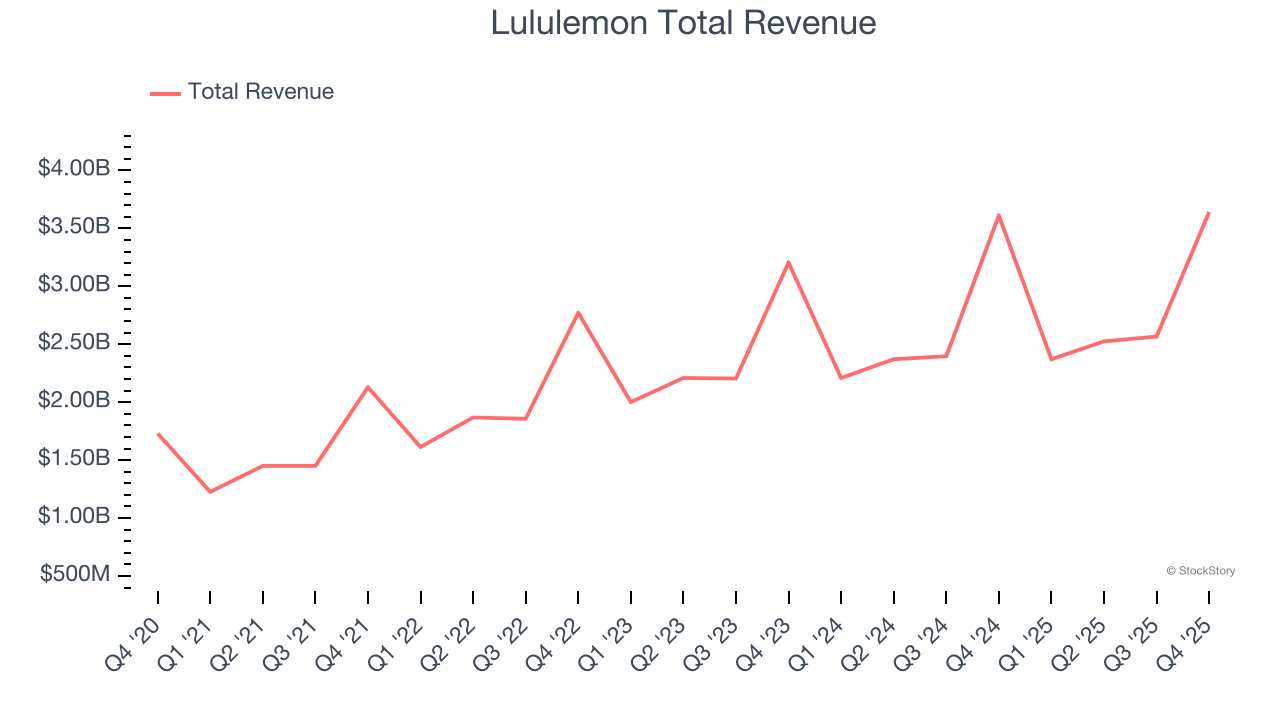
Unsurprisingly, the stock is down 4.5% since reporting and currently trades at $152.10.
Is now the time to buy Lululemon? Access our full analysis of the earnings results here, it’s free.
Best Q4: Tilly's (NYSE: TLYS)
With an emphasis on skate and surf culture, Tilly’s (NYSE: TLYS) is a specialty retailer that sells clothing, footwear, and accessories geared towards fashion-forward teens and young adults.
Tilly's reported revenues of $155.1 million, up 5.3% year on year, outperforming analysts’ expectations by 4.3%. The business had an incredible quarter with EPS guidance for next quarter exceeding analysts’ expectations and a beat of analysts’ EPS estimates.
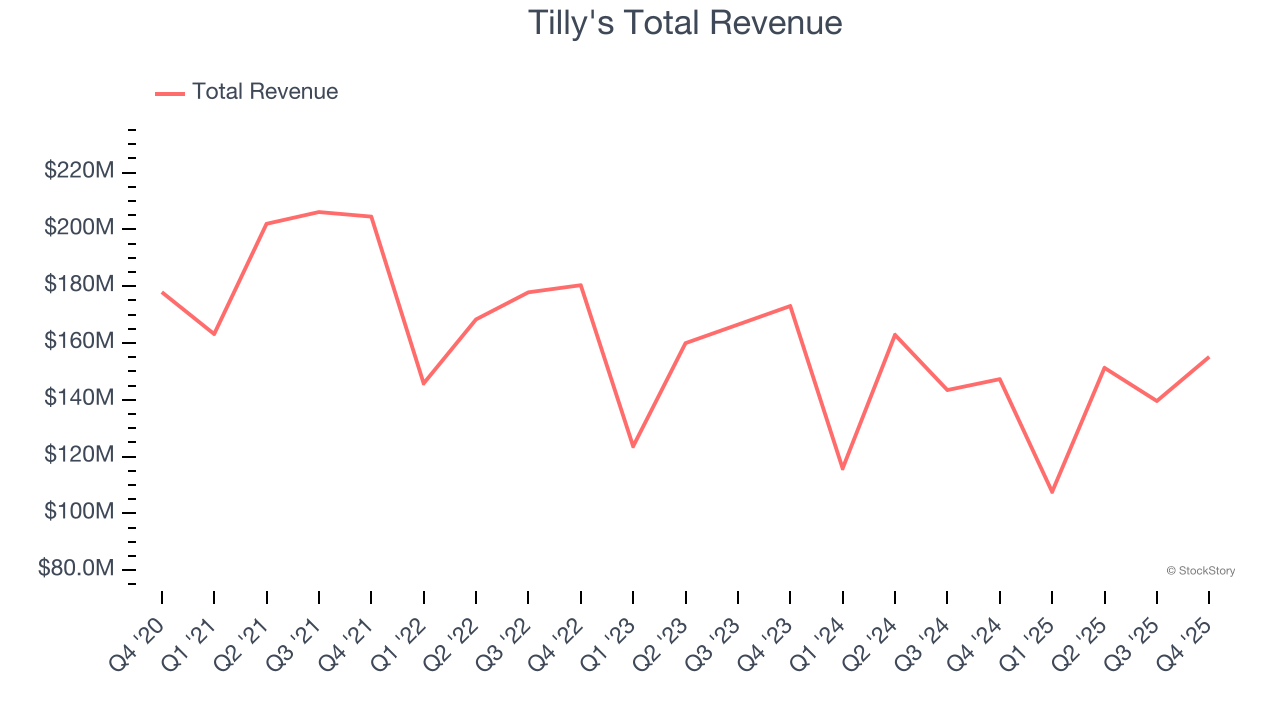
Tilly's scored the biggest analyst estimates beat among its peers. The market seems happy with the results as the stock is up 162% since reporting. It currently trades at $4.27.
Is now the time to buy Tilly's? Access our full analysis of the earnings results here, it’s free.
Abercrombie and Fitch (NYSE: ANF)
Founded as an outdoor and sporting brand, Abercrombie & Fitch (NYSE: ANF) evolved to become a specialty retailer that sells its own brand of fashionable clothing to young adults.
Abercrombie and Fitch reported revenues of $1.67 billion, up 5.4% year on year, in line with analysts’ expectations. It was a slower quarter as it posted EPS guidance for next quarter missing analysts’ expectations significantly and revenue guidance for next quarter missing analysts’ expectations.
As expected, the stock is down 10% since the results and currently trades at $89.32.
Read our full analysis of Abercrombie and Fitch’s results here.
Torrid (NYSE: CURV)
Promoting a message of body positivity and inclusiveness, Torrid Holdings (NYSE: CURV) is a plus-size women’s apparel and accessories retailer.
Torrid reported revenues of $236.2 million, down 14.3% year on year. This result beat analysts’ expectations by 2.2%. Overall, it was a strong quarter as it also recorded a beat of analysts’ EPS estimates and an impressive beat of analysts’ EBITDA estimates.
Torrid delivered the highest full-year guidance raise but had the slowest revenue growth among its peers. The stock is up 34.8% since reporting and currently trades at $1.69.
Read our full, actionable report on Torrid here, it’s free.
Gap (NYSE: GAP)
Operating under the Gap, Old Navy, Banana Republic, and Athleta brands, Gap (NYSE: GAP) is an apparel and accessories retailer selling casual clothing to men, women, and children.
Gap reported revenues of $4.24 billion, up 2.1% year on year. This print met analysts’ expectations. More broadly, it was a mixed quarter as it also recorded an impressive beat of analysts’ EBITDA estimates but full-year EPS guidance missing analysts’ expectations.
Gap had the weakest performance against analyst estimates among its peers. The stock is down 7.8% since reporting and currently trades at $25.09.
Read our full, actionable report on Gap here, it’s free.
Market Update
Late in 2025 into early 2026, there was hand wringing around artificial intelligence. For software companies, the fear was that AI would erode pricing power and compress margins as new tools made it easier to replicate what once required expensive enterprise platforms. Crypto investors had their own version of the same anxiety: if AI agents could trade, allocate capital, and manage wallets autonomously, what exactly was the long-term value of today’s crypto infrastructure?
These concerns triggered a noticeable rotation away from these sectors and into safer havens. But markets rarely dwell on one narrative for long. Spring 2026 came, and the focus shifted abruptly from technological disruption to geopolitical risk. The US’ conflict with Iran became the dominant driver of market psychology, and when geopolitics takes center stage, the script changes quickly. Investors stop debating growth rates and start worrying about oil supply, inflation, and global stability.
Want to invest in winners with rock-solid fundamentals? Check out our Top 6 Stocks and add them to your watchlist. These companies are poised for growth regardless of the political or macroeconomic climate.
StockStory’s analyst team — all seasoned professional investors — uses quantitative analysis and automation to deliver market-beating insights faster and with higher quality.