RV Manufacturer Winnebago (NYSE: WGO) beat Wall Street’s revenue expectations in Q1 CY2026, with sales up 6% year on year to $657.4 million. On the other hand, the company’s full-year revenue guidance of $2.9 billion at the midpoint came in 0.7% below analysts’ estimates. Its non-GAAP profit of $0.27 per share was 11.3% above analysts’ consensus estimates.
Is now the time to buy Winnebago? Find out by accessing our full research report, it’s free.
Winnebago (WGO) Q1 CY2026 Highlights:
- Revenue: $657.4 million vs analyst estimates of $627.2 million (6% year-on-year growth, 4.8% beat)
- Adjusted EPS: $0.27 vs analyst estimates of $0.24 (11.3% beat)
- Adjusted EBITDA: $24.4 million vs analyst estimates of $25.08 million (3.7% margin, 2.7% miss)
- The company reconfirmed its revenue guidance for the full year of $2.9 billion at the midpoint
- Management reiterated its full-year Adjusted EPS guidance of $2.45 at the midpoint
- Operating Margin: 1.8%, in line with the same quarter last year
- Free Cash Flow was -$29.1 million compared to -$18.9 million in the same quarter last year
- Market Capitalization: $990 million
CEO Commentary“Our team delivered a solid quarter and executed with diligence in a challenging market,” said President and Chief Executive Officer Michael Happe.
Company Overview
Created to provide high-quality, affordable RVs to the post-war American family, Winnebago (NYSE: WGO) is a manufacturer of recreational vehicles, providing a range of motorhomes, travel trailers, and fifth-wheel products for outdoor and adventure lifestyles.
Revenue Growth
Reviewing a company’s long-term sales performance reveals insights into its quality. Even a bad business can shine for one or two quarters, but a top-tier one grows for years. Unfortunately, Winnebago struggled to consistently increase demand as its $2.91 billion of sales for the trailing 12 months was close to its revenue five years ago. This was below our standards and suggests it’s a low quality business.
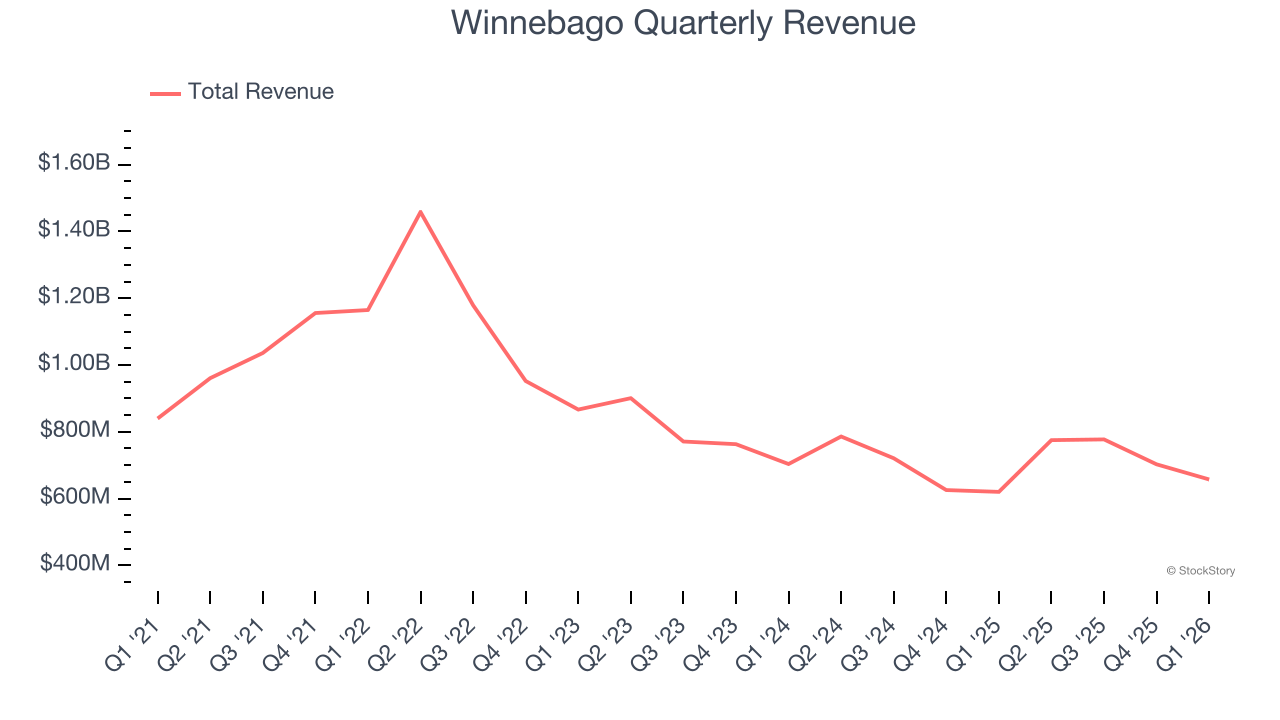
Long-term growth is the most important, but within industrials, a half-decade historical view may miss new industry trends or demand cycles. Winnebago’s recent performance shows its demand remained suppressed as its revenue has declined by 3.7% annually over the last two years. 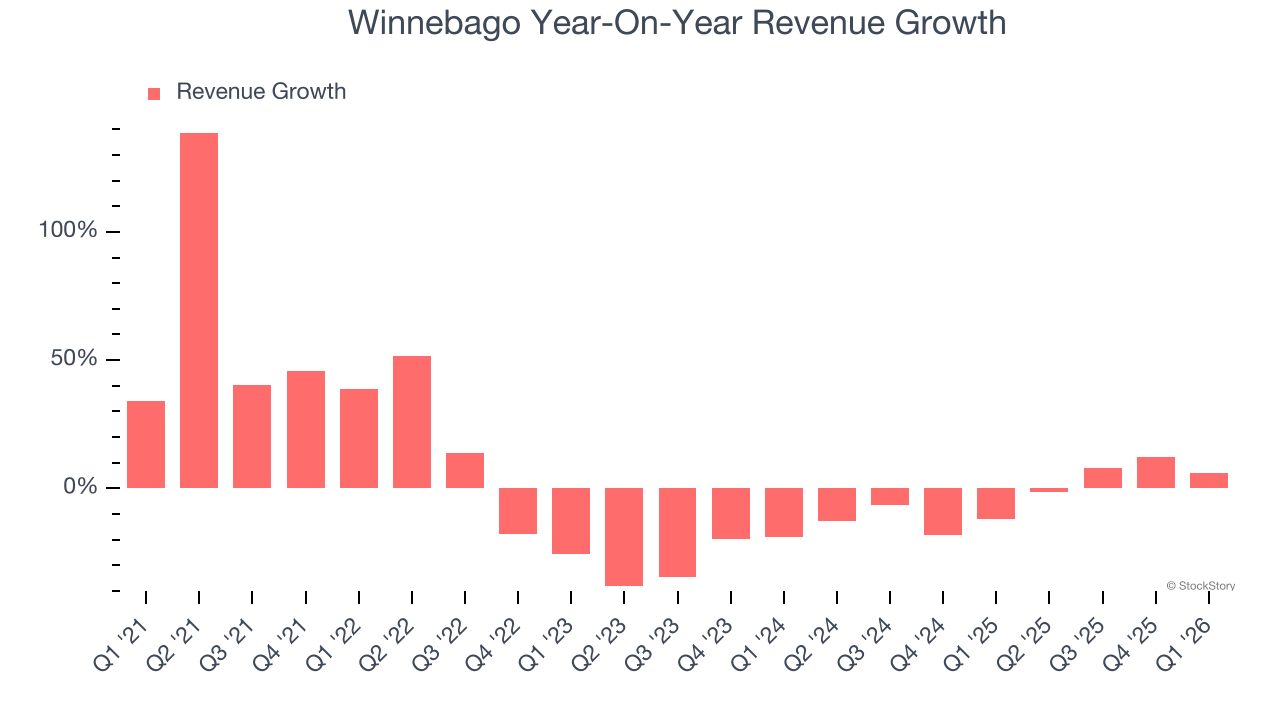
Winnebago also breaks out the revenue for its most important segments, Motorhomes and Towables, which are 46.3% and 39.9% of revenue. Over the last two years, Winnebago’s Motorhomes revenue (homes on wheels) averaged 5.4% year-on-year growth while its Towables revenue (non-motorized vehicles) was flat. 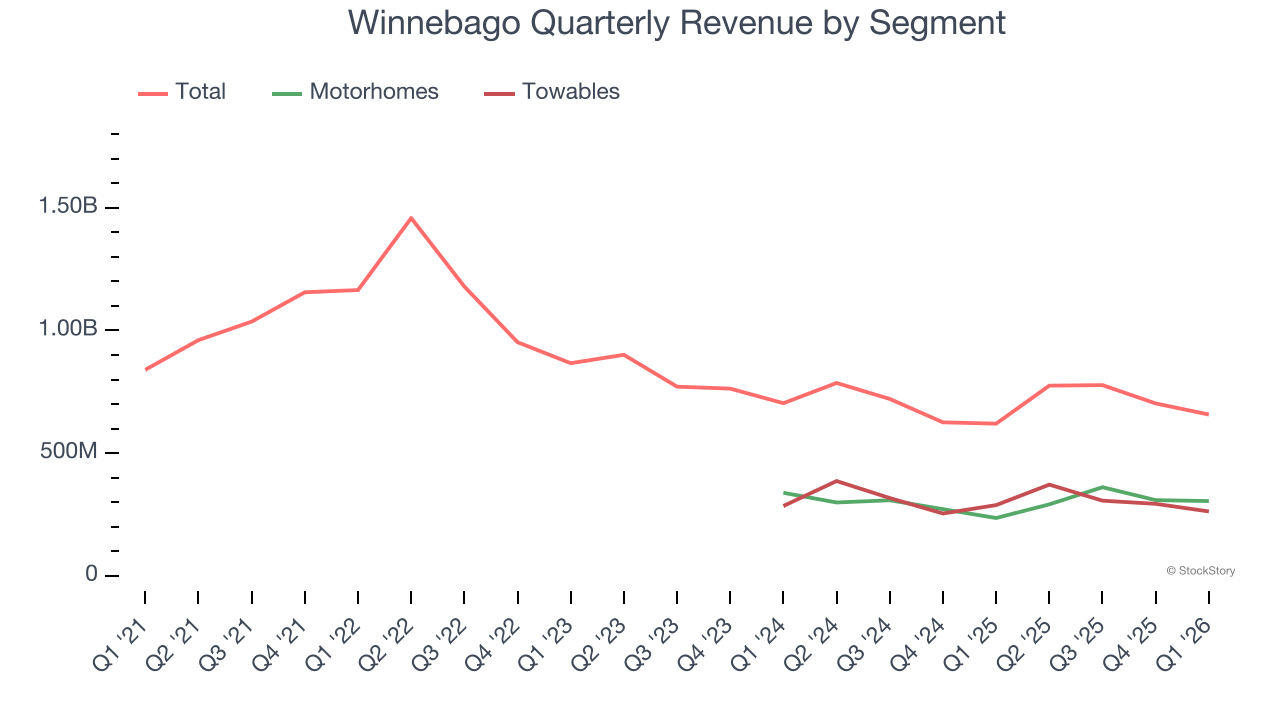
This quarter, Winnebago reported year-on-year revenue growth of 6%, and its $657.4 million of revenue exceeded Wall Street’s estimates by 4.8%.
Looking ahead, sell-side analysts expect revenue to grow 1.3% over the next 12 months. While this projection implies its newer products and services will fuel better top-line performance, it is still below the sector average.
ONE MORE THING: The $21 AI Application Stock Wall Street Forgot. While Wall Street obsesses over who’s building AI, one company is already using it to print money. And nobody’s paying attention.
AI chip stocks trade at ridiculous valuations. This company processes a trillion consumer signals monthly using AI and trades at a third of the price. The gap won’t last. The institutions will figure it out. You need to see this first. Read the FREE Report Before They Notice.
Operating Margin
Operating margin is an important measure of profitability as it shows the portion of revenue left after accounting for all core expenses – everything from the cost of goods sold to advertising and wages. It’s also useful for comparing profitability across companies with different levels of debt and tax rates because it excludes interest and taxes.
Winnebago was profitable over the last five years but held back by its large cost base. Its average operating margin of 7.3% was weak for an industrials business. This result isn’t too surprising given its low gross margin as a starting point.
Analyzing the trend in its profitability, Winnebago’s operating margin decreased by 9.1 percentage points over the last five years. Winnebago’s performance was poor no matter how you look at it - it shows that costs were rising and it couldn’t pass them onto its customers.
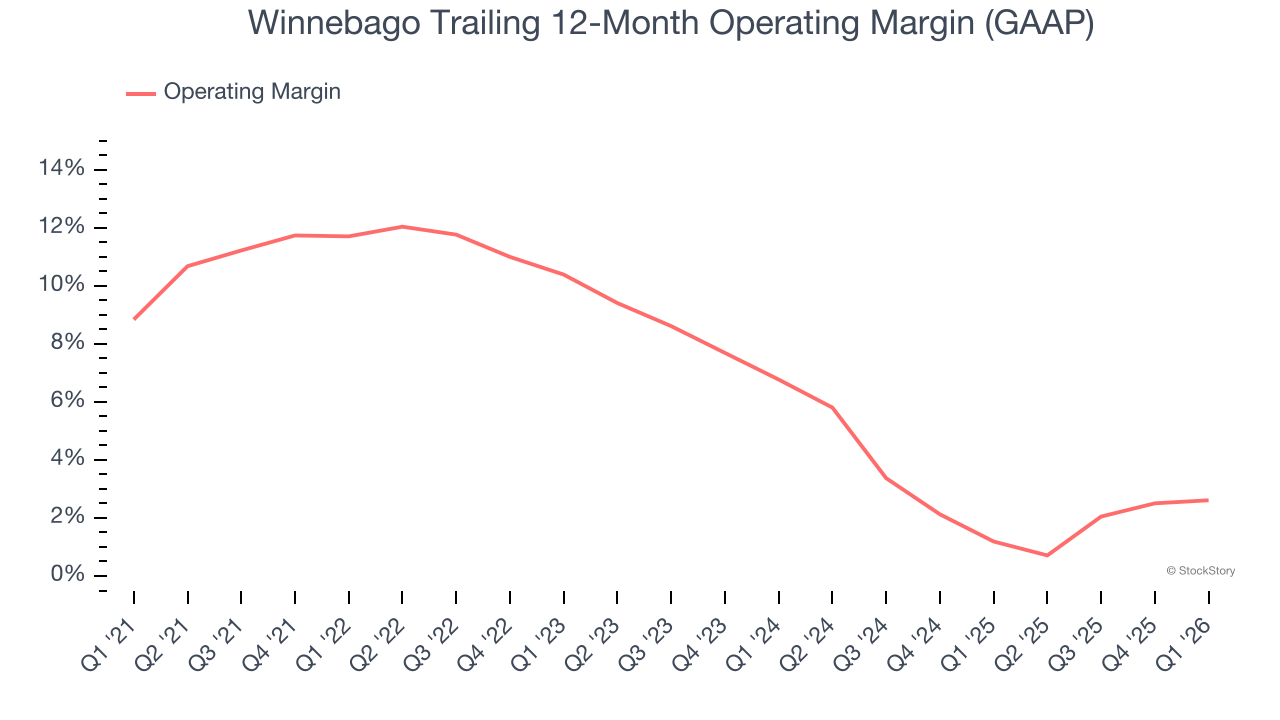
This quarter, Winnebago generated an operating margin profit margin of 1.8%, in line with the same quarter last year. This indicates the company’s cost structure has recently been stable.
Earnings Per Share
We track the long-term change in earnings per share (EPS) for the same reason as long-term revenue growth. Compared to revenue, however, EPS highlights whether a company’s growth is profitable.
Sadly for Winnebago, its EPS declined by 15.4% annually over the last five years while its revenue was flat. This tells us the company struggled because its fixed cost base made it difficult to adjust to choppy demand.
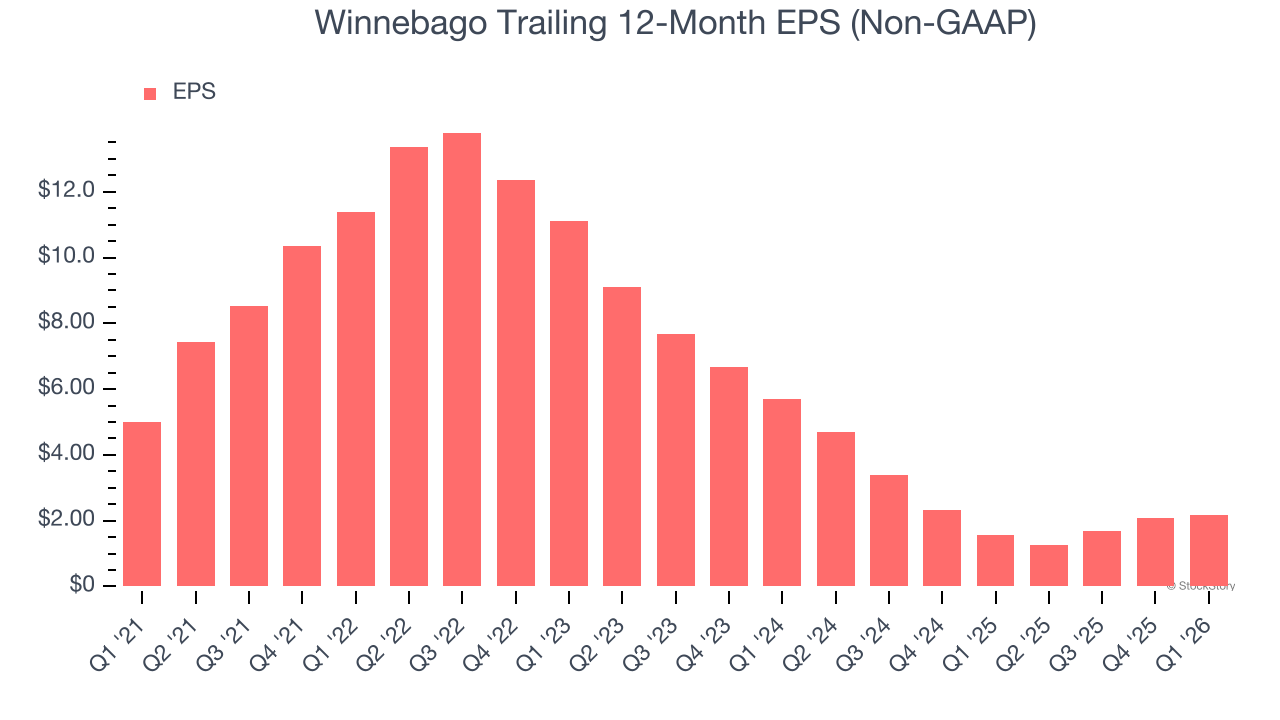
We can take a deeper look into Winnebago’s earnings to better understand the drivers of its performance. As we mentioned earlier, Winnebago’s operating margin was flat this quarter but declined by 9.1 percentage points over the last five years. This was the most relevant factor (aside from the revenue impact) behind its lower earnings; interest expenses and taxes can also affect EPS but don’t tell us as much about a company’s fundamentals.
Like with revenue, we analyze EPS over a shorter period to see if we are missing a change in the business.
For Winnebago, its two-year annual EPS declines of 38.4% show it’s continued to underperform. These results were bad no matter how you slice the data.
In Q1, Winnebago reported adjusted EPS of $0.27, up from $0.19 in the same quarter last year. This print easily cleared analysts’ estimates, and shareholders should be content with the results. Over the next 12 months, Wall Street expects Winnebago’s full-year EPS of $2.17 to grow 23.7%.
Key Takeaways from Winnebago’s Q1 Results
We were impressed by how significantly Winnebago blew past analysts’ revenue expectations this quarter. We were also glad its EPS outperformed Wall Street’s estimates. On the other hand, its full-year EPS guidance fell slightly short of Wall Street’s estimates. Zooming out, we think this was a mixed quarter. Investors were likely hoping for more, and shares traded down 2.2% to $34.32 immediately following the results.
So do we think Winnebago is an attractive buy at the current price? What happened in the latest quarter matters, but not as much as longer-term business quality and valuation, when deciding whether to invest in this stock. We cover that in our actionable full research report which you can read here (it’s free).