Auto parts and accessories retailer Advance Auto Parts (NYSE: AAP) missed Wall Street’s revenue expectations in Q3 2026, with revenue falling 1.2% year on year to $2.01 billion. On the other hand, the company’s outlook for the full year was close to analysts’ consensus estimates, with revenue guided to $8.5 billion at the midpoint. Its non-GAAP profit of $0.79 per share was 1.8% above analysts’ consensus estimates.
For more on Advance Auto Parts, read our free full research report.
Advance Auto Parts (AAP) Q3 2026 highlights:
- Revenue $2.01 billion vs S&P analysts’ consensus estimates of $2.04 billion (1.2% year-on-year decline, 1.4% miss)
- Adjusted EPS $0.79 vs S&P analysts’ consensus estimates of $0.78 (1.8% beat)
- Revenue guidance The company reconfirmed its revenue guidance for the full year of $8.5 billion at the midpoint
- Adjusted EPS guidance Management lowered its full-year adjusted EPS guidance to $2.93 at the midpoint, a 0.8% decrease
- Operating margin 2.3%, up from 1.1% in the same quarter last year
- Free cash flow -$119.9 million compared to -$76 million in the same quarter last year
- Locations 4,325 at quarter end, up from 4,297 in the same quarter last year
- Same-store sales fell 1.2% year on year (3% in the same quarter last year)
- Market capitalization $3.07 billion
"Our comparable sales performance improved as the quarter progressed. Main Street Pro outperformed throughout the quarter while DIY trends improved compared to the softer trends experienced during the summer. I thank the team for their hard work and commitment to serving our customers," said Shane O'Kelly, president and chief executive officer. "Sales declined in the low-single-digit range during the first eight weeks before turning positive in the final four weeks, supported by improved transaction volumes. The Pro channel led performance in Q3, with low-single-digit sales growth including stronger Main Street Pro growth. The DIY channel declined in the low-single-digit range for the quarter, with trends recovering from negative mid-single-digit levels at the start of the quarter. Despite the volatile demand environment and industry cost pressures, we delivered an adjusted operating margin of 4.5% in Q3 and generated over $100 million of free cash flow year-to-date. We believe that our strategic initiatives are starting to gain traction and we remain focused on delivering sustainable, profitable growth over the long term."
Revenue growth
A company’s long-term revenue performance is one signal of its overall quality. Any business can experience short-term success, but top-performing ones sustain growth for years.
With $8.6 billion in revenue over the past 12 months, Advance Auto Parts is a mid-sized retailer, which sometimes brings disadvantages compared to larger competitors benefiting from better economies of scale.
Advance Auto Parts’s revenue declined by 3.8% per year over the last three years as it closed stores.
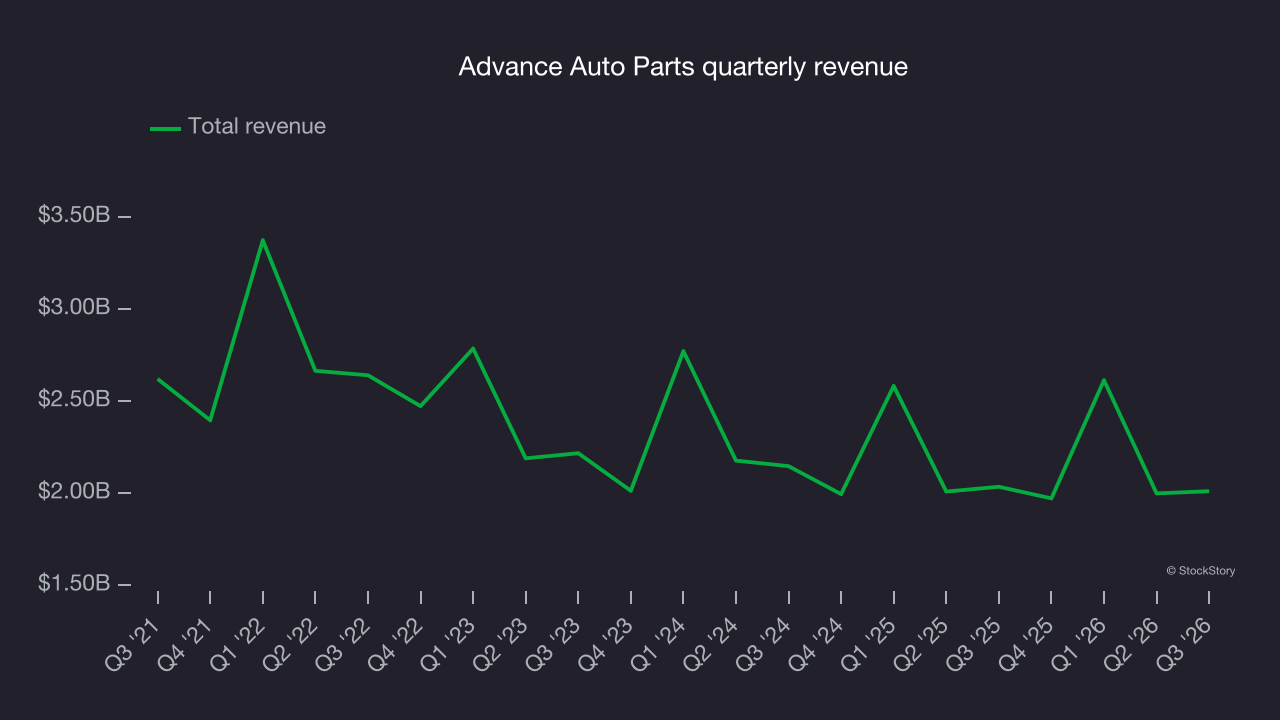
This quarter, Advance Auto Parts missed Wall Street’s consensus estimates and reported an uninspiring 1.2% year-on-year revenue decline, generating $2.01 billion of revenue.
Looking ahead, sell-side analysts expect revenue to remain flat over the next 12 months, according to S&P. Although this projection implies its newer products will improve revenue performance, it is still below the sector average.
Store performance
Number of stores
The number of stores a retailer operates is a critical driver of how quickly company-level revenue can grow.
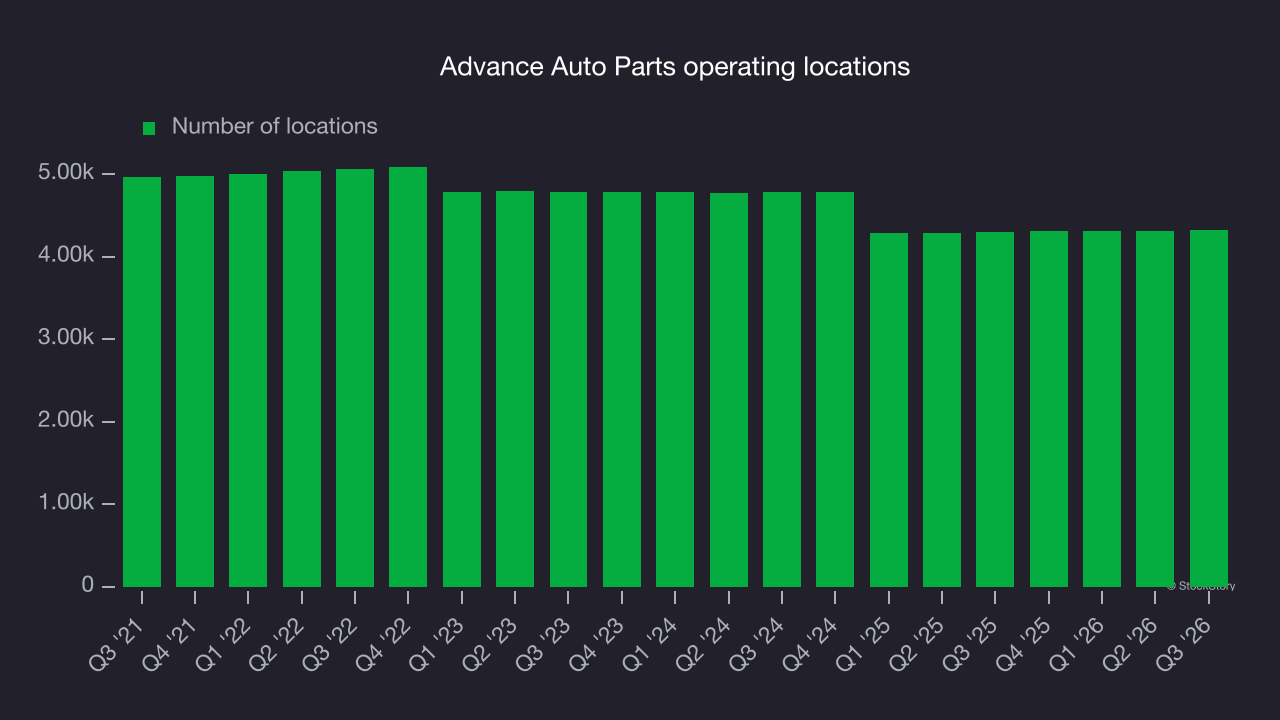
Advance Auto Parts operated 4,325 locations in the latest quarter. Over the last two years, the company has reduced its store count at an average annual rate of 4.9%.
When a retailer shutters stores, it usually means that brick-and-mortar demand is less than supply, and it is responding by closing underperforming locations to improve profitability.
Same-store sales
A company’s store base only paints one part of the picture. When demand is high, it makes sense to open more. But when demand is low, it’s prudent to close some locations and use the money in other ways. Same-store sales provide a deeper understanding of this issue by measuring organic growth at brick-and-mortar shops open for at least a year.
Advance Auto Parts’s demand within its existing locations has barely increased over the last two years as its same-store sales were flat. This performance isn’t ideal, and Advance Auto Parts is attempting to boost same-store sales by closing stores (fewer locations sometimes lead to higher same-store sales).
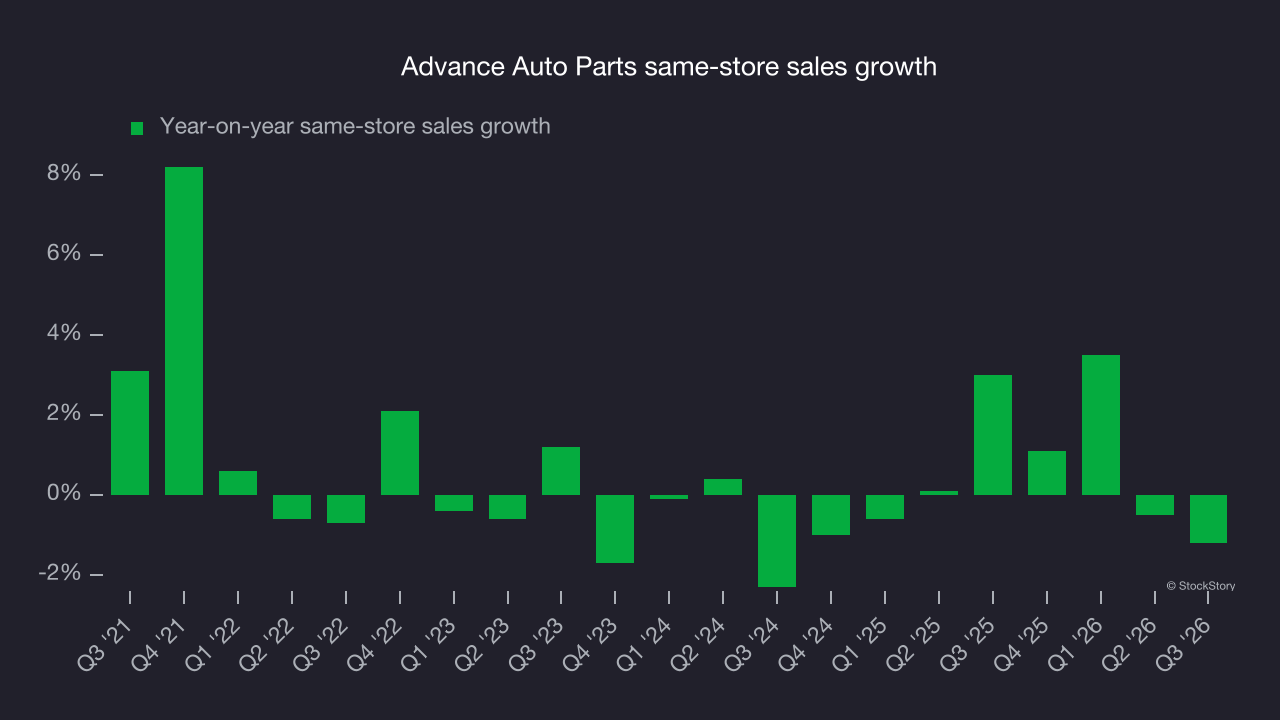
In the latest quarter, Advance Auto Parts’s same-store sales edged lower by 1.2% year on year. This decline was a reversal from its historical levels.
Key takeaways from Advance Auto Parts’s Q3 results
Advance Auto Parts offered few positives in Q3: Revenue narrowly missed Wall Street’s consensus estimates, and full-year EPS guidance also fell slightly short. It was a disappointing quarter overall. Shares fell 4.2% to $48.63 immediately after the results.
Advance Auto Parts had a tough quarter, but that alone doesn’t determine whether to invest. What happened in the latest quarter matters, but not as much as longer-term business quality and valuation when deciding whether to invest in this stock. For more on that, read our full research report here (it’s free).