Pharmaceutical company Amneal Pharmaceuticals (NASDAQ: AMRX) reported revenue ahead of Wall Street’s expectations in Q3 2026, with revenue up 10% year on year to $862.7 million. The company’s full-year revenue guidance of $3.2 billion at the midpoint came in 1.2% above analysts’ consensus estimates. Its non-GAAP profit of $0.26 per share was 9.5% above analysts’ consensus estimates.
For more on Amneal, read the full research report for free.
Amneal (AMRX) Q3 2026 highlights:
- Revenue $862.7 million vs S&P analysts’ consensus estimates of $811.3 million (10% year-on-year growth, 6.3% beat)
- Adjusted EPS $0.26 vs S&P analysts’ consensus estimates of $0.24 (9.5% beat)
- Adjusted EBITDA $207 million vs analysts’ consensus estimates of $183.7 million (24% margin, 12.7% beat)
- Revenue guidance The company lifted its revenue guidance for the full year to $3.2 billion at the midpoint from $3.15 billion, a 1.6% increase
- Adjusted EPS guidance Management raised its full-year adjusted EPS guidance to $1.06 at the midpoint, a 5% increase
- EBITDA guidance $807.5 million at the midpoint for the full year, above analysts’ consensus estimates of $778.6 million
- Operating margin 11.1%, up from 9% in the same quarter last year
- Free cash flow margin 7.7%, down from 13.5% in the same quarter last year
- Market capitalization $7.12 billion
“Amneal delivered another quarter of strong, broad-based performance, enabling us to increase our 2026 guidance once more. As we prepare to enter 2027, our financial performance is accelerating driven by a number of key catalysts and new launches, including Women’s Health patches, biosimilars, injectables such as lanreotide, CREXONT®, and BREKIYA® autoinjector. The Kashiv integration is proceeding well, and we are excited about the long-term growth potential in biosimilars. With the breadth and depth of opportunities across our portfolio, we remain highly confident in Amneal’s robust growth outlook,” said Chirag and Chintu Patel, Co-Founders and Co-Chief Executive Officers of Amneal.
Revenue growth
Examining a company’s long-term performance can provide clues about its quality. Any business can deliver a good quarter or two, but the best consistently grow over the long term. Over the last five years, Amneal grew its revenue at a decent 9.1% compounded annual growth rate. Its growth was slightly above the average healthcare company and shows its offerings resonate with customers.
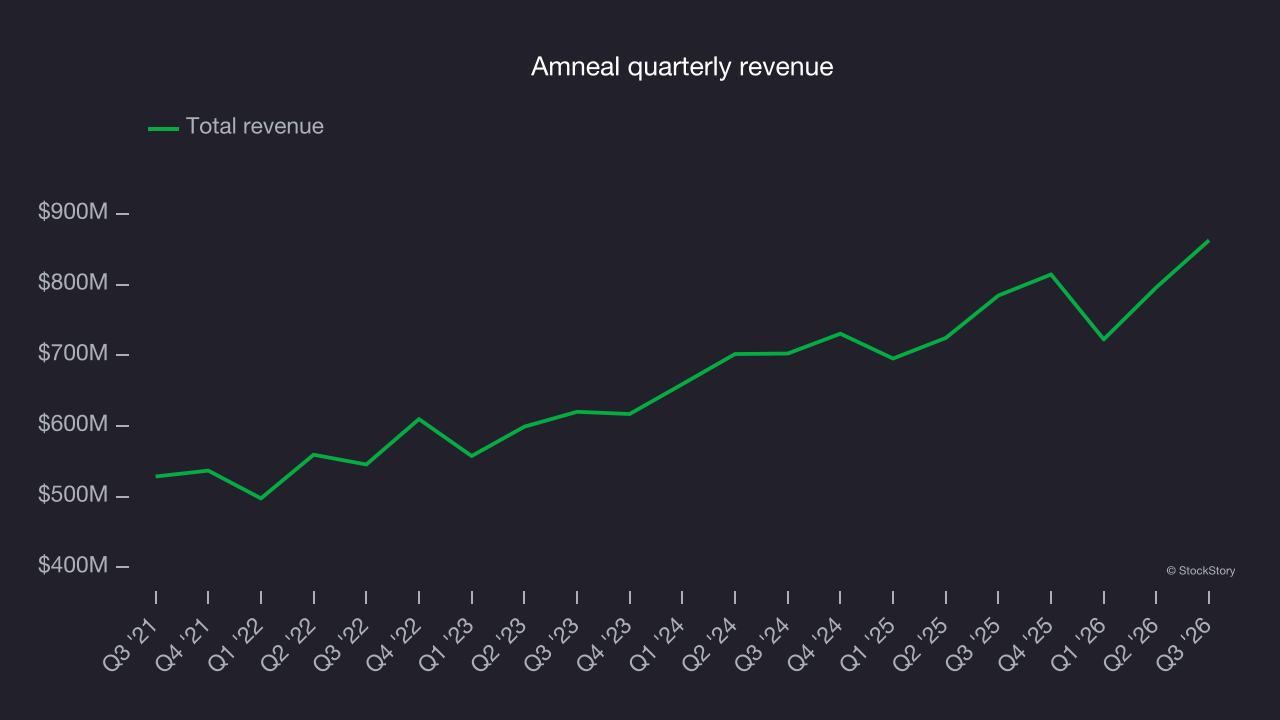
Long-term growth matters most, but within healthcare, a half-decade historical view may miss recent innovations or disruptive industry trends. Amneal’s annualized revenue growth of 9.2% over the last two years aligns with its five-year trend, suggesting its demand was stable. 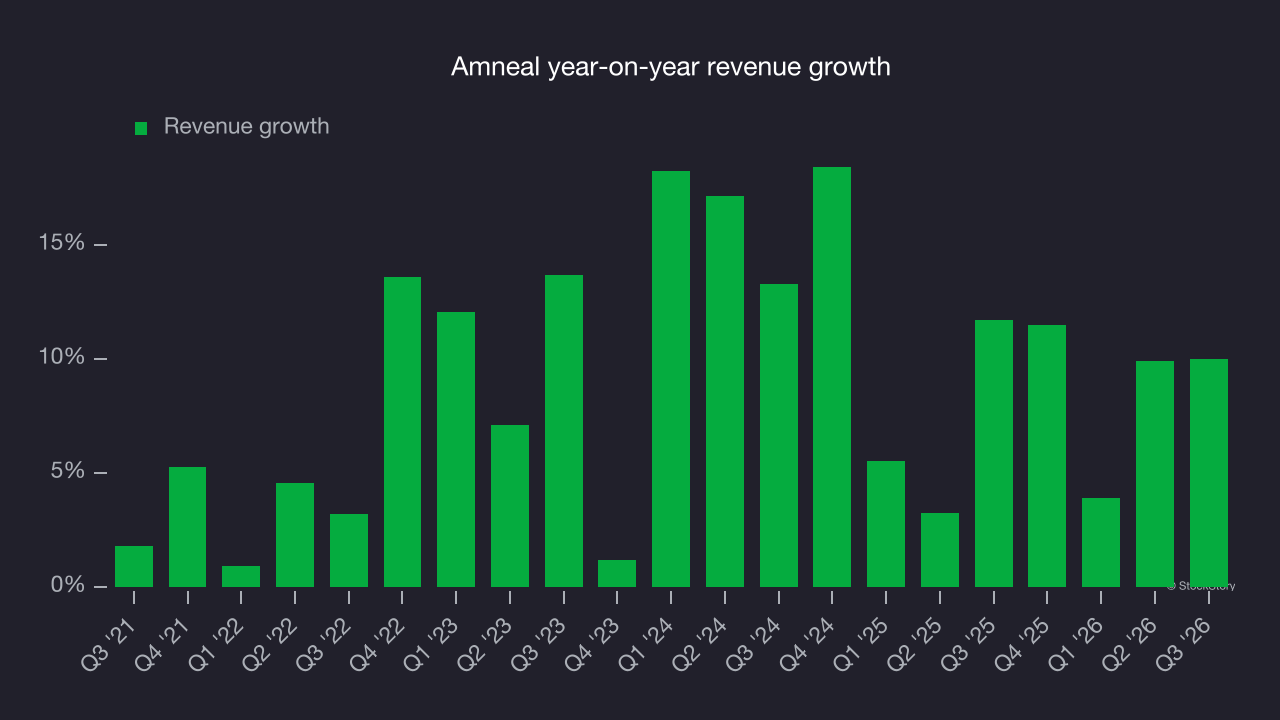
This quarter, Amneal reported year-on-year revenue growth of 10%, and its $862.7 million in revenue exceeded Wall Street’s consensus estimates by 6.3%.
Looking ahead, sell-side analysts expect revenue to grow 2.3% over the next 12 months, according to S&P, a deceleration versus the last two years. This underwhelming projection indicates its products and services will face some demand challenges.
Adjusted operating margin
Amneal has been an efficient company over the last five years. It was one of the more profitable businesses in the healthcare sector, with an average adjusted operating margin of 20.1%.
Amneal’s adjusted operating margin rose by 1.8 percentage points over the last five years, as its revenue growth provided operating leverage.
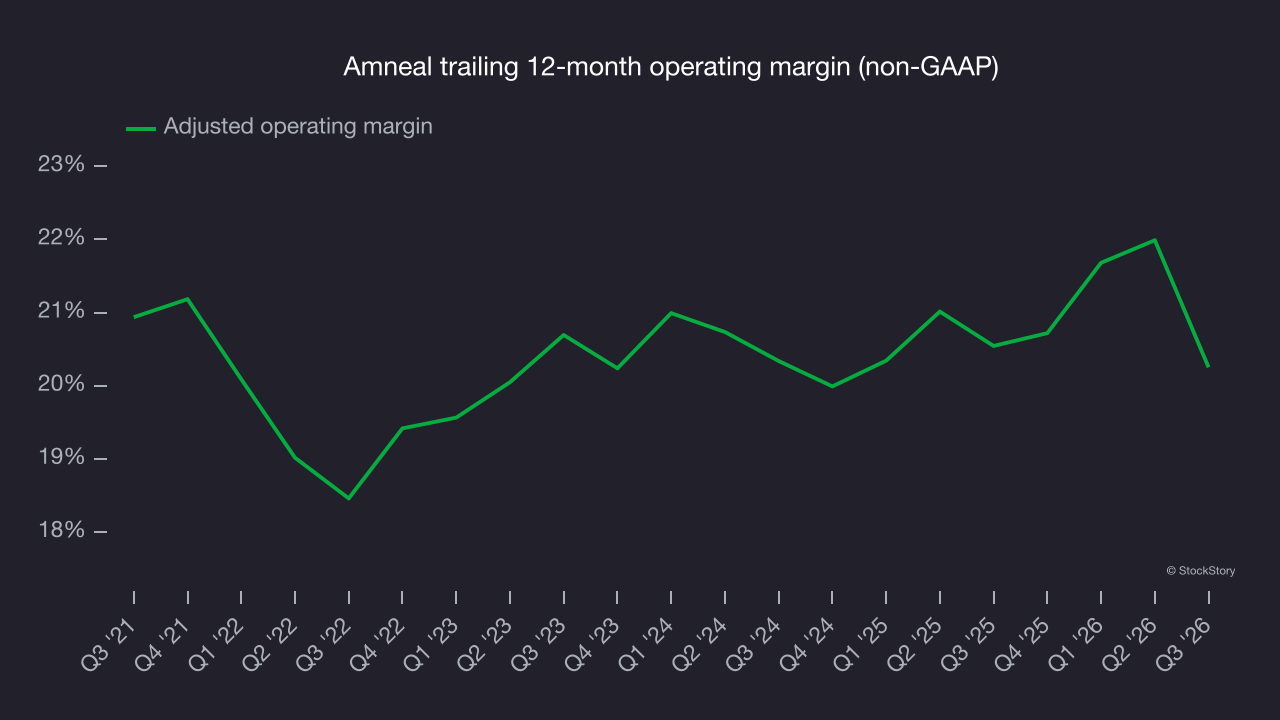
In Q3, Amneal generated an adjusted operating margin of 12.3%, down 6.1 percentage points year on year. This contraction shows it was less efficient because its expenses grew faster than its revenue.
Earnings per share
The long-term change in earnings per share, or EPS, matters for the same reason as long-term revenue growth. Compared to revenue, however, EPS highlights whether a company’s growth is profitable.
Amneal’s EPS grew at a decent 5.4% compounded annual growth rate over the last five years. Despite its adjusted operating margin improvement during that time, this performance was lower than its 9.1% annualized revenue growth, indicating that non-fundamental factors such as interest and taxes affected its ultimate earnings.
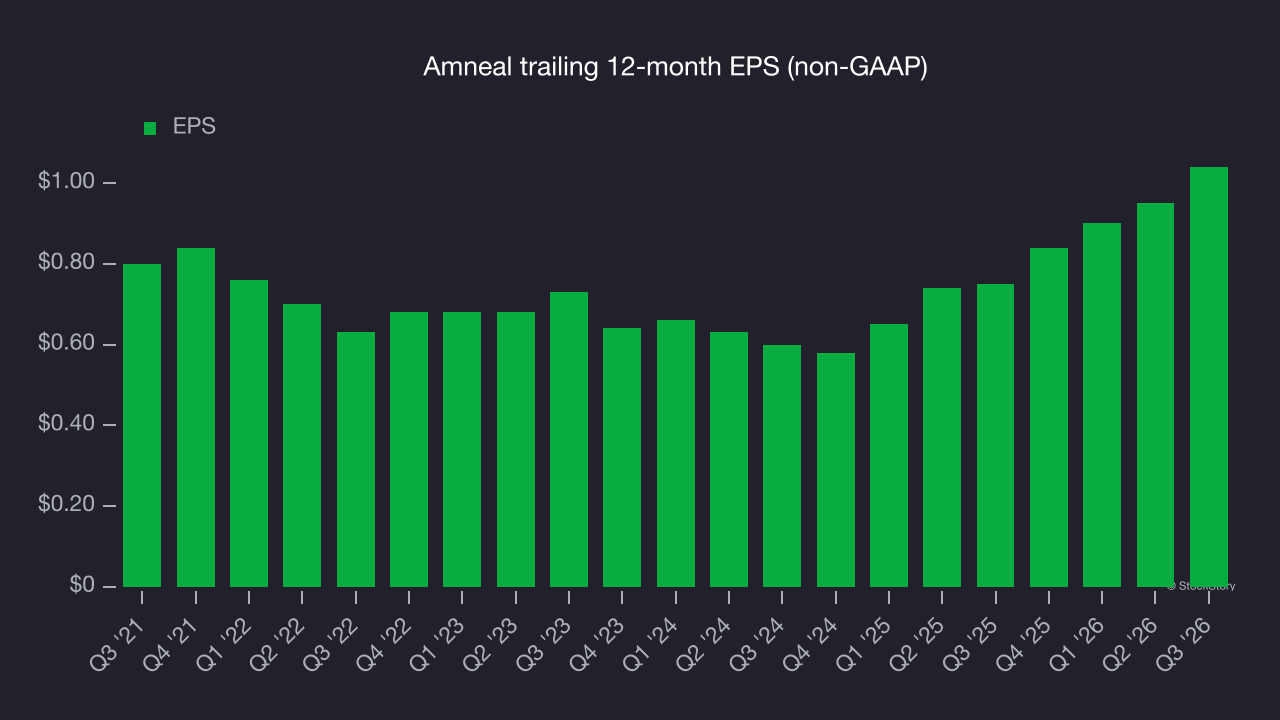
Examining Amneal’s quality of earnings helps explain its performance. A five-year view shows Amneal has diluted its shareholders, growing its share count by 125%. This dilution overshadowed its increased operational efficiency and has led to lower per share earnings. Taxes and interest expenses can also affect EPS but don’t tell us as much about a company’s fundamentals. 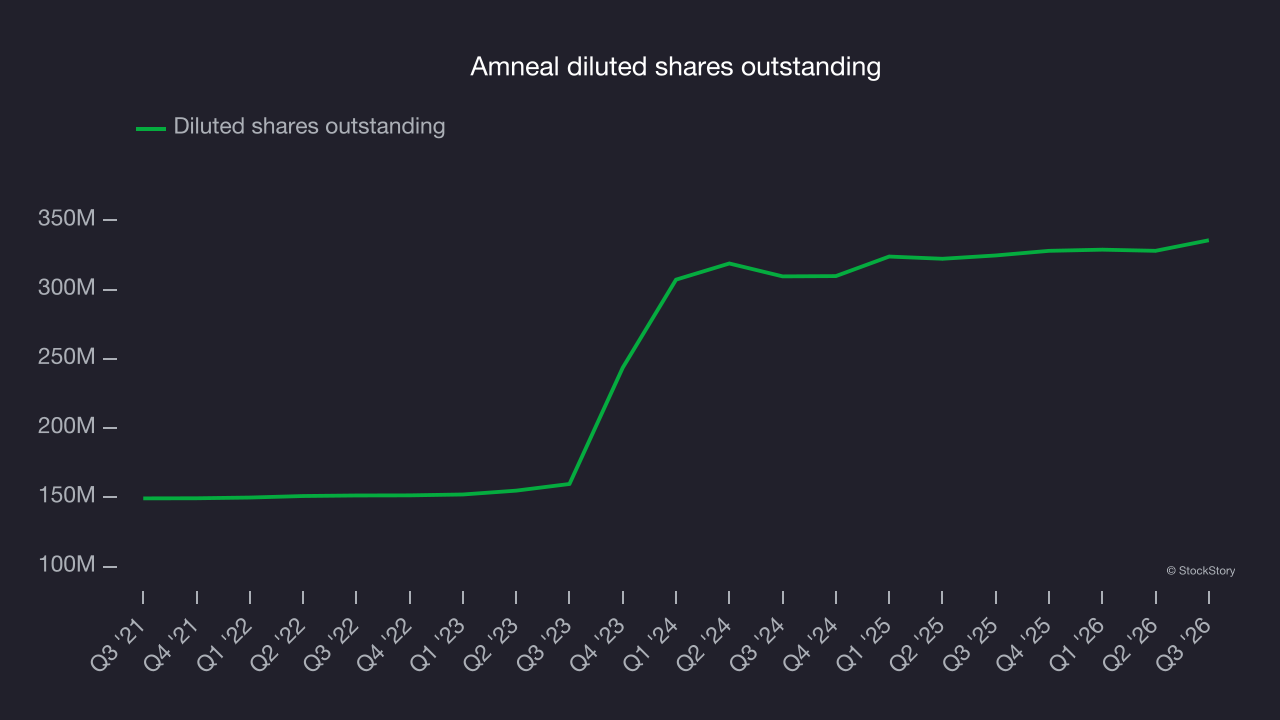
In Q3, Amneal reported adjusted EPS of $0.26, up from $0.17 in the same quarter last year. This result beat analysts’ consensus estimates by 9.5%. Over the next 12 months, Wall Street expects Amneal’s full-year EPS to grow 4.5% from $1.04 to $1.09, according to S&P.
Key takeaways from Amneal’s Q3 results
Revenue well above analysts’ consensus estimates and full-year EPS guidance ahead of Wall Street’s consensus gave Amneal’s Q3 report some clear positives. It was a good quarter, but investors were likely hoping for more. Shares fell 3% to $19.83 immediately after the release.
For investors considering Amneal at its current price, the latest quarter matters, but longer-term business quality and valuation matter more when deciding whether to invest. For more on Amneal, read the full research report here (it’s free).