Website building platform Wix (NASDAQ: WIX) reported Q3 2026 results exceeding the market’s revenue expectations, with revenue up 12.9% year on year to $570.2 million. Its non-GAAP profit of $1.42 per share was 5.5% above analysts’ consensus estimates.
For more on Wix, read our free full research report.
Wix (WIX) Q3 2026 highlights:
- Revenue $570.2 million vs S&P analyst consensus of $566.1 million (12.9% year-on-year growth, 0.7% beat)
- Adjusted EPS $1.42 vs S&P analyst consensus of $1.35 (5.5% beat)
- Adjusted operating income $68.73 million vs analysts’ consensus estimates of $73.9 million (12.1% margin, 7% miss)
- Operating margin -2.9%, down from -1.5% in the same quarter last year
- Free cash flow margin 13.1%, up from 10.9% in the previous quarter
- Annual recurring revenue $2.02 billion (38.7% year-on-year growth)
- Billings $569.9 million at quarter end, up 10.8% year on year
- Market capitalization $2.92 billion
"Base44, our biggest bet, continues to outperform expectations, driven by our leading product, clear strategy and relentless execution underpinned by aggressive and necessary investments," said Avishai Abrahami, co-founder and CEO of Wix. "Last week, we also launched Wix Studio Two, which I believe is the best editor we have ever built and the first truly open platform product in Wix's history. That openness is what excites me most. We are in an era where professionals move fluidly between AI tools, code and visual design, and they expect their work to move with them. Studio Two was built for exactly that moment. We rebuilt the foundation so that AI generation, visual design on the canvas and standard React code operate as one continuous workflow on the same project – built for exactly where the work of professionals and the technology meet right now. Studio Two is also a statement about where Wix as a whole is heading. Openness is a principle for our entire platform, and over time every one of our products will connect to the tools our users already work with. I can't wait to see what our Partners build with it – and what all of our users will build as this openness extends across Wix."
Revenue growth
Examining a company’s long-term performance can provide clues about its quality. Even a bad business can perform well for one or two quarters, but a high-quality one grows for years. Over the last five years, Wix grew its revenue at a 12.5% compounded annual growth rate. Though this growth is acceptable on an absolute basis, we need to see more than just revenue growth for the software sector, which can display significant earnings volatility. This means our bar for the sector is particularly high, reflecting the non-essential and hit-driven nature of the products and services offered. Additionally, the five-year growth period starts around Covid, when revenue was depressed before rebounding.
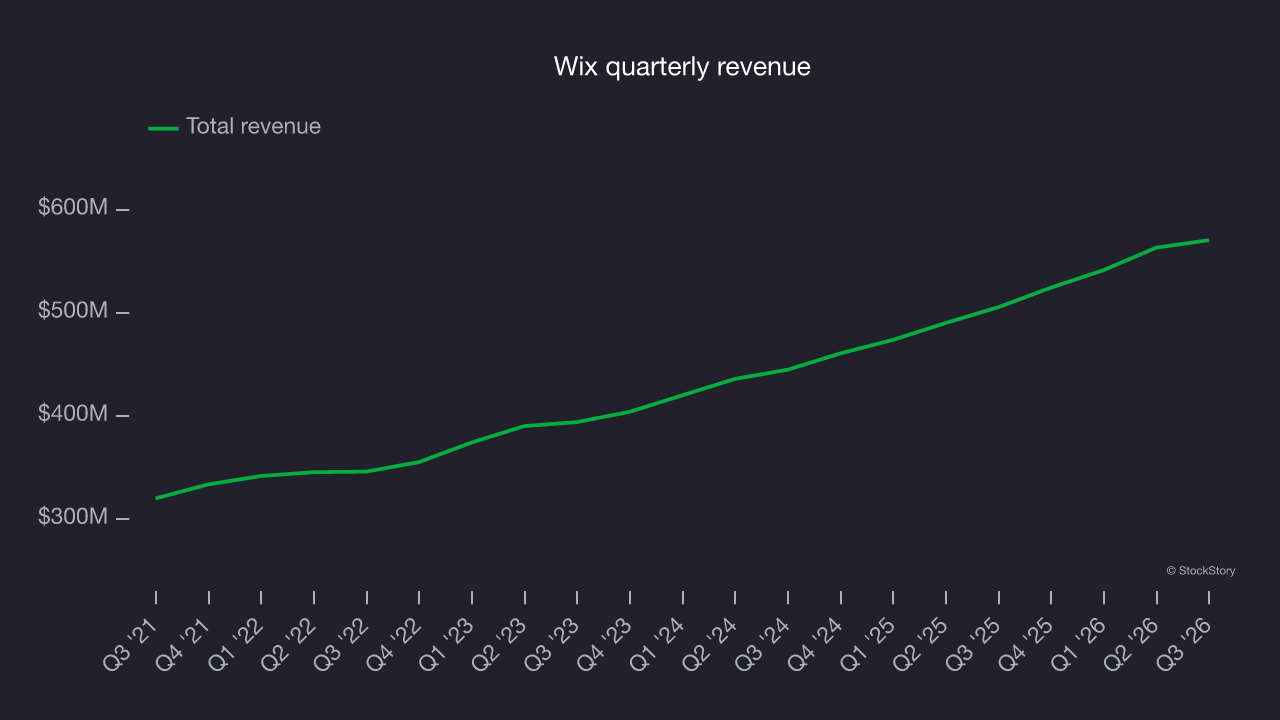
Long-term growth is the most important, but within software, a half-decade historical view may miss new innovations or demand cycles. Wix’s annualized revenue growth of 13.6% over the last two years is above its five-year trend, which is encouraging.
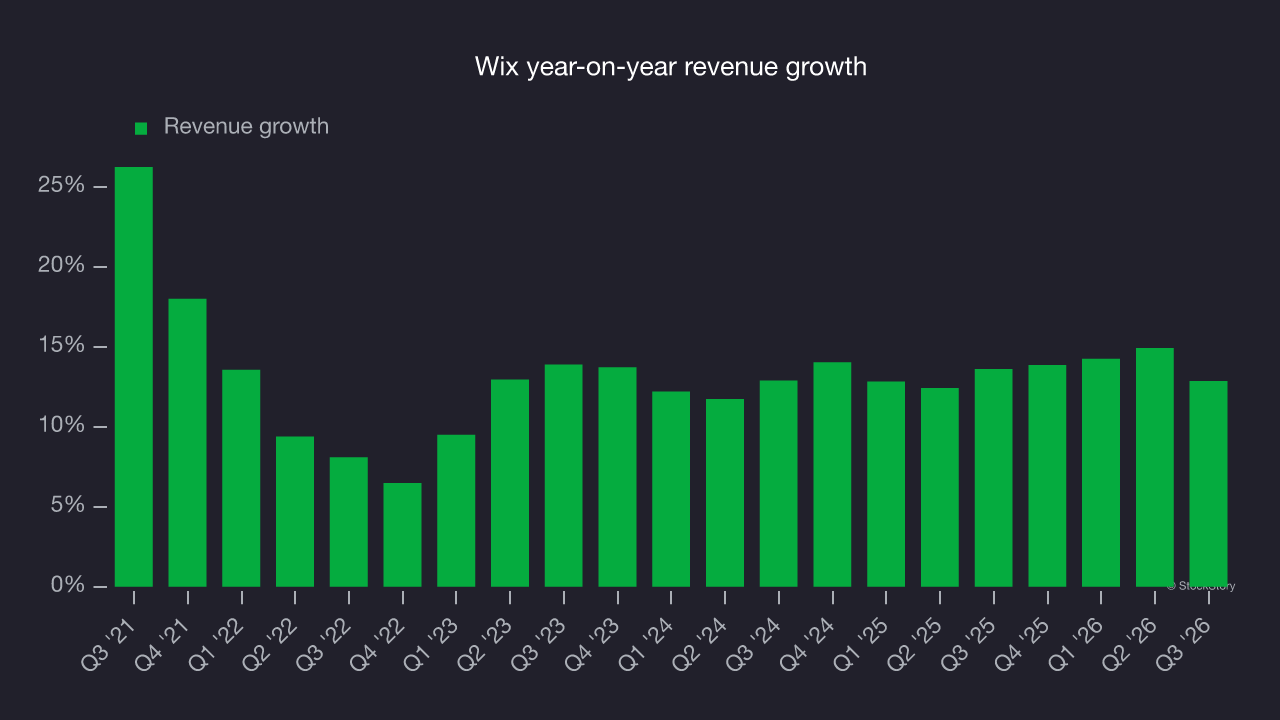
This quarter, Wix reported year-on-year revenue growth of 12.9%, and its revenue of $570.2 million exceeded Wall Street’s consensus estimates by 0.7%.
Looking ahead, sell-side analysts expect revenue to grow 10.9% over the next 12 months, according to S&P, a slight deceleration versus the last two years. This projection is underwhelming and suggests its products and services will face some demand challenges.
Annual recurring revenue
While reported revenue for a software company can include low-margin items like implementation fees, annual recurring revenue, or ARR, is the sum of the next 12 months of contracted revenue purely from software subscriptions, or the high-margin, predictable revenue streams that make software-as-a-service businesses valuable.
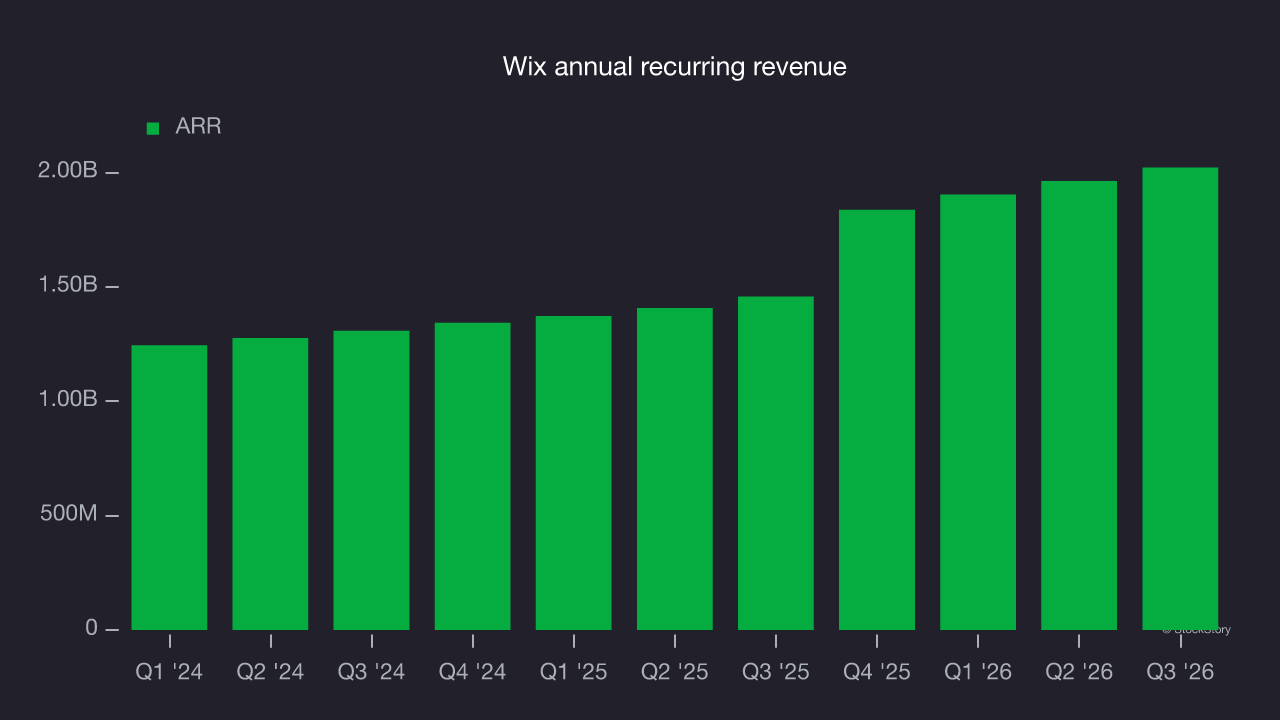
Wix’s ARR reached $2.02 billion in Q3, and its growth over the last four quarters was strong, averaging 38.4% year on year. This alternative revenue metric grew faster than total revenue, which likely means that the recurring portions of the business are growing faster than less predictable, more volatile ones such as implementation fees. That could be a positive sign for future revenue growth.
Customer acquisition efficiency
The customer acquisition cost, or CAC, payback period measures the months a company needs to recoup the money spent on acquiring a new customer. This metric helps assess how quickly a business can break even on its sales and marketing investments.
It’s relatively expensive for Wix to acquire new customers as its CAC payback period was 57 months this quarter. The company’s slow recovery of its sales and marketing expenses indicates it operates in a highly competitive market and must invest to stand out, even if the return on that investment is low.
Key takeaways from Wix’s Q3 results
Wix’s Q3 was mixed in our view. Shares edged higher 1.2% to $70.58 immediately after the results.
What should investors consider before investing in Wix? The decision depends on its valuation and business quality as well as the latest quarter. Read the full research report here (it’s free).