Mortgage banking company PennyMac Financial Services (NYSE: PFSI) fell short of the market’s revenue expectations in Q3 2026, with revenue falling 25.6% year on year to $469 million. Its non-GAAP profit of $1.05 per share was 14.9% below analysts’ consensus estimates.
For more on PennyMac Financial Services, read our free full research report.
PennyMac Financial Services (PFSI) Q3 2026 highlights:
- Revenue $469 million vs S&P analysts’ consensus estimates of $524.2 million (25.6% year-on-year decline, 10.5% miss)
- Adjusted EPS $1.05 vs S&P analysts’ consensus estimates of $1.23 (14.9% miss)
- Tangible book value per share $83.85 vs analysts’ consensus estimates of $84.64 (6% year-on-year growth, 0.9% miss)
- Market capitalization $3.29 billion
“Our servicing business delivered strong profitability, while our production segment reported a pretax loss due an industry-wide contraction in origination activity coupled with margin pressure near the end of the quarter,“ said Chairman and CEO David Spector. “We expect mortgage demand will remain subdued due to higher interest rates, and as a result we have taken aggressive and proactive steps to right-size our platform appropriately. By the first quarter of 2027 we expect to have reduced our annualized operating expenses by $160 million from the second quarter of 2026.”
Revenue growth
From lending activities to service fees, most banks build their revenue model around two income sources. Interest rate spreads between loans and deposits create the first stream, with the second coming from charges on everything from basic bank accounts to complex investment banking transactions. Over the last five years, PennyMac Financial Services’s demand was weak and its revenue declined by 12% per year. That outcome points to poor business quality.
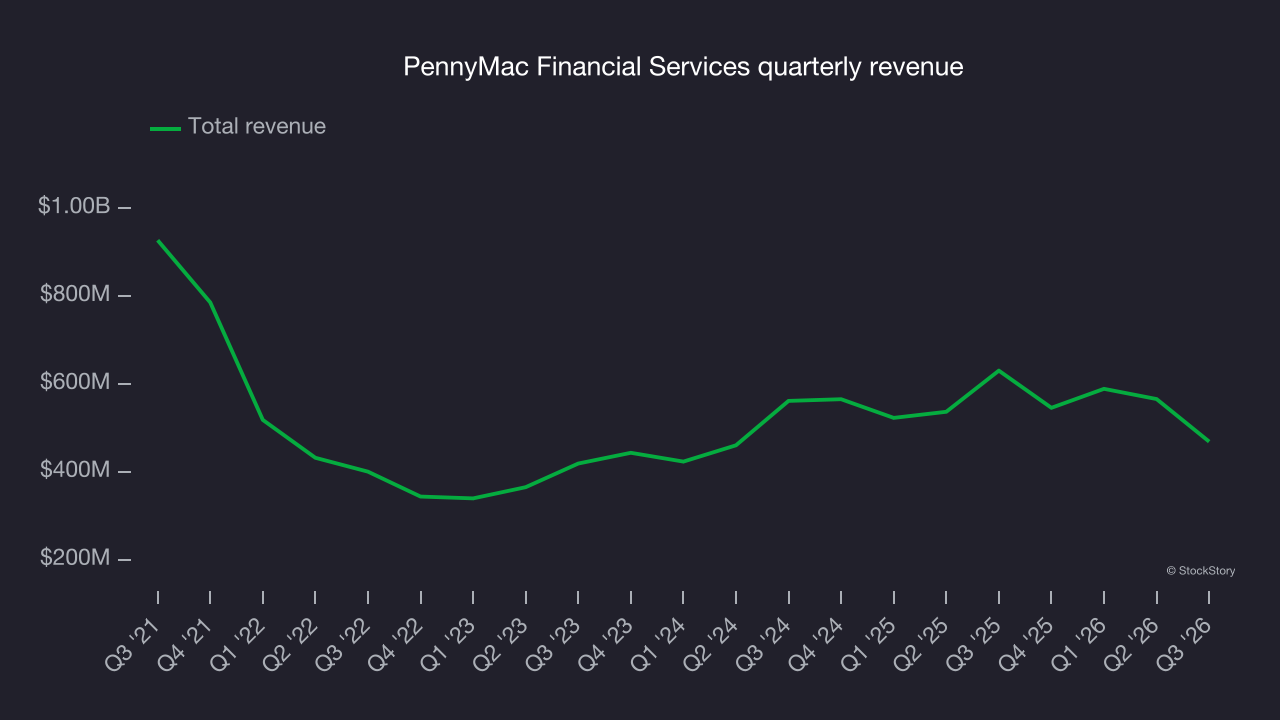
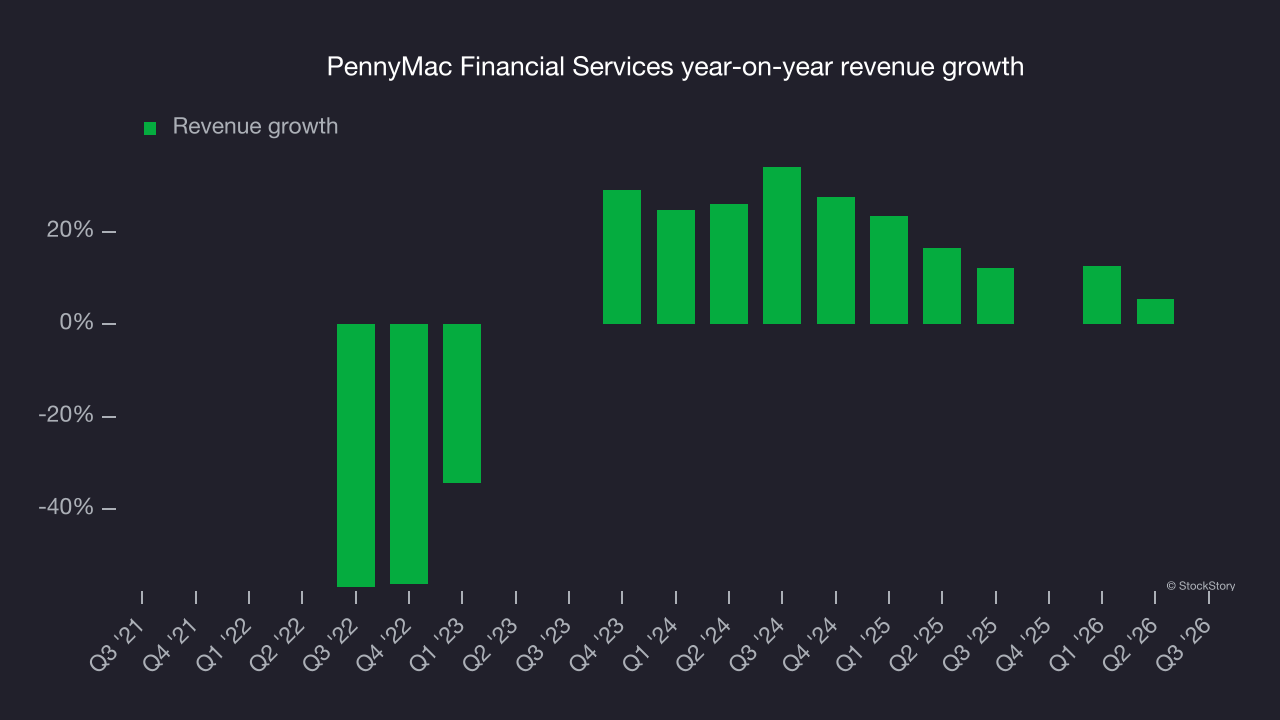
This quarter, PennyMac Financial Services missed Wall Street’s consensus estimates and reported an uninspiring 25.6% year-on-year revenue decline, generating $469 million of revenue.
Net interest income made up -1.9% of the company’s total revenue during the last five years, meaning PennyMac Financial Services is well diversified and has a variety of income streams driving its overall growth. Nevertheless, net interest income is critical to analyze for banks because investors consider it a higher-quality, more recurring revenue source.
Tangible book value per share (TBVPS)
Banks operate as balance sheet businesses, with profits generated through borrowing and lending activities. Valuations reflect this reality, emphasizing balance sheet strength and long-term book value compounding ability.
When analyzing banks, tangible book value per share (TBVPS) takes precedence over many other metrics. This measure isolates genuine per-share value by removing intangible assets of debatable liquidation worth. On the other hand, EPS is often distorted by mergers and flexible loan loss accounting. TBVPS provides clearer performance insights.
PennyMac Financial Services’s TBVPS grew at a strong annual rate of 8.3% over the last five years. The last two years show a similar trajectory as TBVPS grew by 9.1% annually from $70.50 to $83.85 per share.
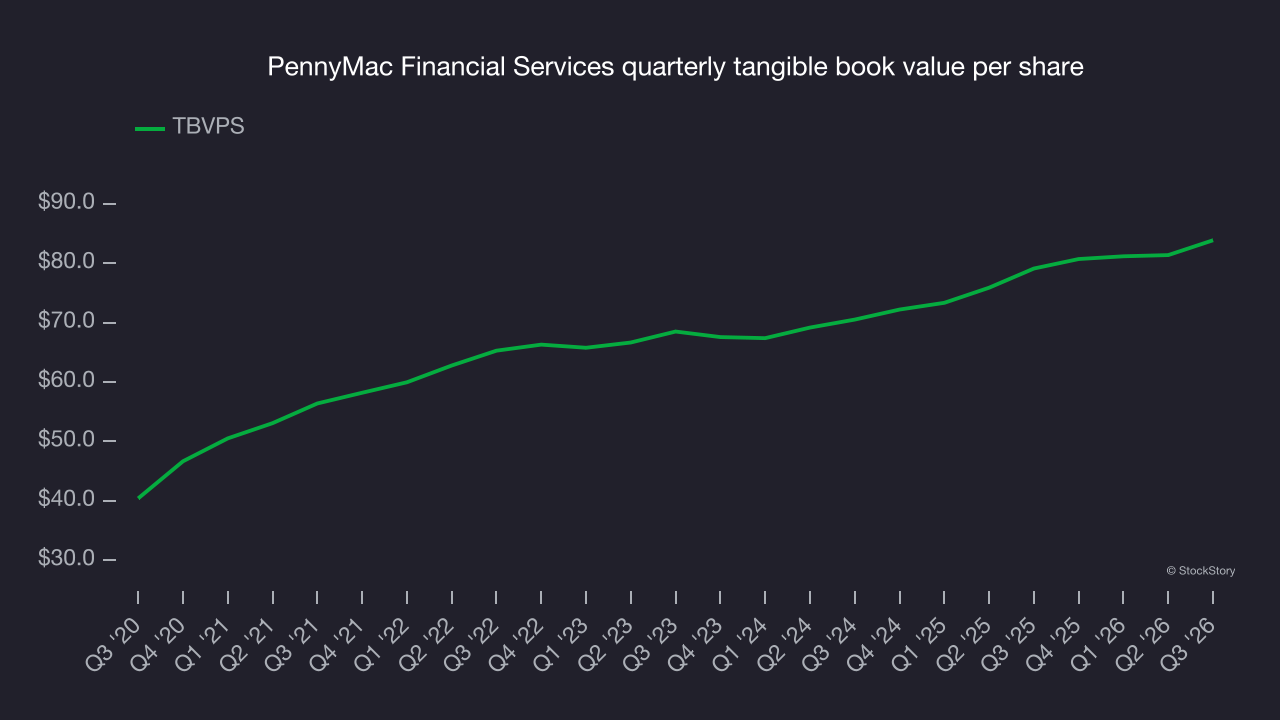
Over the next 12 months, consensus estimates call for PennyMac Financial Services’s TBVPS to grow by 9.6% to $91.87, a paltry growth rate.
Key takeaways from PennyMac Financial Services’s Q3 results
PennyMac Financial Services delivered a weaker quarter with few positives, as revenue and EPS both fell short of Wall Street’s consensus estimates. Shares fell 2.8% to $62.67 immediately after the release.
PennyMac Financial Services had a tough quarter, but does that create an investment opportunity? What happened in the latest quarter matters, but not as much as longer-term business quality and valuation when deciding whether to invest in this stock. For more on that, read our full research report here (it’s free).