Heating, ventilation, air conditioning and refrigeration company Carrier Global (NYSE: CARR) reported Q3 2026 results beating Wall Street’s revenue expectations, with revenue up 12.3% year on year to $6.26 billion. The company’s full-year revenue guidance of $23.9 billion at the midpoint came in 2.4% above analysts’ consensus estimates. Its non-GAAP profit of $0.87 per share was 13.4% above analysts’ consensus estimates.
For more on Carrier Global, read the full research report for free.
Carrier Global (CARR) Q3 2026 highlights:
- Revenue $6.26 billion vs S&P analysts’ consensus estimates of $6.10 billion (12.3% year-on-year growth, 2.6% beat)
- Adjusted EPS $0.87 vs S&P analysts’ consensus estimates of $0.77 (13.4% beat)
- Revenue guidance The company lifted its revenue guidance for the full year to $23.9 billion at the midpoint from $23 billion, a 3.9% increase
- Adjusted EPS guidance Management lowered its full-year adjusted EPS guidance to $2.88 at the midpoint, a 0.9% decrease
- Operating margin -36.3%, down from 9.7% in the same quarter last year
- Free cash flow margin 10.8%, up from 4% in the same quarter last year
- Organic revenue rose 15% year on year (beat)
- Market capitalization $46.38 billion
"We delivered strong third quarter performance, with orders, sales and adjusted EPS all up between 15% and 35%, with very strong free cash flow," said Chairman & CEO David Gitlin. "Organic orders were up ~35%, with data center orders up ~300%, resulting in over $8.5 billion of backlog, up 60% versus last year, reflecting continued strong demand for our differentiated solutions. We expect to deliver double-digit organic sales and adjusted EPS growth in 2026, while record backlog levels give us confidence to sustain this momentum into 2027 and beyond."
Revenue growth
A company’s long-term revenue performance can indicate its overall quality. Any business can have short-term success, but a top-tier one grows for years. Carrier Global’s revenue grew at a sluggish 2.6% compounded annual growth rate over the last five years, falling short of our standards.
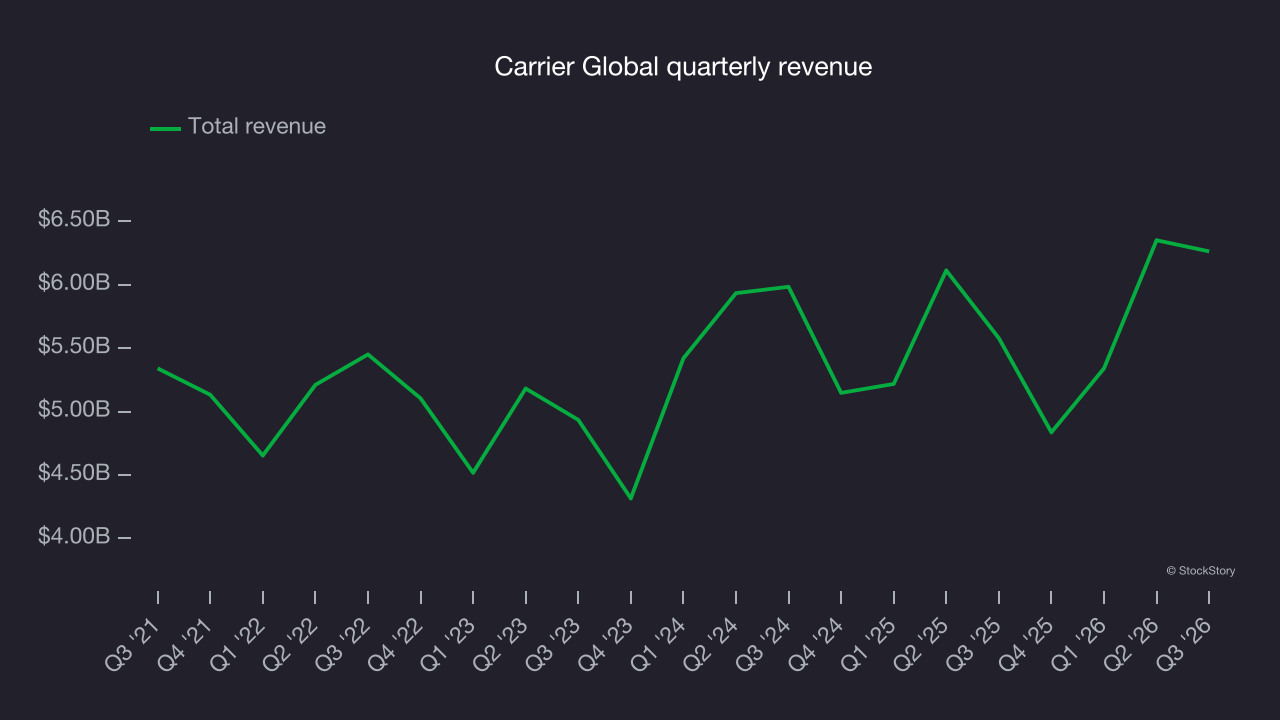
Long-term growth is the most important, but within industrials, a half-decade historical view may miss new industry trends or demand cycles. Carrier Global’s annualized revenue growth of 2.6% over the last two years aligns with its five-year trend, suggesting its demand was consistently weak. 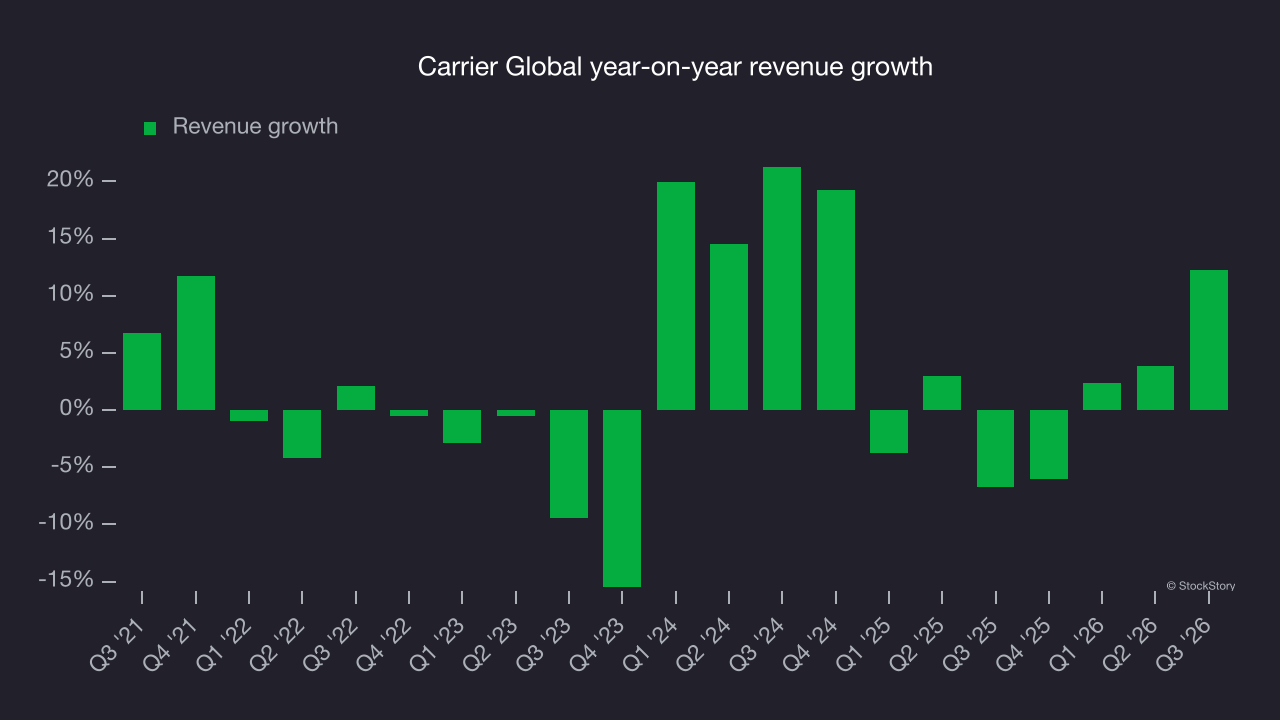
The company’s organic revenue offers a closer look at its revenue dynamics by stripping out one-time events like acquisitions and currency fluctuations that don’t accurately reflect its fundamentals. Over the last two years, Carrier Global’s organic revenue averaged 2.3% year-on-year growth. This aligned with its two-year revenue growth, indicating that core operations (not acquisitions and divestitures) drove most of its results. 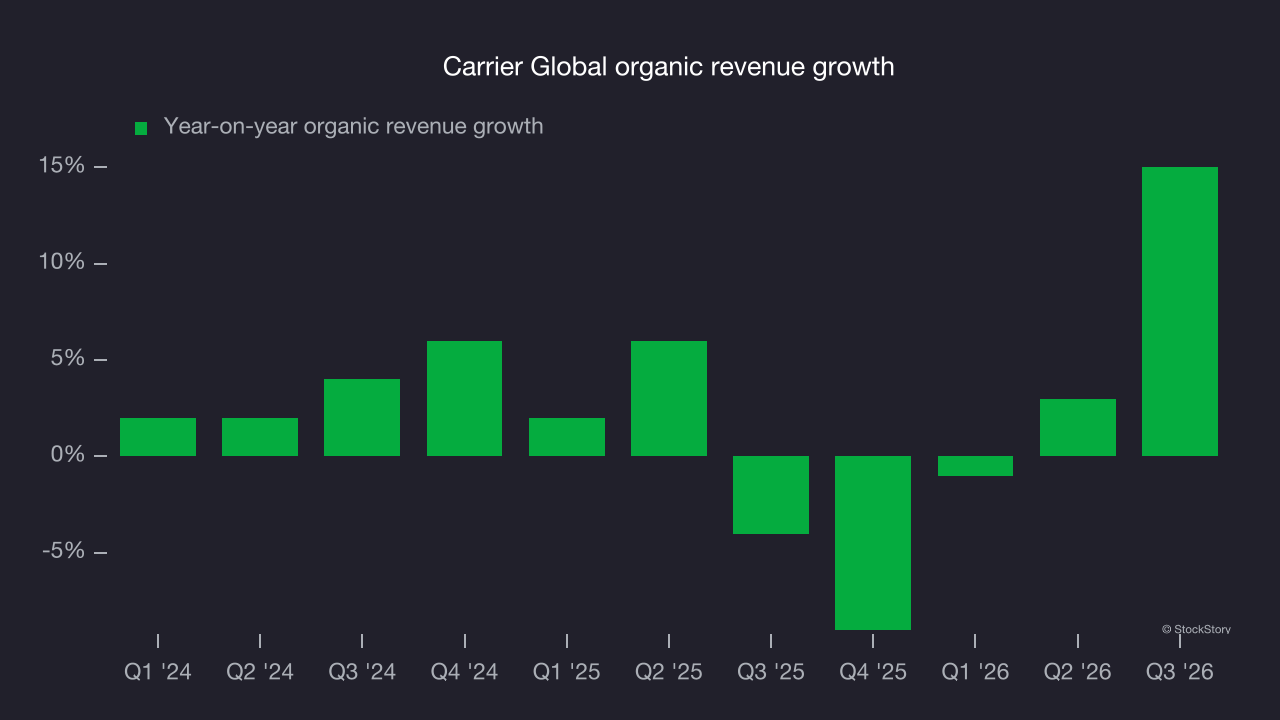
This quarter, Carrier Global reported year-on-year revenue growth of 12.3%, and its $6.26 billion of revenue exceeded Wall Street’s consensus estimates by 2.6%.
Looking ahead, sell-side analysts expect revenue to grow 7% over the next 12 months, according to S&P. While this projection implies its newer products and services will spur better top-line performance, it is still below the sector average.
Operating margin
Operating margin is a key measure of profitability. Think of it as net income, the bottom line, excluding the impact of taxes and interest on debt, which are less connected to business fundamentals.
Carrier Global has managed its cost base well over the last five years. It demonstrated solid profitability for an industrials business, producing an average operating margin of 10.1%. This result was particularly impressive because of its low gross margin, which is mostly a factor of what it sells and requires substantial shifts to change meaningfully. Companies have more control over their operating margins, and high operating margins alongside low gross margins indicate well-managed operations.
Analyzing the trend in its profitability, Carrier Global’s operating margin decreased by 27 percentage points over the last five years. This raises questions about the company’s expense base because its revenue growth should have given it leverage on its fixed costs, resulting in better economies of scale and profitability.
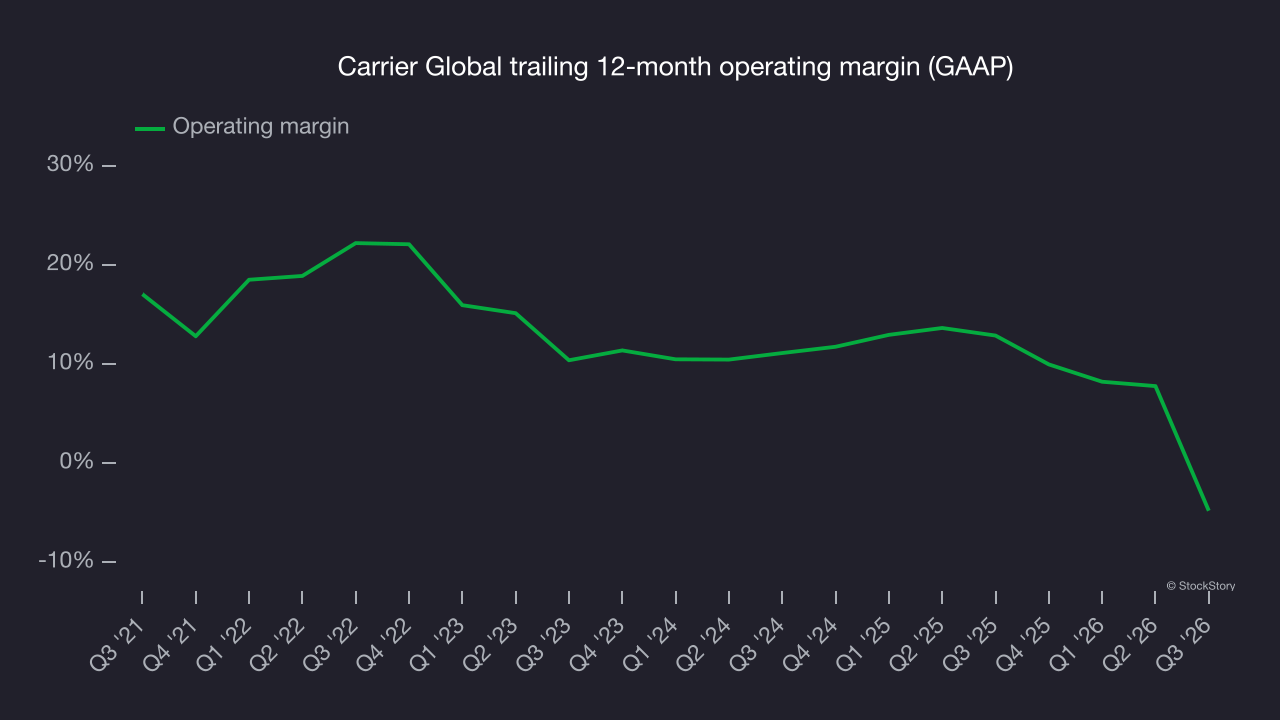
This quarter, Carrier Global generated an operating margin of negative 36.3%, down 46 percentage points year on year. Its operating margin declined more than its gross margin, suggesting it was less efficient as expenses such as marketing, R&D and administrative overhead increased.
Earnings per share
Revenue trends explain a company’s historical growth, but the long-term change in earnings per share (EPS) points to the profitability of that growth. For example, a company could inflate its revenue through excessive spending on advertising and promotions.
Carrier Global’s unimpressive 4.3% annual EPS growth over the last five years aligns with its revenue performance. That indicates it maintained its per-share profitability as it expanded.
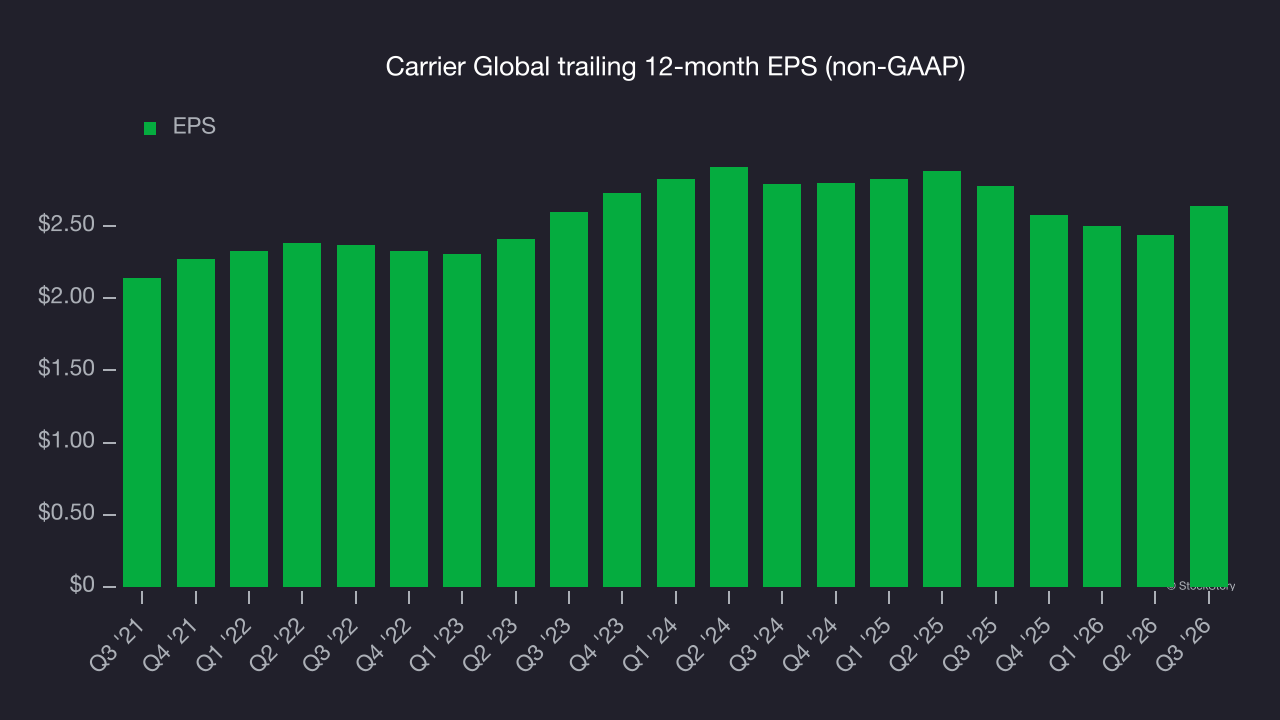
As with revenue, examining EPS over a more recent period can provide insight into an emerging theme or development for the business.
Carrier Global’s EPS declined at an annual rate of 2.7% over the last two years, a poor performance that trailed its 2.6% two-year revenue growth.
A closer look at Carrier Global’s earnings helps explain the drivers of its performance. Carrier Global’s operating margin has declined over the last two years. This was the most relevant factor (aside from the revenue impact) behind its lower earnings; interest expenses and taxes can also affect EPS but don’t tell us as much about a company’s fundamentals.
In Q3, Carrier Global reported adjusted EPS of $0.87, up from $0.67 in the same quarter last year. This result easily cleared analysts’ consensus estimates, a positive outcome for shareholders. Over the next 12 months, Wall Street expects Carrier Global’s full-year EPS to grow 21.5% from $2.64 to $3.21, according to S&P.
Key takeaways from Carrier Global’s Q3 results
Carrier Global’s quarter had some important positives: organic revenue topped analysts’ consensus estimates, and its full-year revenue guidance also exceeded Wall Street’s consensus. Shares rose 2.3% to $57.55 immediately after the release.
Carrier Global may have had a good quarter, but the latest results matter much less than longer-term fundamentals and valuation when deciding whether the stock is a buy. For more on those factors, read our full research report here (it’s free).